Soybean harvest on again

Nov 10, 2009 10:47 AM, By David Bennett, Farm Press Editorial Staff

It isn’t a “straight-forward, black-and-white decision” on whether to harvest soybeans. Insurance often comes into play. Poor soybeans on heavy clay “will be difficult to cut. It’ll rut the fields up and you can hardly sell them. If you do sell them, you may get $2.50 to $3 from a salvage buyer. Given that kind of price versus the cost to harvest and deliver, it’s a lot to consider.”

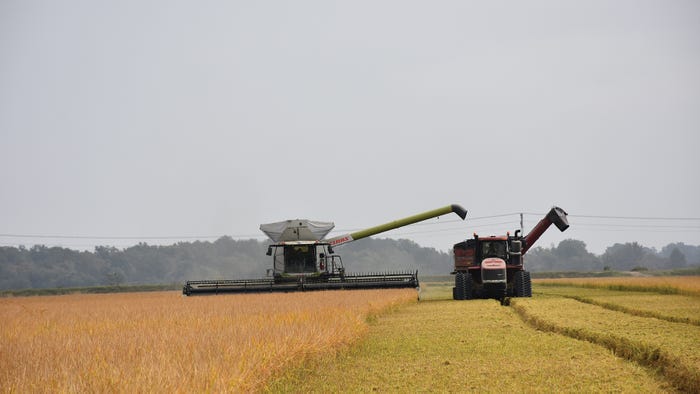
As November took over from October, rains finally eased across a waterlogged Mid-South and many of the region’s producers were able to restart harvest. Still weeks behind and facing yet-to-crest rivers and a forecast predicting more rain the week of Nov. 9, harvest had picked up even more urgency.

By Nov. 6, Mississippi soybeans were about 70 percent harvested. The last third will “take some time and be fairly slow going,” says Trey Koger, Mississippi Extension soybean specialist. “Probably half that 30 percent is in really bad shape. So, there’s 15 percent of our total crop that might be abandoned.”

Is there an area of the state with more of that 15 percent?

“Those are spread out. At the same time, it’s important to say that there are also good beans sporadically throughout the state. However, the vast majority of good beans are very late-planted Group 5s north of Highway 6 — basically the northern quarter of Mississippi. Don’t forget, we had a particularly late-planted crop in the north.”

Unfortunately, when it comes to soybeans in terrible shape, it isn’t a “straight-forward, black-and-white decision” on whether to harvest. Insurance often comes into play. Poor soybeans on heavy clay “will be difficult to cut. It’ll rut the fields up and you can hardly sell them. If you do sell them, you may get $2.50 to $3 from a salvage buyer. Given that kind of price versus the cost to harvest and deliver, it’s a lot to consider.”

In Arkansas, beans in the north part of the state are better than those in the south. “The south has some really bad situations — Ashley, Chicot, Desha and Drew counties are especially hard-hit,” says Jeremy Ross, Arkansas Extension soybean specialist. “But beans are being docked all over. Before the dry weather came in, just about every load from fields around Weiner (located in north-central Arkansas) was being docked around 10 percent.

“Around the state, a lot of seed is damaged. I talked to one dryer who told me dockage was ranging anywhere from 1 percent to 100 percent. It’s scattered.”

Some of Tennessee’s earliest beans had “pretty good yields and quality,” says Angela Thompson, Tennessee Extension soybean specialist. Then, Group 3s and 4s were hit with rains for up to six weeks. After that, “yields have been good but quality has been a problem. I hope we’re at least 90 percent done with corn. We may be 50 to 60 percent finished with beans. Beans planted later are showing better yields and quality. Hopefully, we’re on the upswing.”

Get Copyright ClearanceWant to use this article? Click here for options!
© 2010 Penton Media, Inc.


Latest Jobs

resources

events icon events

product info icon tradeshows

tradeshow icon digests

research icon photos

Continuing Education


(New Course)
Weed Resistance Management in Cotton

This course covers a wide range of options to effectively control weeds in cotton and reduce the risk of weed resistance management. It is accredited for hours/units for licensed/accredited applicators in 7 U.S. Cotton Belt states (Florida, Georgia, New Mexico, Oklahoma, Texas, South Carolina an d Tennessee. CCA credit is pending).

This course is accredited in Texas, Oklahoma, New Mexico, Virginia, West Virginia and Wyoming as well as for CCA credits:

(New Course)
Spray Drift Management

Keeping crop protection chemicals on the crop for which they are intended has been a cornerstone of farming not only to protect neighboring crops, but to not waste money allowing products to drift off the intended target. This accredited online continuing education course covers the critical elements of spray drift management.

Back to Top

Browse Print Issues

Additional Resources

subscribe to Farm Press Daily Southeast Farm Press Southwest Farm Press Western Farm Press