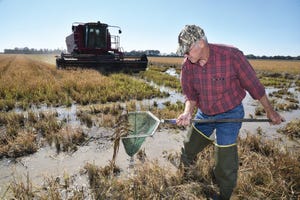
Black root rot on soybeans

More About:

Black root rot, a fungal disease that infects cotton and soybeans, may be affecting more soybean acres across the Delta, and Mississippi State University researchers are working to reduce its impact.

Mississippi Agricultural and Forestry Experiment Station researchers Gabe Sciumbato and Tom Allen have been conducting laboratory studies to learn more about the disease, which has not yet been diagnosed in Mississippi’s soybeans. Black root rot has been most notable in Delta cotton. However, the disease has been known to infect soybeans in other states.

“Black root rot has been in cotton in the Delta for years, but because of the area’s recent shift to soybeans, signs of the disease are increasing statewide and are likely to impact yields,” said Sciumbato, a plant pathologist at MSU’s Delta Research and Extension Center at Stoneville, Miss. “We are monitoring for signs of outbreaks and trying to isolate them, then get a diagnosis confirmed.”

The fungus that causes black root rot overwinters in plant debris and infects developing plants when seedlings are three to four weeks old. In severe cases, the roots turn black and plants die from loss of nutrient absorption.

“In our variety trials, we are screening soybean varieties for resistance to the fungus,” Sciumbato said.

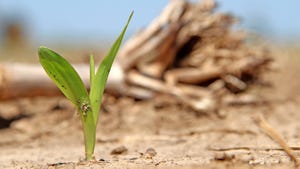
Allen, who is also an MSU Extension plant pathologist, said evidence of the fungus can be seen aboveground within the first few weeks of growth. Symptoms include stunting, stacking of leaf nodes, and alternating yellow and green spots along veins. These symptoms are similar to other plant disorders such as soil compaction, nutrient deficiencies or more generalized plant stress, and diseases like sudden death syndrome, stem canker and red crown rot. The disease is most severe when high numbers of reniform nematodes (a destructive species of underground worms) are present in the field.

“The fungus tends to appear in acres that had been farmed in cotton and commonly develops during cool, wet conditions, which can be encountered following early planting periods,” Allen said “However, over the past two seasons, we have identified the particular symptoms that can be attributed to this disease on almost every soil type in Mississippi.”

Diagnosis of black root rot requires confirmation by a lab, yet options for controlling or preventing the disease are limited. Seed treatment is one potential method to limit the impact of black root rot. Additionally, attempting to determine if available varieties are tolerant of the fungus could provide producers with valuable information.

In 2009, agricultural economists estimated Mississippi’s 2.2 million acres of soybeans to have a farm-gate value of $432 million.

Discuss this article 0

Post new comment

Sign in or Register to use your Delta Farm Press ID
(optional)
CAPTCHA
This question is for testing whether you are a human visitor and to prevent automated spam submissions.
Incorrect please try again
Enter the words above: Enter the numbers you hear:
Farm Press Newsletters
Sign Up!

For the Delta Farm Press Newsletter
Keep up with the latest news with our daily newsletter
Continuing Education
New Course

Keeping crop protection chemicals on the crop for which they are intended has been a cornerstone of farming not only to protect neighboring crops, but to not waste money allowing products to drift off the intended target. This accredited online continuing education course covers the critical elements of spray drift management.

New Course

This course covers a wide range of options to effectively control weeds in cotton and reduce the risk of weed resistance management. It is accredited for hours/units for licensed/accredited applicators in 7 U.S. Cotton Belt states (Florida, Georgia, New Mexico, Oklahoma, Texas, South Carolina an d Tennessee. CCA credit is pending).