Cattle nutrition in era of expensive inputs

May 17, 2007 10:20 AM, By David Bennett
Farm Press Editorial Staff

Ideally, cattle producers would like to graze their herds as much as possible. Cutting out hay cheapens the whole operation.

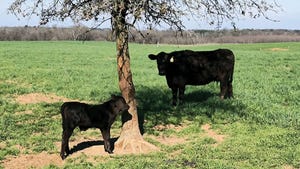
“Cows were put out here as late as Jan. 30,” said John Jennings, Arkansas Extension forage specialist, at one of his test fields at the recent field day at the Livestock and Forestry Branch Station in Batesville, Ark. “The last weight was taken in early April. There’s a 71-day period we’re measuring.”

In all four cow groups tested, the cows lost weight. One reason was the weather was warm through January and then turned cold and stayed cold into March. Then it got very warm before turning cold again. “There was a lot of stress on the cows.”

The cows that grazed early pastures had calves that gained, on average, an extra 0.3 pound per head, per day. That’s compared to the cows that were fed hay. Per cow, that equals an extra 49 cents per day in value.

The cows that were grazing ate half as much hay as those fed full hay while on dormant bermudagrass pasture. “If we put a cost on that at current prices ($50 per round bale), that’s $1.16 per head, per day for the cows fed full hay.

“Last fall, round bales were $35. That would equate to 81 cents per head, per day. That’s pretty expensive”

Researchers also put nitrogen on the pastures at $24 per acre. The nitrogen was meant to kick in sometime in late winter through the spring. On each of the 5-acre fields it cost $120 to fertilize.

Add the extra forage produced due to that and there was a $230 savings on hay. And the cows were able to get on pasture earlier.

“Look at the extra calf gains on cows that are grazing. That came out to a $295 savings per cow grouping. The extra calf gain and the savings in hay from grazing early pasture figures out to a $525 advantage for the cow groups on pasture. (That’s) an 87-cent advantage per head, per day between early grazing versus feeding hay until spring grass arrives.”

Jennings figured there would be a 30-cow herd over a 71-day period. “That comes out — depending on whether you use the current hay price of last fall’s — between $1,400 and $2,100 in improvements or savings. That’s quite a value.”

The calves that were continuously grazed with no rotation lost 29 pounds more than those rotationally grazed. “That isn’t a huge amount but something to keep in mind.”

On April 16, clippings were taken from the four fields. In the continuously grazed pasture, “it came out to about 33 pounds of green forage material per acre — that’s very, very low. The rotationally grazed pasture came out to 273 pounds per acre — still low, but much more than continuous graze.

“Bottom line, if we’re going to manage our pastures, there are some options.”

• Every day you aren’t feeding hay saves $1.16 per head.

• Having both cool- and warm-season grasses “helps us. If you have them, you can extend the grazing season and it doesn’t matter whether you’re fall or spring calving.”

• Don’t wait until March to fertilize for fescue. “We want to get some on pastures in February so those can be started quicker. That doesn’t have to happen across all your acres but on enough to set the cow herd up.”

• On warm-season grasses like bermuda, fertilize when nighttime temperatures reach 60 degrees for a week. Most years, that window opens from mid-April into early May depending on location. “This year, it happened in March and then a freeze occurred. March is too early to fertilize bermudagrass. Hopefully nobody got in too early.”

• Rotationally grazing pastures helps. Research shows you get 40 percent more grazing days if you go from twice-monthly rotation to twice-weekly rotation. That’s out of the same pasture. “On our demonstrations across the state, we’ve seen producers that strip-graze stockpile pastures… and save $10 per animal unit more than those that continuously graze pasture. So there’s value all year long.”

• Fertilize for fall/winter pastures. Nitrogen is about 55 cents per pound. “P and K are also high. But considering everything, fertilizer is still cheaper than hay.”

• Across 90 demonstrations over four years, researchers found producers saved $12 to $29 per animal unit by grazing stockpiled bermudagrass or fescue in the winter instead of feeding hay. “What does it cost to start a tractor or truck and move hay around? One producer last winter told me it costs him about a tank of diesel a week to move hay. That cost him $7 per day.”

• Soil test pastures and know what actual fertility is. Anywhere it’s appropriate, add some legumes and clover — lespedeza, vetch, clovers all help. “Nitrogen at 55 cents per pound is very expensive — allowing clover to do work for us helps the bottom line.”

e-mail: dbennett@farmpress.com

Get Copyright ClearanceWant to use this article? Click here for options!
© 2008 Penton Media, Inc.


Latest Jobs

Read More Daily News

Food industry: new attacks on corn ethanol

Nov 20, 2008 4:21 PM

A broad coalition of food industry, environmental and other “grassroot” organizations are calling on President-elect Barack Obama and Congress to enact legislation phasing out subsidies for ethanol production....

Could Arkansas have a record soybean yield?

Nov 20, 2008 10:26 AM

On Nov. 18, Delta Farm Press spoke with Jeremy Ross, Arkansas Extension soybean specialist. ...
Guest Comments: Doha in December

Nov 20, 2008 10:21 AM

During my tenure as chairman of the National Cotton Council, I have represented the industry in several important meetings across the United States and around the world....

Louisiana wheat acres down by half

Nov 20, 2008 10:17 AM

Farmers are planting the 2009 Louisiana wheat crop, which will be on significantly fewer acres than the 2008 wheat crop. ...

Tri-State Soybean Forum Jan. 9

Nov 20, 2008 10:11 AM

Producers from Arkansas, Louisiana, and Mississippi will have an opportunity to hear the latest in soybean research during the 2009 Tri-State Soybean Forum, Jan. 9, at the Thomas Jason Lingo Center in Oak Grove, La....

Delta Farm Press News

Southeast Farm Press News
Southwest Farm Press News
Western Farm Press News
resources

events icon events

product info icon tradeshows

tradeshow icon digests

research icon photos

Continuing Education

Accredited in Florida, Georgia, New Mexico, Oklahoma, Texas, South Carolina and Tennessee:


(New Course)
Weed Resistance Management in Cotton

This course covers a wide range of options to effectively control weeds in cotton and reduce the risk of weed resistance management. It is accredited for hours/units for licensed/accredited applicators in 7 U.S. Cotton Belt states (Florida, Georgia, New Mexico, Oklahoma, Texas, South Carolina an d Tennessee. CCA credit is pending).

For National Certified Crop Advisers

A free American Society of Agronomy-accredited one-CEU course on spray drift management.

Back to Top

Continuing Education

Accredited in Florida, Georgia, New Mexico, Oklahoma, Texas, South Carolina and Tennessee:


(New Course)
Weed Resistance Management in Cotton

This course covers a wide range of options to effectively control weeds in cotton and reduce the risk of weed resistance management. It is accredited for hours/units for licensed/accredited applicators in 7 U.S. Cotton Belt states (Florida, Georgia, New Mexico, Oklahoma, Texas, South Carolina an d Tennessee. CCA credit is pending).

For National Certified Crop Advisers

A free American Society of Agronomy-accredited one-CEU course on spray drift management.

Browse Print Issues

Additional Resources

subscribe to Farm Press Daily Southeast Farm Press Southwest Farm Press Western Farm Press