Research equipment running on soy biodiesel

Dec 6, 2006 9:15 AM, By Stephanie Schupska
University of Georgia

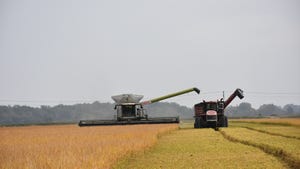
Soybean researcher Dale Wood climbed onto a combine harvester at the University of Georgia Plant Sciences Farm in Oconee County. He grabbed the controls and took the machine for a slow spin, careful not to mow down a row of developing soybeans.

Did he notice any difference between running the farm’s equipment on soy biodiesel and on regular diesel? “No,” he said. “And that’s a good thing.”

Run by crop and soil scientists of the UGA College of Agricultural and Environmental Sciences, the farm is a place where Wood and his colleagues run tests on soybeans. Researchers from other departments also use the land for various projects.

A connecting factor in all of the research is a red tank that sits at the edge of a barn. Farm workers head there when their equipment needs a refill of a mix of petroleum diesel and soy biodiesel.

The Georgia Crop Improvement Association provided the pump and tank to promote soy biodiesel use. They outfitted the Georgia Seed Development Commission with the same equipment.

“The idea with soybean biodiesel is to let the farm use it in their tractors and combines,” said GCIA Executive Director Terry Hollifield. “In a way, it’s allowing the soybean breeder to help his own cause.”

Hollifield said there’s already a glut of soy oil on the market. “It’s not the healthiest oil on the market,” he said. “But you have to have soybean meal for the livestock industry. That’s why we’re encouraging the use of soybean oil in biodiesel.”

Even with the glut, all the soybean oil in the United States — about 3.4 billion gallons — would be only a fraction of the 45 billion gallons of diesel needed for U.S. transportation alone, said Georgia Seed Development Commission director Mike Garland. But it would be a move in the right direction.

“Biodiesel is a bridge to the future,” Garland said. “We need to use good science and good business in biodiesel and build that bridge.”

Keys in all of this, Garland said, are learning from past fuel mistakes and focusing on environmental, economic and national security issues.

Roger Boerma, a soybean breeder and director of the UGA Center for Soybean Improvement, has been researching soybeans at UGA since 1973. As he’s watched the interest in biofuels increase, he’s glad “to see farmers at the forefront of our country’s strategy of providing a safe, readily available and renewable supply of energy.”

Even as Wood and Boerma study soybeans, the rest of the state has lost much of its attraction to the crop. The 2 million acres once planted in soybeans in Georgia have dropped to 200,000.

Boerma predicts that the downward spiral will reverse as the demand for vegetable oil for biodiesel use expands. “How much expansion we see in soybean production,” he said, “will depend on how the next (federal) farm bill is structured.”

If farmers see dollars in soybeans again, Garland says they’re ready. “We know how to produce soybeans in Georgia,” he said. “In this battle for alternative energy sources, we need to go immediately with what we know.”

Boerma said it’s possible to increase the oil content of soybean seeds by 30 percent or more. Current varieties contain 20 percent to 21 percent oil.

“There are landraces from Asia that contain 27 to 28 percent oil,” he said. “A soybean variety with higher oil content will generally produce lower protein content. In the end, it depends on which seed component — oil or protein — is of the most value to the end user.”

Biofuels aren’t the final answer to energy independence. But “there’s no doubt,” Boerma said, “that it’s more pleasant to stand on the sidewalk next to a bus burning biodiesel than one burning conventional petroleum diesel.”

Get Copyright ClearanceWant to use this article? Click here for options!
© 2010 Penton Media, Inc.


Latest Jobs

Read More Daily News

Tillage tests — ‘trash farm for profit’

Feb 9, 2010 9:47 AM

As he speaks, Merle Anders has a small prop on the table behind him: a baseball cap inscribed with “Trash Farming for Profit.” ...

Reduced-till and cotton seedling diseases

Feb 9, 2010 9:43 AM

Managing no-till or reduced-till cotton production properly, including following appropriate planting recommendations and taking care of early weed problems, may reduce potential for disease outbreaks....

Chicken litter — ‘smell of success’

Feb 9, 2010 9:33 AM

Having used poultry litter on his family’s Jonesboro, Ark.-area farm for years, Wayne Wiggins III is a proponent of the practice. ...

NCC: 10.1 million cotton acres

Feb 8, 2010 10:30 AM

After three straight years of declines, U.S. cotton acreage could be headed back up, according to the National Cotton Council’s 27th annual Early Season Planting Intentions Survey....

Weed resistance, Washington headline Farm & Gin Show

Feb 8, 2010 10:24 AM

This year’s Mid-South Farm and Gin Show offers “perhaps the best set of exhibits ever,” says Tim Price, manager of the annual event to be held Feb. 26-27 at the downtown Memphis Cook Convention Center....

Delta Farm Press News
Southeast Farm Press News
Southwest Farm Press News
Western Farm Press News

resources

events icon events

product info icon tradeshows

tradeshow icon digests

research icon photos

Continuing Education


(New Course)
Weed Resistance Management in Cotton

This course covers a wide range of options to effectively control weeds in cotton and reduce the risk of weed resistance management. It is accredited for hours/units for licensed/accredited applicators in 7 U.S. Cotton Belt states (Florida, Georgia, New Mexico, Oklahoma, Texas, South Carolina an d Tennessee. CCA credit is pending).

This course is accredited in Texas, Oklahoma, New Mexico, Virginia, West Virginia and Wyoming as well as for CCA credits:

(New Course)
Spray Drift Management

Keeping crop protection chemicals on the crop for which they are intended has been a cornerstone of farming not only to protect neighboring crops, but to not waste money allowing products to drift off the intended target. This accredited online continuing education course covers the critical elements of spray drift management.

Back to Top

Browse Print Issues

Additional Resources

subscribe to Farm Press Daily Southeast Farm Press Southwest Farm Press Western Farm Press