Farmer’s wife speaks from the heart

Nov 9, 2006 9:15 AM, By Ford L. Baldwin
Practical Weed Consultants

I have received a lot of comments on an article I wrote a few weeks ago about how glad I am that some choose to farm. In this article I’m including some rather lengthy quotes from one response.

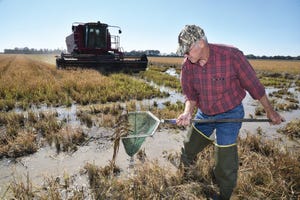
“I am the proud wife of a farmer for nineteen and a half years. I will be the first to admit that I didn’t have a clue about everything involved in farming until I became a farmer’s wife.

“I am amazed by the number of people who I believe are happy to see farmers fail. A lot of people seem to think that all farmers do is drive around in their trucks and try to get money from the government.

“I would like to see these people follow my husband around for just one day. I would dare to say that they would change their minds quickly. Everyday is a gamble. Whether it is grain prices, weather, equipment breakdowns, disease, or any number of complications, they have to take every day as it comes and keep going.

“My husband is fortunate enough to be a third generation farmer. He has worked along with his father and grandfather since he was a teenager, and there is nothing he would rather do. He provides a good living for our family and we are very proud of his hard work and dedication.

“He works long, hard hours and sometimes the mental anguish is unbearable, but he has a great attitude and makes the best of every situation. It breaks my heart every time I hear of a farmer having to quit, because I know it would devastate my husband to have to quit.”

She took a lot of the thoughts I attempted to convey and said them much more effectively — simply because she is there.

While some of the articles I write in the winter are not about weed science, they are fun and most farmers do not want to think about weeds and herbicides right now anyway.


Getting back to weed issues, there will be a significant increase in wheat acreage this year. I am receiving a few weed control questions. One is whether or not a burn-down herbicide is needed when wheat is planted no-till.

There is often the misconception that a killing frost will solve all of the existing vegetation problems. Wheat is a winter crop and the weed problems are winter weeds. I always recommend a burn-down herbicide in no-till wheat.

The weed complex will often include ryegrass. Quite often a nice flush of ryegrass will be emerged at planting time. If you kill this flush, and plant into the undisturbed seedbed, you often have a big jump on the ryegrass problem.

You do not want to skimp on glyphosate rates with ryegrass. I always recommend a minimum of 3 pints of the 4 pound-per-gallon glyphosate or equivalent. When in doubt, I will increase that a pint.

In addition to ryegrass, a lot of what I term the winter junk weeds that are usually non-competitive in conventionally planted wheat can be very competitive in no-till wheat. That is because they are often emerged at planting and get the jump on the crop.

Unless the field is just “squeaky clean,” use a burn-down herbicide. That will assure you the crop will get an even start and later emerging problems will be much easier to deal with.

The must-kill weed in wheat is ryegrass and it has to be controlled while small. For non-resistant ryegrass, Hoelon, Osprey and Axial, a new herbicide, can all be effective.

Controlling resistant ryegrass is much more difficult. Your county agent should have some good information that Bob Scott, University of Arkansas weed scientist, has put together comparing herbicides for ryegrass control. I will also include some of his information in future articles.

e-mail: ford@weedconsultants.com

Get Copyright ClearanceWant to use this article? Click here for options!
© 2009 Penton Media, Inc.


Latest Jobs

Read More Daily News

Arkansas loss near quarter billion dollars

Nov 6, 2009 2:56 PM

A wetter-than-normal growing season has cut into Arkansas’ farm receipts by more than $224.8 million as of Nov. 1, according to a preliminary report issued by the University of Arkansas Division of Agriculture....

Cotton: a lot on the ground

Nov 6, 2009 11:13 AM

Cotton losses due to record rainfall during September and October in Mississippi totaled $71 million by early November, or nearly half the value of the expected crop, according to the Mississippi Department of Agriculture and Commerce....

Rep. Cassidy: rethink conservation efforts

Nov 6, 2009 11:02 AM

The only Louisianan on the House Agriculture Committee, Rep. Bill Cassidy tries to keep his state’s agricultural interests at the forefront....

Residuals in LibertyLink program

Nov 6, 2009 10:57 AM

Before continuing with my pigweed control articles, I have tried to think of something encouraging to say about trying to get a crop out with the weather we are having. ...

Letter: Mule-headed bunch of farmers

Nov 6, 2009 10:54 AM

I was greatly disappointed in Morgan Freeman’s recent comments referring to the base stock of this state as a mule-headed bunch of farmers (see Behind the curtain: ‘mule-headed farmers’?). ...

Delta Farm Press News

Southeast Farm Press News

Southwest Farm Press News
Western Farm Press News

resources

events icon events

product info icon tradeshows

tradeshow icon digests

research icon photos

Continuing Education


(New Course)
Weed Resistance Management in Cotton

This course covers a wide range of options to effectively control weeds in cotton and reduce the risk of weed resistance management. It is accredited for hours/units for licensed/accredited applicators in 7 U.S. Cotton Belt states (Florida, Georgia, New Mexico, Oklahoma, Texas, South Carolina an d Tennessee. CCA credit is pending).

This course is accredited in Texas, Oklahoma, New Mexico, Virginia, West Virginia and Wyoming as well as for CCA credits:

(New Course)
Spray Drift Management

Keeping crop protection chemicals on the crop for which they are intended has been a cornerstone of farming not only to protect neighboring crops, but to not waste money allowing products to drift off the intended target. This accredited online continuing education course covers the critical elements of spray drift management.

Back to Top

Continuing Education


(New Course)
Weed Resistance Management in Cotton

This course covers a wide range of options to effectively control weeds in cotton and reduce the risk of weed resistance management. It is accredited for hours/units for licensed/accredited applicators in 7 U.S. Cotton Belt states (Florida, Georgia, New Mexico, Oklahoma, Texas, South Carolina an d Tennessee. CCA credit is pending).

This course is accredited in Texas, Oklahoma, New Mexico, Virginia, West Virginia and Wyoming as well as for CCA credits:

(New Course)
Spray Drift Management

Keeping crop protection chemicals on the crop for which they are intended has been a cornerstone of farming not only to protect neighboring crops, but to not waste money allowing products to drift off the intended target. This accredited online continuing education course covers the critical elements of spray drift management.

Browse Print Issues

Additional Resources

subscribe to Farm Press Daily Southeast Farm Press Southwest Farm Press Western Farm Press