New rust find in northwest Louisiana

Aug 15, 2006 10:27 AM, By David Bennett
Farm Press Editorial Staff

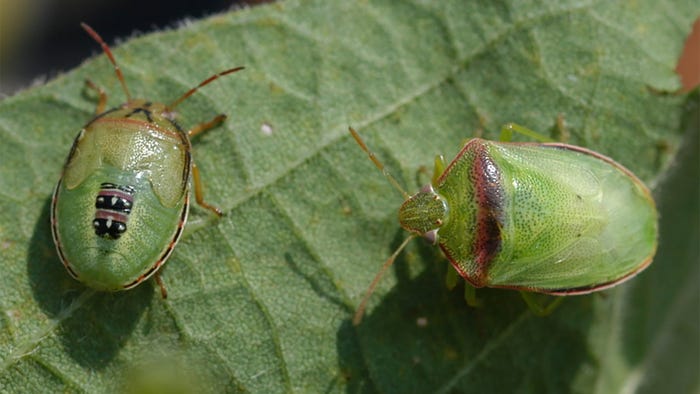
Asian soybean rust has been found in northwest Louisiana’s Natchitoches Parish. Discovered in a Group 4 production field on Aug. 11, the disease was confirmed on Aug. 14.

The field “was almost far enough along not to worry with rust,” says Boyd Padgett, LSU AgCenter plant pathologist. “I’ve heard nothing about more being found in surrounding areas. That doesn’t surprise me. It feels like it’s about 300 degrees, right now. And there’s been no rain.

“Honestly, I’m surprised with this hot, dry weather it’s even moving slowly. The conditions have been very prohibitive.”

In terms of potential impact of the find, David Lanclos says he “was much more nervous about the rust find in Alexandria three weeks ago. Nothing bad has come of that and ever since the soybean crop has advanced in growth. There’s just not much left for rust to jump on in the state.

“In the northwest region, drought is wearing the crop out, so this find is a minor worry,” says the LSU AgCenter soybean specialist. “Most of those beans are early and some are already coming out of the field.”

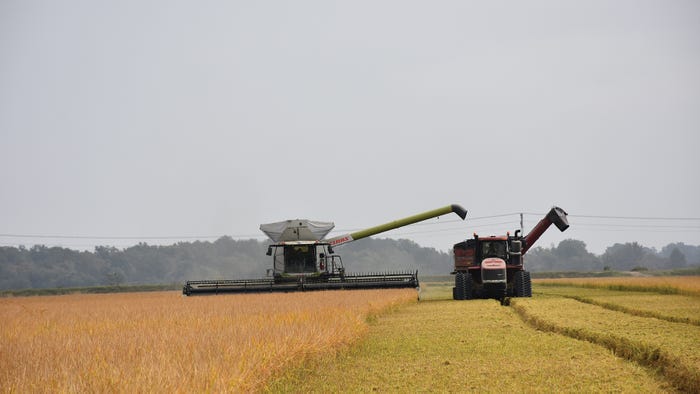
Soybean harvest in the state is going “full blast. We’re probably pulling 10,000 acres a day, right now.”

Lanclos, who walked the infected field, is “amazed” rust was found. “It’s so dry there are big cracks opened up. Regardless, he farmer has applied a triazole so the crop should be fine. The incidence was very low.”

Soybeans in the northeast are “at least R-5,” says Padgett. “Most are done or finishing out. Harvest is moving along. Yield reports are all over the board.”

There are “a few” beans still in susceptible stages.

“Those are mostly beans after wheat. Before treating any of those, producers need to consider yield potential. Anyone wanting up-to-date news on ASR should check the toll-free number (800) 516-0865.”

Arkansas reaction

“We don’t think (the Natchitoches find) is any cause for alarm,” says Trey Reaper, Arkansas Extension soybean verification coordinator. “It’s still 100 miles-plus from the state line. Even so, we’re continuing to scout intensely, especially in southern Arkansas.

“Remember, it was a good three weeks ago when it was found in Alexandria. In all that time, it only jumped a parish or two.”

If the Arkansas crop can escape the disease for another three weeks, “we’ll be out of the threat window. Many of our south Arkansas beans are already at R-4. They’re beginning to develop full seed and it won’t be long before they reach R-6.”

Judging from ASR’s progress in Louisiana this year, it doesn’t appear the disease “will blow up in our fields overnight. We’re not recommending growers spray for rust. If they want to treat with a fungicide for foliar diseases like frogeye or aerial blight, we recommend they stay with full-label products like Quadris or Headline. At this point, a rust material isn’t warranted for protection.”

Outlook

The USDA recently forecast Arkansas to produce a 35-bushel state average.

“That’s optimistic,” says Reaper. “I don’t want to be pessimistic, but the crop is shorter and a 35-bushel average doesn’t seem plausible. The conditions the crop has been under all year — whether early-season or late-season fields — have meant a lot of stress from heat and/or drought.”

There are some highly productive fields that will cut 60 or 70 bushels.

“In general, though, we’re off from last year. It’s been very difficult to keep up with water demand. And as incredible as it sounds, it seems the heat — especially at night — is even worse than it was last year. That has taken a heavy toll on the crop.”

e-mail: dbennett@farmpress.com

Get Copyright ClearanceWant to use this article? Click here for options!
© 2010 Penton Media, Inc.


Latest Jobs

Read More Daily News

NCC: 10.1 million cotton acres

Feb 8, 2010 10:30 AM

After three straight years of declines, U.S. cotton acreage could be headed back up, according to the National Cotton Council’s 27th annual Early Season Planting Intentions Survey....

Weed resistance, Washington headline Farm & Gin Show

Feb 8, 2010 10:24 AM

This year’s Mid-South Farm and Gin Show offers “perhaps the best set of exhibits ever,” says Tim Price, manager of the annual event to be held Feb. 26-27 at the downtown Memphis Cook Convention Center....

Darneille elected CCI president

Feb 8, 2010 10:22 AM

Wallace L. (Wally) Darneille, a Lubbock, Texas, cooperative official, will serve as 2010 president of Cotton Council International, the National Cotton Council’s export promotions arm....

Rice ‘growth industry’ — Weisemeyer

Feb 8, 2010 10:10 AM

Farmers attending the 2010 joint annual meeting of the Louisiana Rice Council and the Louisiana Rice Growers Association heard an optimistic report from a Washington, D.C., agriculture journalist recently....

U.S. cotton acres: 10.1 million

Feb 5, 2010 5:06 PM

U.S. cotton producers are expected to plant more than 10 million acres for the first time in three years as they begin making preparations for the 2010 planting season....

Delta Farm Press News

Southeast Farm Press News
Southwest Farm Press News

Western Farm Press News

resources

events icon events

product info icon tradeshows

tradeshow icon digests

research icon photos

Continuing Education


(New Course)
Weed Resistance Management in Cotton

This course covers a wide range of options to effectively control weeds in cotton and reduce the risk of weed resistance management. It is accredited for hours/units for licensed/accredited applicators in 7 U.S. Cotton Belt states (Florida, Georgia, New Mexico, Oklahoma, Texas, South Carolina an d Tennessee. CCA credit is pending).

This course is accredited in Texas, Oklahoma, New Mexico, Virginia, West Virginia and Wyoming as well as for CCA credits:

(New Course)
Spray Drift Management

Keeping crop protection chemicals on the crop for which they are intended has been a cornerstone of farming not only to protect neighboring crops, but to not waste money allowing products to drift off the intended target. This accredited online continuing education course covers the critical elements of spray drift management.

Back to Top

Browse Print Issues

Additional Resources

subscribe to Farm Press Daily Southeast Farm Press Southwest Farm Press Western Farm Press