USDA forecast smaller U.S. crops in 2006-07

May 15, 2006 10:03 AM, By Elton Robinson Farm Press Editorial Staff

USDA’s first crop assessment of 2006-07 is for smaller output in all major U.S. crops. However, planting is still under way in many parts of the United States, making the May 12 estimates for the 2006-07 season highly tentative.

U.S. cotton production for 2006-07 is forecast at 20.7 million bales, 13 percent below 2005-06, based on a projected yield of 770 pounds per acre.

U.S. mill use is projected at 5.8 million bales, a 3 percent reduction from 2005-06, as mills continue to lose market share to rising textile imports. Exports are projected at 16.5 million bales, also 3 percent below 2005-06, due mainly to supply limitations. Ending stocks are projected at 4.9 million bales, 22 percent of total use, which would be the tightest since 2003-04.

World cotton production is projected marginally higher at 115 million bales. World consumption is projected at 122 million bales, a 4 percent increase.

China is projected to consume a whopping 51 million bales due to rapid economic expansion. World trade is forecast at 43.5 million bales including 20 million bales of imports by China. World ending stocks are projected at 47.4 million bales.

U.S. soybean production is projected at 3.08 billion bushels, down 6 million bushels from 2005-06. U.S. exports are projected to increase to 1.09 billion bushels because of lower-than-expected Brazilian stocks. Ending stocks for 2006-07 are projected at a record 650 million bushels, up 85 million bushels from 2005-06.

Soybean prices are expected to remain firm mainly due to relatively strong corn and soybean oil prices.

Brazil’s soybean crop is projected lower at 56.5 million tons, reflecting lower-than-expected yields as harvest nears completion.

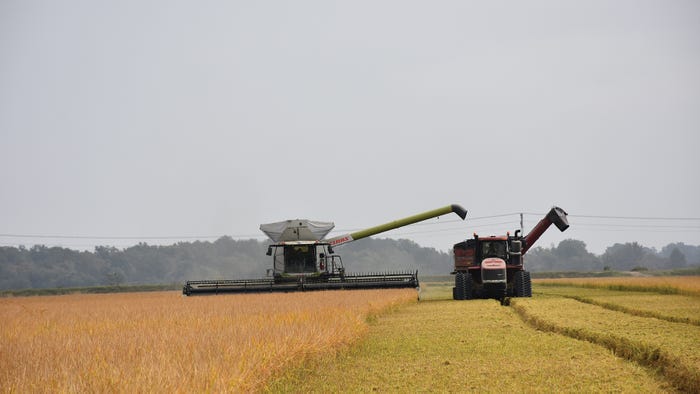
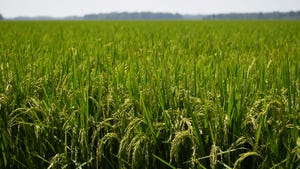
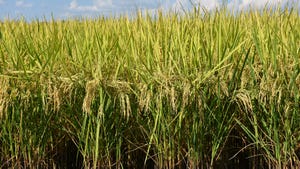
U.S. rice production in 2006-07 is projected at 205 million hundredweight, 18.2 million hundredweight below 2005-06, and the smallest crop since 2003-04. Planted area is estimated at 2.97 million acres and harvested area is projected at 2.95 million acres, both down about 12 percent from 2005.

Average rice yield is projected at a near-record 6,947 pounds per acre, up 311 pounds per acre or nearly 5 percent above weather-reduced yields of 2005-06. Imports for 2006-07 are projected at a record 18 million hundredweight, up 2 million hundredweight from 2005-06.

Exports are projected at 103 million hundredweight, 13 million hundredweight below last year. Ending stocks are projected at 24.6 million hundredweight, nearly 10 million hundredweight below last year, and the lowest stocks since 1998-99. Tighter domestic supplies along with higher global prices will help to support prices during the year.

Global 2006-07 rice production is projected at a record 417 million tons, up 5.5 million from 2005-06. Ending stocks are expected to decline for the sixth consecutive year. The global stocks-to-use ratio is projected at 14.6 percent, down from 16.3 percent in 2005-06, and the lowest since 1974-75.

The 2006-07 U.S. corn crop is projected at 10.55 billion bushels, 5 percent below last year. Total corn supply, at 12.8 billion bushels, is down 3 percent.

Domestic corn use for ethanol production is forecast 34 percent higher to 2.15 billion bushels while exports are forecast 6 percent higher to 2.15 billion due to reduced foreign competition and lower global feed-quality wheat supplies. Ending stocks of 1.1 billion bushels are down from year-earlier levels.

The 2006-07 U.S. wheat crop is forecast at 1.9 billion bushels, down 11 percent from 2005. Winter wheat production is forecast down 12 percent because of increased abandonment and reduced yields.

Exports are projected lower by 100 million bushels, due to tight U.S. supplies. Ending stocks are down 18 percent. Global wheat production, projected at 600 million tons, is down 3 percent while consumption is down 2 percent. Global ending stocks are projected to be the lowest in 25 years.

e-mail: erobinson@farmpress.com

Get Copyright ClearanceWant to use this article? Click here for options!
© 2009 Penton Media, Inc.


Latest Jobs

Read More Daily News

Arkansas loss near quarter billion dollars

Nov 6, 2009 2:56 PM

A wetter-than-normal growing season has cut into Arkansas’ farm receipts by more than $224.8 million as of Nov. 1, according to a preliminary report issued by the University of Arkansas Division of Agriculture....

Cotton: a lot on the ground

Nov 6, 2009 11:13 AM

Cotton losses due to record rainfall during September and October in Mississippi totaled $71 million by early November, or nearly half the value of the expected crop, according to the Mississippi Department of Agriculture and Commerce....

Rep. Cassidy: rethink conservation efforts

Nov 6, 2009 11:02 AM

The only Louisianan on the House Agriculture Committee, Rep. Bill Cassidy tries to keep his state’s agricultural interests at the forefront....

Residuals in LibertyLink program

Nov 6, 2009 10:57 AM

Before continuing with my pigweed control articles, I have tried to think of something encouraging to say about trying to get a crop out with the weather we are having. ...

Letter: Mule-headed bunch of farmers

Nov 6, 2009 10:54 AM

I was greatly disappointed in Morgan Freeman’s recent comments referring to the base stock of this state as a mule-headed bunch of farmers (see Behind the curtain: ‘mule-headed farmers’?). ...

Delta Farm Press News

Southeast Farm Press News

Southwest Farm Press News

Western Farm Press News

resources

events icon events

product info icon tradeshows

tradeshow icon digests

research icon photos

Continuing Education


(New Course)
Weed Resistance Management in Cotton

This course covers a wide range of options to effectively control weeds in cotton and reduce the risk of weed resistance management. It is accredited for hours/units for licensed/accredited applicators in 7 U.S. Cotton Belt states (Florida, Georgia, New Mexico, Oklahoma, Texas, South Carolina an d Tennessee. CCA credit is pending).

This course is accredited in Texas, Oklahoma, New Mexico, Virginia, West Virginia and Wyoming as well as for CCA credits:

(New Course)
Spray Drift Management

Keeping crop protection chemicals on the crop for which they are intended has been a cornerstone of farming not only to protect neighboring crops, but to not waste money allowing products to drift off the intended target. This accredited online continuing education course covers the critical elements of spray drift management.

Back to Top

Browse Print Issues

Additional Resources

subscribe to Farm Press Daily Southeast Farm Press Southwest Farm Press Western Farm Press