Weather brings mix of concerns for soybean farmers

May 10, 2006 9:19 AM, By Alan Blaine

Mississippi’s soybean planting through mid-April was well ahead of our five-year average. Even though the season is off to a good start, it has not been without some concerns.

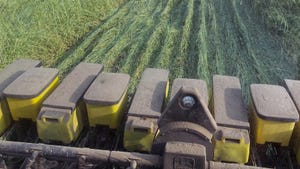
Many farmers started planting earlier than ever before. Although many had some concerns, the yields that early planting has afforded us in recent years made many push the envelope on planting. Some acreage in the Delta was planted as early as late February.

In recent years it appears that spring has shifted. Every year we get started a little earlier than the previous year. The impact of early planting has paid off, but we must exercise some caution. Some of the earliest planted acreage this year was exposed to at least five frosts following emergence. A frost is not the concern many think, but temperatures that approach freezing for an extended period will cause irreversible injury — primarily emerged plants only.

Weather patterns are unpredictable but planting early has allowed us to better match crops to required emergence temperatures. In my opinion if you plant beans and cotton, you should not plant cotton until all your beans are in the ground.

Another concern has been moisture availability. April is normally one of our wetter months. However, this has not been the case in recent years and 2006 has live up to this trend thus far..

A recent front brought some much-needed moisture, but left some areas in the southern two-thirds of the state with little, if any. Accompanying this system was the most widespread hailstorm I have ever seen. Hail damage was observed from just south of Clarksdale, Miss., to south of Hollandale, Miss. All emerged crops were affected, but wheat and beans were hit hardest.

Because of the way in which grass crops emerge, they are protected by a sheath, and the growing point remains below the soil surface for some period following emergence.

Soybeans were not as lucky and farmers affected should consider several factors when deciding whether or not to replant. Even if the soybean terminal is aborted, the plant will develop a new dominant terminal. Any node from the cotyledon up is capable of establishing a new terminal. If a soybean plant is cut off below the cotyledon node, however, it will not regenerate. Although you will experience a slight delay in regrowth, plants will recover soon after being damaged.

Additional points to consider prior to replanting: (1) number of viable plants (healthy plants); (2) stem damage; (3) time of year; (4) soil condition (compaction); and (5) yield potential. Early in the growing season it is often easier to replant or spot plant rather than watch plants slowly recover.

Dry soil conditions and compacted soil have caused emergence concerns in many fields. Evaluate plant populations prior to replanting — we can tolerate lower populations than many believe but this fact is often ignored. In a high-yield potential environment, narrow rows and Roundup Ready varieties can allow us to live with lower populations if forced to.

Conservatively, populations in narrow rows are adequate above 100,000 plants per acre. Wide rows with 75,000 to 100,000 plants per acre should be sufficient. These populations are only a guide, but they are conservative populations.

If plants are healthy, I would not hesitate keeping a stand in the 75,000 to 80,000 range. In a drilled setting, two plants per square foot equal 86,000 plants per acre. This population is more than enough. We are used to higher populations, but the soybean plant has a tremendous ability to compensate given the need.

The down side to keeping a lower population is slower canopy closure. It may require an additional Roundup shot, but that is less expensive than replanting. Recent plant population data has shown little difference in yield with populations ranging from the high 60,000s to 140,000 plants per acre.

In late April the entire state needed a good general rain to complete emergence and minimize soil crusting. If your fields are dry, wait on a rain before trying to replant. Do not get in too big of a hurry to replant or spot plant if it is dry. Seed viability this time of the year is practically unbelievable compared to late May and June.

Alan Blaine is the Mississippi Extension soybean specialist. e-mail: ablaine@pss.msstate.edu

Get Copyright ClearanceWant to use this article? Click here for options!
© 2010 Penton Media, Inc.


Latest Jobs

Read More Daily News

Tillage tests — ‘trash farm for profit’

Feb 9, 2010 9:47 AM

As he speaks, Merle Anders has a small prop on the table behind him: a baseball cap inscribed with “Trash Farming for Profit.” ...

Reduced-till and cotton seedling diseases

Feb 9, 2010 9:43 AM

Managing no-till or reduced-till cotton production properly, including following appropriate planting recommendations and taking care of early weed problems, may reduce potential for disease outbreaks....

Chicken litter — ‘smell of success’

Feb 9, 2010 9:33 AM

Having used poultry litter on his family’s Jonesboro, Ark.-area farm for years, Wayne Wiggins III is a proponent of the practice. ...

NCC: 10.1 million cotton acres

Feb 8, 2010 10:30 AM

After three straight years of declines, U.S. cotton acreage could be headed back up, according to the National Cotton Council’s 27th annual Early Season Planting Intentions Survey....

Weed resistance, Washington headline Farm & Gin Show

Feb 8, 2010 10:24 AM

This year’s Mid-South Farm and Gin Show offers “perhaps the best set of exhibits ever,” says Tim Price, manager of the annual event to be held Feb. 26-27 at the downtown Memphis Cook Convention Center....

Delta Farm Press News

Southeast Farm Press News

Southwest Farm Press News
Western Farm Press News

resources

events icon events

product info icon tradeshows

tradeshow icon digests

research icon photos

Continuing Education


(New Course)
Weed Resistance Management in Cotton

This course covers a wide range of options to effectively control weeds in cotton and reduce the risk of weed resistance management. It is accredited for hours/units for licensed/accredited applicators in 7 U.S. Cotton Belt states (Florida, Georgia, New Mexico, Oklahoma, Texas, South Carolina an d Tennessee. CCA credit is pending).

This course is accredited in Texas, Oklahoma, New Mexico, Virginia, West Virginia and Wyoming as well as for CCA credits:

(New Course)
Spray Drift Management

Keeping crop protection chemicals on the crop for which they are intended has been a cornerstone of farming not only to protect neighboring crops, but to not waste money allowing products to drift off the intended target. This accredited online continuing education course covers the critical elements of spray drift management.

Back to Top

Browse Print Issues

Additional Resources

subscribe to Farm Press Daily Southeast Farm Press Southwest Farm Press Western Farm Press