Aerial imagery works best with footprints in the field

Feb 7, 2006 8:55 AM, By Elton Robinson

GPS, aerial imagery and computers are making variable-rate applications a reality for many Mid-South producers. But according to Coahoma, Miss., crop consultant Joe Townsend, one low-tech input is critical to the process — putting footprints in the field.

Townsend, who spoke at the National Alliance of Independent Crop Consultants in Tucson, Ariz., acquires aerial images of his precision ag customers’ fields from InTime, Inc., a precision agriculture company based in nearby Cleveland, Miss. The images, taken from 12,000 feet, are turned into a scout map which divides the field into seven management zones based on biomass, or plant vigor.

“We put the scout maps on a PDA (handheld computer) with a GPS and go to the field, write our prescriptions, get on the Internet, and put in an application prescription request. We get a card which we stick in the application vehicle, then we spray.”

Townsend uses the images from June until defoliation begins for insecticides, fertilizer, nematicides, miticides, plant growth regulators, defoliants and to help in other agronomy decisions.

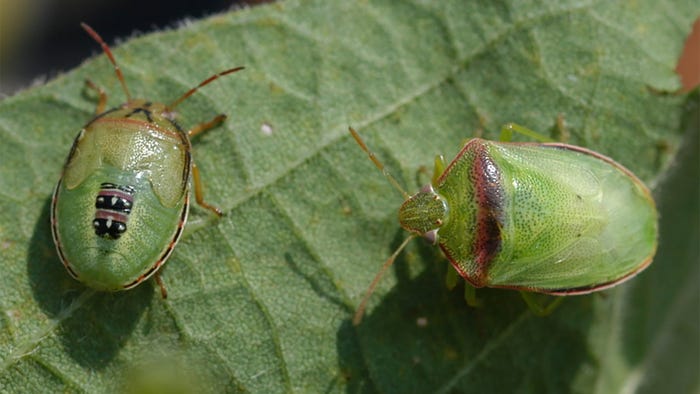
Insecticides — “Plant bugs are a terrible problem in Mississippi,” Townsend said. “A huge number of our cotton fields take about 10 applications during the cotton growing season.”

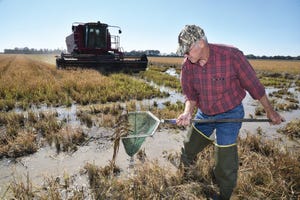
Plant bugs are very attracted to cotton as a function of biomass, notes Townsend. “The greater the mass of cotton, or the more rank it is, the more plant bugs it will attract. So variable-rate technology works very well against plant bugs. We scout fields twice a week with sweep nets and visually, to determine what we need to do.”

Townsend will begin applications “when we have a 2 percent sweep net count per management zone.” When cotton is lapping, no more variable-rate applications are directed at plant bugs.

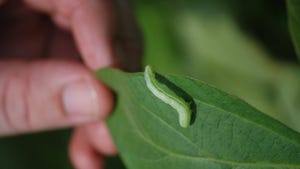
“Tobacco budworms and bollworms are also very attracted to cotton with higher levels of biomass. Some of the materials to control these pests are $15 to $20 per acre for a blanket application, so sometimes, we can save a great deal of money by not spraying the entire field.”

Plant growth regulators — “In the past, we’ve always made a happy-medium plant growth regulator application. We’ve always had tall cotton in the field and small cotton in the field.

“Today, we may have as many five rates of plant growth regulator,” Townsend says. “Quite often we have plant bugs that are associated with rank cotton, so we can put both products in the same spray machine and head to the field. Our eventual goal is cotton that is more uniform across the top.”

Townsend has found that variable-rate applications of plant growth regulator on 15-inch cotton has also worked well.

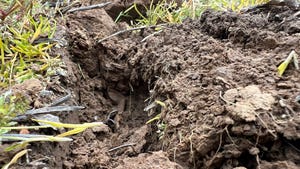
Nematodes — Townsend uses scout maps to find and treat portions of a field for root-knot nematode, going with sidedress applications of Temik and other nematode control measures. “Lower biomass areas are usually in management zones 1 or 2 in the heavier clay soils. The same low biomass areas will happen in the sandier soils where we have the root-knot nematode. I use a sharp shooter shovel to dig up a cotton plant to see the roots to determine if it’s nematodes or something else.”

Yield maps from 1999 and 2005, indicated that the variable-rate Temik applications had significantly increased the yield where nematodes had been detected. “This is encouraging.”

Variable-rate defoliation — “Since we’ve been doing variable-rate defoliation applications, 90 percent of the time we can harvest in one operation. Prior to variable-rate technology, this would have been nearly impossible. And we found that we can get by with a lot less defoliant with cotton that is more mature.”

During a season, Townsend will acquire three to five aerial images. “InTime is good about getting the images to us. Sometimes the weather is a problem, but not that often.”

Townsend says scouting with the scout map is a lot less time-consuming, and helps him make better decisions for his customers. But scouting also requires a good bit of “sight specific” activity to determine why there is variability. “All of us make our living by putting footprints in the field, whether it’s corn, cotton or soybeans. It’s no different with variable-rate technology.”

e-mail: erobinson@prismb2b.com

Get Copyright ClearanceWant to use this article? Click here for options!
© 2009 Penton Media, Inc.


Latest Jobs

Read More Daily News

WTO awards Brazil retaliation authority

Nov 20, 2009 11:01 AM

The World Trade Organization has authorized Brazil to seek retaliation against the United States for it support of two U.S. commodity programs....

Precision ag – online course

Nov 20, 2009 10:53 AM

University of Missouri Extension is offering an eight-week online course on managing farm machinery using precision agriculture, Jan. 12 through March 4....

Soybeans — U.S. key export supplier

Nov 20, 2009 10:48 AM

Weather problems are now thought to be factored into market prices. ...

$485 million loss – Mississippi

Nov 19, 2009 3:57 PM

Mississippi State University agricultural economists calculate Mississippi farmers are suffering an estimated $485 million value loss in 2009. ...

Biofuels goal beyond ethanol

Nov 19, 2009 10:05 AM

If the U.S. is to reach the government-mandated target of producing 36 billion gallons of biofuels annually by 2022, “We will need to change the way we do business,” says a USDA official....

Delta Farm Press News

Southeast Farm Press News

Southwest Farm Press News
Western Farm Press News

resources

events icon events

product info icon tradeshows

tradeshow icon digests

research icon photos

Continuing Education


(New Course)
Weed Resistance Management in Cotton

This course covers a wide range of options to effectively control weeds in cotton and reduce the risk of weed resistance management. It is accredited for hours/units for licensed/accredited applicators in 7 U.S. Cotton Belt states (Florida, Georgia, New Mexico, Oklahoma, Texas, South Carolina an d Tennessee. CCA credit is pending).

This course is accredited in Texas, Oklahoma, New Mexico, Virginia, West Virginia and Wyoming as well as for CCA credits:

(New Course)
Spray Drift Management

Keeping crop protection chemicals on the crop for which they are intended has been a cornerstone of farming not only to protect neighboring crops, but to not waste money allowing products to drift off the intended target. This accredited online continuing education course covers the critical elements of spray drift management.

Back to Top

Continuing Education


(New Course)
Weed Resistance Management in Cotton

This course covers a wide range of options to effectively control weeds in cotton and reduce the risk of weed resistance management. It is accredited for hours/units for licensed/accredited applicators in 7 U.S. Cotton Belt states (Florida, Georgia, New Mexico, Oklahoma, Texas, South Carolina an d Tennessee. CCA credit is pending).

This course is accredited in Texas, Oklahoma, New Mexico, Virginia, West Virginia and Wyoming as well as for CCA credits:

(New Course)
Spray Drift Management

Keeping crop protection chemicals on the crop for which they are intended has been a cornerstone of farming not only to protect neighboring crops, but to not waste money allowing products to drift off the intended target. This accredited online continuing education course covers the critical elements of spray drift management.

Browse Print Issues

Additional Resources

subscribe to Farm Press Daily Southeast Farm Press Southwest Farm Press Western Farm Press