Higher yields with twin-row soybeans

Nov 14, 2005 10:29 AM, By Andrew Bell

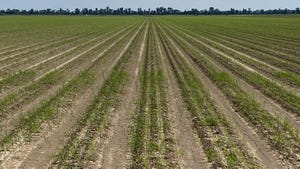
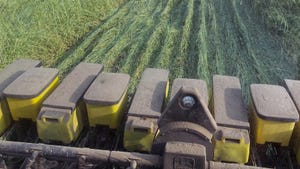
On research plots in Stoneville, Miss., scientists now have some preliminary data many soybean farmers have been anxious to receive. In a side-by-side comparative study of standard, 40-inch, single-row soybeans versus twin-row, two 10-inch rows (based on a 40-inch center), conducted this past growing season, researchers determined that soybeans in twin rows produced more pods and higher yields than those in single rows.

Trey Koger, soybean agronomist at the Agricultural Research Service’s Crop Genetics and Production Research Unit, said he and Dan Poston, Mississippi State University Extension soybean specialist, were not necessarily surprised at the results.

“Twin rows produced, on average, five more pods per plants. Even though that may not sound significant, it is. That adds up to more than half a million more pods an acre in the twin-row system versus the number of pods per acre in the single-row system,” Koger said.

Koger and Poston believe the difference in pod production and soybean yields between the two systems is based on light interception. Since plants in the twin-row system were separated into two rows rather than one in the study, they intercepted almost twice as much light as plants in the single-row system.

In recent years, farming equipment companies have been increasingly marketing twin-row planters over the conventional, single-row planters.

Koger said some equipment representatives estimate that the twin-row planter will provide as much as 2 percent to 10 percent increases in soybean yields. Koger’s study showed similar results: Soybean yields totaled 80 bushels per acre in the twin-row system compared to 73 bushels per acre in the single-row system, marking an 8.5 percent increase in yields in the twin-row system.

While some farmers have seen such an advantage, a scientific, independent comparative study had not been conducted until now.

Koger said an even more important discovery in the study was learning that it may not be necessary to increase seed rates in using the twin-row planting approach to increase yields when compared to single-row planting.

“Now that finding did surprise us somewhat. We thought we would see a difference in the seeding rate but we didn’t,” he said. “In order to compare seeding rates while keeping the plant population the same across twin-row and single-row systems, we planted four, five or six seeds per foot of row in the twin-row system and eight, 10 or 12 seeds per foot of row in the single-row system. This allowed us to compare seeding rates across both systems. Soybean yields ranged from 76 to 78 bushels per acre across all seeding rates in both the twin-row and single-row system.“

The fact that seeding rates did not affect yield is noteworthy Koger said, because it means farmers can increase yields without having to increase seed purchases, up to a point.

Companies offering twin-row planters have recommended that farmers should increase seeding rates by 20 percent to see optimal yield differences between the two planting systems. “Based on results from the first year of our study, it indicates that increasing the seeding rate was not necessary in order to increase yields, but additional research is needed to fully address the seeding rate issue,” he said.

Based on questions from growers, Koger plans on comparing the twin-row and single-row systems to soybeans planted in a more conventional 15- to 20-inch row spacing versus soybeans drilled in 8-inch rows all at the same plant population and at 20 percent higher seeding rates than what is currently recommended. This study will be conducted under both irrigated and non-irrigated settings.

“There is a lot of interest in this from soybean growers. Visitors at our field day over the summer were particularly curious about our study. Some returned to visit the plots,” he said.

George Ray Walker, a soybean and corn farmer in Leland, Miss., has used a twin-row planter for about five years. He has been “very pleased” with the system and plans to stay with it in the future.

Walker turned to twin-row management because of plowing restrictions on his farmland. He is not certain how much credit for his high yields can go toward the twin-row system and how much can be credited for the dual-crop rotation method.

He did estimate that while soybean yields have been slightly higher on some parts of his soil, yields have been significantly higher — as much as seven or eight bushels — on heavier soil areas. He attributes increases to the twin-row planter.

“No. 1, we know we’re getting a yield increase and No. 2, it’s addressing irrigation concerns,” he said. “We also know that we get to canopy quicker which means usually one herbicide application versus two or three applications with a single row.”

Walker said he has known, based on his experience, for several years that higher yields in a twin-row system are achievable without increasing seed rates.

He said the twin-row planter costs about $8,000 more than a single-row planter, but the payback is well worth the investment cost.

“Farmers are really taking a closer look at this based mostly on the higher yield increases,” he said.

e-mail: abell@primediabusiness.com

Get Copyright ClearanceWant to use this article? Click here for options!
© 2009 Penton Media, Inc.


Latest Jobs

Read More Daily News

Pent up demand for cotton?

Jul 6, 2009 10:04 AM

Overview: Hog herds are shrinking, reducing demand for feed grains. Increasing stockpiles of grain and oilseeds are becoming a market concern....

Farm Press Peanut Profitability Awards

Jul 6, 2009 10:01 AM

More than 10 years ago, when Farm Press first approached Marshall Lamb about helping to establish a peanut awards program honoring production efficiency, he was “intrigued” by the possibility....

Peanut Profitability winners challenged in 2008

Jul 6, 2009 9:58 AM

This past year was probably the most interesting year growers have seen in the history of peanut production, says Marshall Lamb, research director for the National Peanut Research Laboratory in Dawson, Ga., and advisor for the Farm Press Peanut Profitability Awards....

Alternative energy: what’s it worth?

Jul 6, 2009 9:54 AM

Without fail, when we write about alternative energy for vehicles — whether it be ethanol, hydrogen, electric, natural gas, whatever — we get e-mails (1) congratulating us on our insight and astuteness and predicting that oil’s ready for the scrap heap of history, or (2) telling us that, however distasteful, we’re going to be shackled to imported oil for a long time to come....

Climate change not aberration

Jul 1, 2009 1:06 PM

The world’s climate is getting warmer, and that could have a profound impact on U.S. agriculture, says Jerry Hatfield, supervisory plant physiologist with USDA’s National Soil Tilth Research Laboratory at Iowa State University....

Delta Farm Press News

Southeast Farm Press News

Southwest Farm Press News
Western Farm Press News

resources

events icon events

product info icon tradeshows

tradeshow icon digests

research icon photos

Continuing Education


(New Course)
Weed Resistance Management in Cotton

This course covers a wide range of options to effectively control weeds in cotton and reduce the risk of weed resistance management. It is accredited for hours/units for licensed/accredited applicators in 7 U.S. Cotton Belt states (Florida, Georgia, New Mexico, Oklahoma, Texas, South Carolina an d Tennessee. CCA credit is pending).

This course is accredited in Texas, Oklahoma, New Mexico, Virginia, West Virginia and Wyoming as well as for CCA credits:

(New Course)
Spray Drift Management

Keeping crop protection chemicals on the crop for which they are intended has been a cornerstone of farming not only to protect neighboring crops, but to not waste money allowing products to drift off the intended target. This accredited online continuing education course covers the critical elements of spray drift management.

Back to Top

Continuing Education


(New Course)
Weed Resistance Management in Cotton

This course covers a wide range of options to effectively control weeds in cotton and reduce the risk of weed resistance management. It is accredited for hours/units for licensed/accredited applicators in 7 U.S. Cotton Belt states (Florida, Georgia, New Mexico, Oklahoma, Texas, South Carolina an d Tennessee. CCA credit is pending).

This course is accredited in Texas, Oklahoma, New Mexico, Virginia, West Virginia and Wyoming as well as for CCA credits:

(New Course)
Spray Drift Management

Keeping crop protection chemicals on the crop for which they are intended has been a cornerstone of farming not only to protect neighboring crops, but to not waste money allowing products to drift off the intended target. This accredited online continuing education course covers the critical elements of spray drift management.

Browse Print Issues

Additional Resources

subscribe to Farm Press Daily Southeast Farm Press Southwest Farm Press Western Farm Press