Variable-rate phosphate applications help rice yields

Mar 1, 2005 10:23 AM, By Elton Robinson


CLEVELAND, Miss. -- The old Radio Shack computer had been on a shelf collecting dust for over 20 years. Then Michael Aguzzi went sleuthing through its files and found a way to increase yields on his family’s rice farming operation.

The Aguzzis farm 3,500 acres of rice and 3,500 acres of soybeans in a one-to-one rotation program near Cleveland, Miss. All of their fields are precision leveled, a project the family began in the late 1970s. But they haven’t been completely satisfied with the results of land leveling in some areas.

“Some of our cuts were over a foot deep, and we were seeing problems in those areas,” Michael said. “Before 2000, we noticed a progressively worsening situation — spots in the field where plants were stunted and the areas did not yield well. When we drove through the areas with a combine, it would really make us sick.

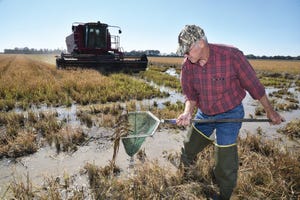
AGUZZI

“One problem was that we didn’t have a way to record what was going on the field. We only knew generally where those cut spots were.”

In 2000, Aguzzi was put in charge of finding the problem areas and treating the sites with a spin spreader and pelletized chicken litter.

First he added yield monitoring capability to one of farm’s five combines. “From a cost standpoint, equipping five machines with full-blown yield mapping would be quite expensive. With one combine, we’ll see gaps in the data, but it easily picks up trends.”

Then he took a trip back into time. “We made the cuts back in the early 1980s. The computer (where the cut sheets were stored) is an old Radio Shack, Model 3, TRS 80, which had been sitting on a shelf since the mid-1980s. It was so covered in dust and dirt that we had to take the keyboard apart and use tin foil to help type commands.”

Aguzzi managed to pull up the old cut sheets stored on the computer. He searched the Internet for a program that would run something that old on a new machine. “We found it and were able to access all our old data — where our cuts were and where they were in the field.”

Aguzzi took a hand-held GPS to the field and mapped where the old cuts had been made. Yield mapping data corroborated that the cut areas corresponded to many of the low-yielding parts of fields.

One low-yielding area clearly showed where an old ridge ran through the field prior to precision leveling, noted Aguzzi.

In 2001, the Aguzzis made variable-rate preplant applications of pelletized chicken litter to address the problem.

“The chicken litter worked in some spots. After talking with Tim Walker (assistant research professor, Delta Research and Extension Center, Stoneville, Miss.) we understood we really weren’t building something there. It was kind of a one-time use.”

In addition, satisfying the soil’s phosphate needs through chicken litter can cost the producer $12 per pound of phosphate applied, according to Walker. “If phosphate is the issue, we need to put out phosphate, and we can do it economically.”

Since soil samples indicated very low levels of phosphorus in cut areas, Aguzzi decided to try a variable-rate preplant application of Triple Super Phosphate (0-46-0) in 2003, following a year of soybeans.

That fall, the cut area in one field yielded 158.5 bushels per acre, which exceeded the average field yield of 152 bushels per acre. That was a vast improvement in yield in the cut areas.

In another area of the same field, Aguzzi doubled up in one area of the field, “just to see what happened. We applied 200 pounds in that spot. It yielded 164.3 bushels per acre.”

In another field in 2003, Aguzzi applied Triple Super Phosphate at 175 pounds per acre in cut areas, except in a check plot. “Yields for the treated area ranged from 150 bushels to 162 bushels. The check area yielded 139 bushels. An unintentional check area (where Aguzzi ran out of fertilizer) yielded 73 bushels per acre.”

Aguzzi said soybean yields have not been affected in the cut areas. “We don’t see those areas in our bean yield maps, but we do see signs of drought stress a little quicker. Last year, after two applications of phosphate, those areas did not show (drought stress) as quickly as they normally did.”

Aguzzi made a blanket application of 100 pounds of Triple Super Phosphate in a strip plot in a field with no history of yield reductions due to cuts. “We didn’t help ourselves much with the application,” he said, noting only a slight increase in yield where phosphate was applied.

The solution — “It’s more important for us to address the specific sites where we are having problems. We need to take on those problems first.”

e-mail: erobinson@primediabusiness.com

Get Copyright ClearanceWant to use this article? Click here for options!
© 2008 Penton Media, Inc.


Latest Jobs

Read More Daily News

Arkansas corn, milo: moisture, harvest issues

Aug 29, 2008 10:57 AM

South Arkansas — especially Chicot and Ashley counties in the extreme southeast — has had “buckets of rainfall in August,” says Jason Kelley, Arkansas Extension corn and grain sorghum specialist. ...

Bull corn market gone kaput?

Aug 29, 2008 10:06 AM

Is another bull market in the running for corn despite bearish news from USDA for higher ending stocks and production? ...

Louisiana research: raising corn, soybean yields

Aug 29, 2008 10:04 AM

Corn with improved resistance to aflatoxin and soybeans that won’t lose quality from Louisiana’s heavy rains are two of the crop breeding goals of an LSU AgCenter researcher at the Dean Lee Research and Extension Station in Alexandria, La....

Beltwide Cotton Conferences return to San Antonio

Aug 29, 2008 10:02 AM

The National Cotton Council-coordinated 2009 Beltwide Cotton Conferences is set for Jan. 5-8 at the Marriott Rivercenter/Riverwalk hotels in San Antonio, Texas....

Pioneer corn: history and future

Aug 29, 2008 10:00 AM

A wall of exotic corn varieties — some towering, some odd-looking — was the backdrop for a stop at the recent field day on Kip Cullers’ Stark City, Mo., farm....

Delta Farm Press News

Southeast Farm Press News

Southwest Farm Press News

Western Farm Press News

resources

events icon events

product info icon tradeshows

tradeshow icon digests

research icon photos

Continuing Education

For Texas and Oklahoma Licensed Applicators

A free online continuing education course on spray drift management accredited by the Texas and Oklahoma departments of agriculture.

For National Certified Crop Advisers

A free American Society of Agronomy-accredited one-CEU course on spray drift management.

ACCREDITED IN CALIFORNIA ONLY:


Almond Pest Management

Get the latest info on almond insect pest management and earn 2 hrs. CE DPR and CCA credit in California.

California Groundwater Protection Regulations

Earn 2 hrs. in California laws and regs CE and learn how to protect California groundwater supplies.

Powdery Mildew Control in California Grapevines

Learn about the No. 1 grape disease in California; earn 2 California CE hours.

ACCREDITED IN CALIFORNIA AND ARIZONA:


Insecticide Resistance Management in Agronomic and Row Crops

A 3-hr. CE approved for California and Arizona licensees and CCAs in both states.

Agronomic Weed Resistance Management in Row Crops, Trees Nuts and Vines

Weeds Resistance Management is approved for 3 hours of CE credit for all California and Arizona licensees and Certified Crop Advisers.

Lepidopterous Pest Management/ Pesticide Safety

This course is approved for 2 hours in Arizona and California (1 hr. of laws/regs; 1 hour Other) and for CCAs.

Managing Spray Drift to Minimize Problems

2-hrs laws and regs for California licensees; 2 hours in Arizona and for CCAs.

Back to Top

Browse Print Issues

Additional Resources

subscribe to Farm Press Daily Southeast Farm Press Southwest Farm Press Western Farm Press