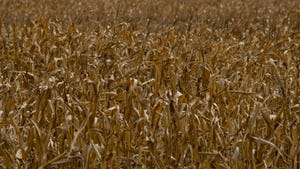
USDA corrects production report errors

Oct 28, 2008 10:36 AM, By Elton Robinson
Farm Press Editorial Staff

A million acres too much here and there added up to up to an embarrassing moment for USDA’s National Agricultural Statistics Service in late October. After the agency released its Oct. 10 crop production report, Farm Service Agency analysts observed discrepancies between NASS acreage numbers and those in the definitive FSA database.

NASS reissued the Oct. 10 crop production report on Oct. 28 to reflect the corrections. NASS repeated its acreage estimation process for dry edible beans, canola, corn, sorghum, soybeans, and sunflower. The errors also resulted in the World Agricultural Outlook Board reissuing its world agricultural supply and demand estimates.

Corn planted and harvested area were both lowered 1 million acres from the Oct. 10 forecast. Corn production is forecast at 12.033 billion bushels, down 167 million from the Oct. 10 forecast. Feed and residual use is projected 50 million bushels lower at 5.3 billion with the smaller crop and higher expected sorghum feeding.

Corn exports are projected 50 million bushels lower at 1.95 billion on tighter supplies. Ending stocks are projected at 1.088 billion bushels, down 66 million from the previous forecast. The season-average farm price range is raised 5 cents on each end of the range to $4.25 to $5.25 per bushel.

Planted and harvested area for soybeans were both reduced 1.1 million acres. Soybean production is forecast at 2.94 billion bushels, down 45 million from the Oct. 10 forecast. Soybean exports are projected 30 million bushels lower at 1.02 billion bushels reflecting reduced supplies and higher prices.

Soybean crush is unchanged from the Oct. 10 projection leaving the soybean meal and soybean oil balance sheets unchanged. Ending stocks are projected at 205 million bushels, down 15 million from the Oct. 10 forecast. The U.S. season-average soybean price range is projected at $9.70 to $11.20, up 10 cents on both ends of the range.

Sorghum production is forecast at 472 million bushels, up 8 million from the Oct. 10 forecast. Feed and residual use was raised 10 million bushels with increased supplies. The projected season-average farm price is unchanged at $3.70 to $4.70 per bushel.

e-mail: erobinson@farmpress.com

Get Copyright ClearanceWant to use this article? Click here for options!
© 2009 Penton Media, Inc.


Latest Jobs

HEADLINES

Cotton gins closing as acres fall

Jul 9, 2009 12:04 PM, By Bonnie Coblentz, MSU Ag Communications

Fewer cotton acres in Mississippi mean less demand for cotton ginning, and whole communities in the Mississippi Delta are feeling the impact of the loss of their livelihood....

Herbicide shortages frustrating

Jul 9, 2009 12:02 PM, By Ford L. Baldwin, Practical Weed Consultants, LLC.

At this point in the season, things continue to get more complicated. ...

Pontotoc field day July 14

Jul 9, 2009 12:00 PM

Mississippi State University research and Extension experts will provide information and demonstrations about agronomic research activities July 14 when the Pontotoc Ridge-Flatwoods Branch Experiment Station hosts its annual Research and Demonstration Tour....

Problems implementing farm bill

Jul 9, 2009 8:04 AM, By David Bennett, Farm Press Editorial Staff

The writing and passage of the 2008 farm bill was hardly a smooth ride. ...

Louisiana ag recovery program

Jul 9, 2009 8:02 AM

Details of the $44.5 million Louisiana Farm and Agribusiness Recovery Grant and Loan Program were unveiled at the recent annual Farm Bureau convention in New Orleans....

Disease can sneak up on peanut producers

Jul 9, 2009 8:00 AM, By Elton Robinson, Farm Press Editorial Staff
Earlier this year, more than 80 growers from Mississippi’s three major peanut-growing areas gathered in Hattiesburg, Miss., for the second annual Mississippi Peanut Growers Association meeting and short course....

Disease pressure builds in Mississippi peanuts

Jul 8, 2009 9:50 AM, By Elton Robinson, Farm Press Editorial Staff

One of the biggest benefits to growing peanuts in Mississippi has been the relative lack of disease pressure compared to other more established growing regions of the Southeast....

resources

events icon events

product info icon tradeshows

tradeshow icon digests

research icon photos

Continuing Education


(New Course)
Weed Resistance Management in Cotton

This course covers a wide range of options to effectively control weeds in cotton and reduce the risk of weed resistance management. It is accredited for hours/units for licensed/accredited applicators in 7 U.S. Cotton Belt states (Florida, Georgia, New Mexico, Oklahoma, Texas, South Carolina an d Tennessee. CCA credit is pending).

This course is accredited in Texas, Oklahoma, New Mexico, Virginia, West Virginia and Wyoming as well as for CCA credits:

(New Course)
Spray Drift Management

Keeping crop protection chemicals on the crop for which they are intended has been a cornerstone of farming not only to protect neighboring crops, but to not waste money allowing products to drift off the intended target. This accredited online continuing education course covers the critical elements of spray drift management.

Back to Top

Continuing Education


(New Course)
Weed Resistance Management in Cotton

This course covers a wide range of options to effectively control weeds in cotton and reduce the risk of weed resistance management. It is accredited for hours/units for licensed/accredited applicators in 7 U.S. Cotton Belt states (Florida, Georgia, New Mexico, Oklahoma, Texas, South Carolina an d Tennessee. CCA credit is pending).

This course is accredited in Texas, Oklahoma, New Mexico, Virginia, West Virginia and Wyoming as well as for CCA credits:

(New Course)
Spray Drift Management

Keeping crop protection chemicals on the crop for which they are intended has been a cornerstone of farming not only to protect neighboring crops, but to not waste money allowing products to drift off the intended target. This accredited online continuing education course covers the critical elements of spray drift management.

Browse Print Issues

Additional Resources

subscribe to Farm Press Daily Southeast Farm Press Southwest Farm Press Western Farm Press