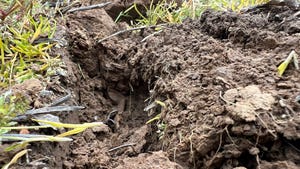
Fungicide-resistant Rhizoctonia solani found in Louisiana

What is in this article?:

  • Soil-borne Rhizoctonia solani fungus found to be resistant to strobilurin fungicides.
  • Fungus causes sheath blight in rice and aerial blight in soybeans.
  • So far, only in a small area of southern Louisiana.


A suspected mutation of the Rhizoctonia solani fungus has been found to be resistant to strobilurin fungicides. So far, the soil-borne fungus – which causes sheath blight in rice and aerial blight in soybeans – is only in a small area of southern Louisiana

Even so, “this is a significant discovery,” said David Lanclos, Louisiana agronomic service representative for Syngenta, on Friday morning. “The situation developed last year -- primarily in Acadia Parish in the Mowata area, between Crowley and Eunice -- when we began noticing some product issues in the field. We were called and began trying to figure it out.”

Lanclos and colleagues solicited input from “very experienced plant pathologists (at Syngenta’s research facility) in Vero Beach, Florida.”

Following a series of major tests, the pathologists “came up with (fungicide) tolerance levels for Rhizoctonia solanithat are too high for the traditional strobilurin products to work anymore.”

The week of Jan. 2, “we sent information to the LSU AgCenter about it – they’ve been in the communication loop the whole time. Now, we must educate farmers about the discovery.”

Among Lanclos’ other comments:

Who first discovered it?

“Originally, one of our salesmen, Josh Zaunbrecher, who works in southern Louisiana, found it.”

What was the timeline on this?

“We were called out near the end of last year’s rice-growing season, just as the water was being pulled off.

“We went into the impacted area and pulled samples and got the results back after the first of the year. Preliminary results weren’t good but we’ve now done (intense testing) that confirmed the tolerance.”

The pathologists tested “for resistance to azoxystrobin (Quadris) and propiconazole (Tilt). The azoxystrobin results were mixed but not the propiconazole. In all cases tested in Vero Beach, all of the samples came back susceptible to propiconazole, which is great news. Tilt will have to be a component to a successful fungicide program in 2012 for southwest Louisiana.

“The strobilurin class of fungicide chemistry -- including Quadris, Stratego, and Headline – are not going to be effective against Rhizoctonia solani in that area. Fungicides in the same class of chemistry share the same mode of action against pathogens and therefore they are assumed to be cross-resistant.”

What are the fears about the resistance moving?

“That’s a very good question. It will be an educational experience for us all.

“The disease is rather unique in the way it’s transferred from field to field. It isn’t like a traditional rust disease with air-borne spores.

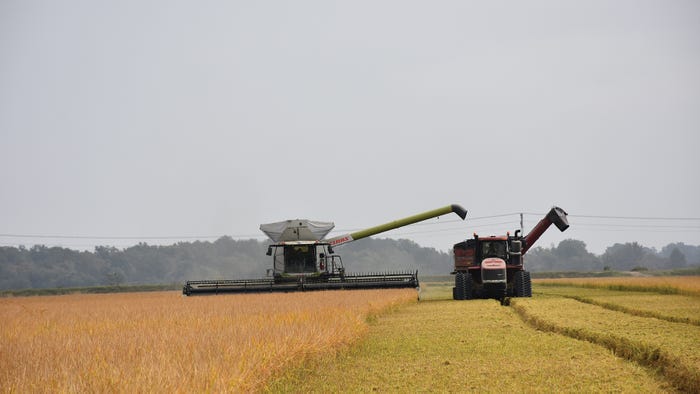
“It’s mainly moved through soil and crop debris. It can be moved by people’s feet walking in contaminated soil. It can move through equipment, combines, anything along those lines.

“Can we control it? At this point, the fungicides that we have available will have diminished or no control on it specifically.  However, they can and will continue to have control or efficacy against lots of other diseases. The way that we are going to manage the disease is through BMP’s (Best Management Practices) and, hopefully, in the future with (new) fungicides.”

On suggested BMPs…

“First, we need to make sure everyone understands what this disease is and how it spreads.

“Equipment is the main spreader of the fungus. Based on that fact, we suggest equipment be pressure-washed, combines be blown out, things along those lines.

“Going into the 2012 planting season, what can we use as crop strategies to rotate away from Rhizoc? The first and, likely best, strategy is crawfish production (followed by) sorghum, corn or pasture. I fully realize that these rotation strategies don’t occur overnight. It will be a long-term rotation strategy with other crops that will have to be used to combat this.

Discuss this article 1

This is kind of a scary find. I do find it interesting that a "salesman" found this disease in the fields. I hope that it gets under control fast so that farmers can get down to business.

  •  


    We always need to look deeper into what we are being told in order to recognize this problem so that we don't get blindsided by "doom and gloom" people who only want to sell us things.

By Kyle.L  on Jan 18, 2012
Post new comment
Sign In or register to use your Delta Farm Press ID
(optional)

Continuing Education Courses

New Course

The 2,000-member Weed Science Society of America’s (WSSA) Herbicide Resistance...

Potassium nitrate has a positive effect in controlling plant pests and diseases when applied...
This online CE course details sound mechanical irrigation design and management practices to...
Farmer-to-Farmer Used Equipment