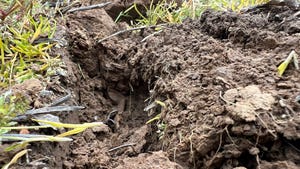
Resistant mare’s tail in southeast Missouri

PORTAGEVILLE, Mo. — Mare’s tail, a familiar nemesis for Missouri farmers, has reappeared with a new resistance to glyphosate-based herbicides, a University of Missouri weed scientist said.

Mare’s tail, also known as horseweed in the Delta region, “isn’t a new problem, but until recently, glyphosate controlled it,” said Andy Kendig, weed science specialist at MU Delta Research Center in Portageville. “Now, we see fields where everything is burnt down except horseweed. It’s really erupted over the past two years.”

“Some of the mare’s tail problem is due to glyphosate-only burndown treatments,” Kendig said. “The good news is that we have a couple of very good treatment options. The bad news is that it doesn’t always get done.”

MU researchers recommend a March application of an herbicide such as 2,4–D or Clarity, he said. “These two herbicides are essential to control mare’s tail — or primrose and several other troublesome weeds.

Even if a few late-germinating horseweeds escape, this application is still needed.

Without the preplant burndown application, he said, “you have to go with mediocre cleanup options. There are only a few choices,” including “old-fashioned tillage.”

Kendig and other researchers on the Delta Center Weed Science Project will present their latest findings at the Delta Center Field Day scheduled for Sept. 2.

Anthony Ohmes, MU Extension agronomist in Mississippi County, Mo., will address the problems of weed control in wheat. “Ryegrass continues to be among our most difficult problems,” he said. “In some cases, ryegrass has become resistant to grass-only herbicides” traditionally used to control them.

Ohmes will discuss new herbicide compounds that can control ryegrass effectively as well as rotating herbicides and other resistance management techniques. He’ll also talk about other weeds in winter wheat, such as cheat and cornflower.

Delta researchers at the field day will also speak on weed control in rice, Roundup Ready Flex cotton and scouring rush infestations.

For more information about the field day, call the Delta Center at 573-379-5431.

Forrest Rose is an Extension and ag information specialist with the University of Missouri.

Discuss this article 0

Post new comment

Sign in or Register to use your Delta Farm Press ID
(optional)
CAPTCHA
This question is for testing whether you are a human visitor and to prevent automated spam submissions.
Incorrect please try again
Enter the words above: Enter the numbers you hear:
Farm Press Newsletters
Sign Up!

For the Delta Farm Press Newsletter

Keep up with the latest news with our daily newsletter

Continuing Education
New Course

Keeping crop protection chemicals on the crop for which they are intended has been a cornerstone of farming not only to protect neighboring crops, but to not waste money allowing products to drift off the intended target. This accredited online continuing education course covers the critical elements of spray drift management.

New Course

This course covers a wide range of options to effectively control weeds in cotton and reduce the risk of weed resistance management. It is accredited for hours/units for licensed/accredited applicators in 7 U.S. Cotton Belt states (Florida, Georgia, New Mexico, Oklahoma, Texas, South Carolina an d Tennessee. CCA credit is pending).