Oversupply from record 2012 peanut crop points to fewer acres this year

What is in this article?:

“There’s no doubt in anyone’s mind that we need a decrease in peanut production for 2013,” says Marshall Lamb, research leader of the USDA/Agricultural Research Service National Peanut Research Laboratory at Dawson, Ga., who spoke at the annual meeting of the Mississippi Peanut Growers Association. “The question is: What do we need to produce in 2013 in order to get back to a reasonable carryout that is healthy for the industry?"

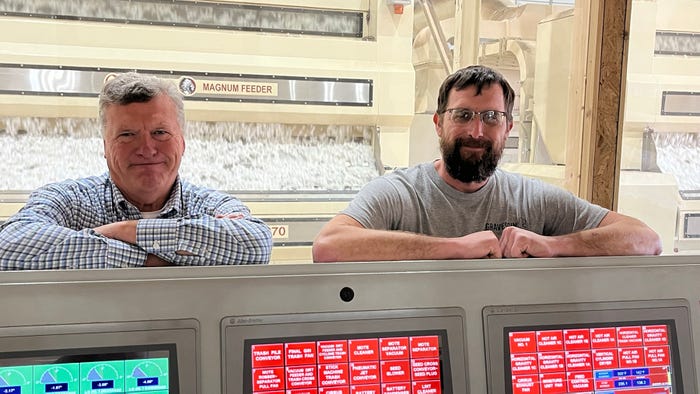
JOE CAMPBELL, from left, Golden Peanut Company, Camilla, Ga., visits with producer Keith Driskell, Grand Bay, Ala., and Kris Balkcom, Auburn University Extension agronomy and soils research associate, at the annual meeting of the Mississippi Peanut Growers Association.

“Incredible, mind-boggling yields” for U.S. peanut producers last year left the industry with a worrisome carryover going into 2013 — which could bring acreage cutbacks of as much as 40 percent this year, says Marshall Lamb.

“There’s no doubt in anyone’s mind that we need a decrease in production for 2013,” the research leader of the USDA/Agricultural Research Service National Peanut Research Laboratory at Dawson, Ga., said at the annual meeting of the Mississippi Peanut Growers Association at Hattiesburg.

“The question is: What do we need to produce in 2013 in order to get back to a reasonable carryout that is healthy for the industry? We had a record carryout of roughly 1.35 million farmer stock tons going into 2013 — some analysts say as high as 1.5 million.

“We need to get back to a reasonable carryout level, which would equate to production this year of about 1.5 million farmer stock tons. With an average 3,400 lb. U.S. yield, that would suggest 900,000 acres for 2013, or about a 38 percent decrease from last year and a 30 percent decrease from the 2008-12 average. I’d like to see a bit more acreage than that as a buffer in case weather or other problems should cause yields to drop to around 3,000 tons.”

The saving grace for last year’s record crop has been demand, chiefly unexpected purchases from China, Lamb says.

“China has come into the market because they couldn’t get the peanuts they usually buy from India, so they’ve purchased significant amounts of U.S. peanuts, which has been great for us in terms of dealing with our oversupply.

“Demand in the export market has basically doubled compared to a year ago, due mainly to China’s purchases. China crushes about 80 percent of the peanuts they import, which results in about half oil, half meal. They’ve been buying peanuts from India, which are often contaminated with aflatoxin, and crushing concentrates the aflatoxin in the meal.

“We’re hoping that as they crush our U.S. peanuts, they will see how good the resulting meal is, and may realize it’s not all about price, but also quality, which we deliver. Hopefully, they will remain a more stable customer, although I have a feeling price may drive their buying decisions ahead of quality.”

Also helping boost demand, Lamb says, U.S. manufacturers are introducing new product lines for peanuts and are expanding existing product lines.

“We need to move out as many peanuts as possible so shellers don’t have to store them too long. Our shellers

are working as hard as they can to get these peanuts shelled, but they may not be able to have them all shelled by the time we start delivering the 2013 crop this fall.”

At the time of the Mississippi grower meeting, no contracts had been offered for 2013 peanuts, Lamb said, and there were still uncontracted peanuts in the loan.

“Given prices for other crops, we should be able to reduce peanut acres in order to get supply and demand back in balance, and hopefully attractive prices for other crops will offer farmers some economic stability with reduced peanut acreage.

Discuss this Article 2

Anonymous (not verified)
on Feb 25, 2013

I think it is great that at least one group of farmers are trying to control growth to maintain decent prices . Too bad the dairymen wouldn't do the same .

Alonso (not verified)
on Feb 25, 2013

I am a farmer of peanut GA06, I would like to know:
How much of the surplus farmer stock tons did the Chinese purchased?
What kind of prices we could hope to obtain for this and next year?
How we keep the Chinese to buy from us again?
What prices they pay for Indian Peanuts crop?

Post new comment
Sign In or register to use your Delta Farm Press ID

(optional)

Continuing Education
Potassium nitrate has a positive effect in controlling plant pests and diseases when applied...
This online CE course details sound mechanical irrigation design and management practices to...

Newsletter Signup