Fewer cows, more Bt cotton… smaller carbon footprint

Oct 14, 2008 10:37 AM, By Forrest Laws
Farm Press Editorial Staff

Reducing the carbon footprint. Environmentalists tell us we should be doing everything we can to lower the amount of greenhouse gases and other pollutants being released into the atmosphere.

But what if someone said you could reduce the carbon footprint of your farm by planting more Bt cotton or corn or by using some other technology such as recombinant bovine somatotropin in dairy cows?

Scientists at Cornell University have released a study showing that increasing milk production by another 10 pounds per cow with the product can do wonders for reducing the carbon footprint of dairy herds.

“The popular belief is that agriculture accounts for about 16 percent of greenhouse gas emissions,” said Jude Capper, a post-doctoral research associate at Cornell. “The figure is actually closer to 6 percent and dairy accounts for about 11 percent of that total.”

Capper, a speaker at the World Dairy Expo in Madison, Wis., showed a magazine cover of cows standing in a creek to illustrate how far dairy farmers have come on environmental issues. “That’s a nice bucolic scene,” she says. “But if you did that today you would get hammered by EPA.”

The industry could be faced with similar problems in the future because of methane gas emissions and nitrogen leaching from cows and cow manure. (Capper, a native of Great Britain, pronounces the word me-thane with a long e.)

Increasing the productivity of cows with products such as rbST or Posilac could reduce the carbon footprint by continuing to lower the number of cows required to feed a growing world population.

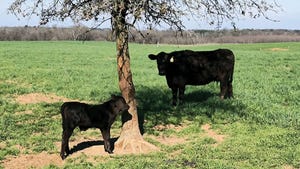
Dairy cow numbers have been coming down as productivity has increased. In 1944, 25.6 million dairy cows were required to provide 117 billion pounds of milk. In 2007, 9.2 million cows produced 186 billion pounds of milk.

Another 10 pounds of milk would reduce the industry’s carbon footprint by about 9 percent, says Capper. If 1 million cows produced an extra 10 pounds of milk per day, dairy farmers would need 2.5 million tons less feed per year and 540,000 less acres of cropland.

“We would save enough electricity to power 15,000 households, generate enough heat for 16,000 households and enough water to supply 10,000 households per year,” said Capper. “In all, we would lower greenhouse gas emissions by 1.9 million metric tons.”

To bring the numbers down to the local level, a herd of 150 cows that produced another 10 pounds would require 245 fewer tons of feed, 53 fewer acres of farmland and 132,000 fewer gallons of water. “It would mean the equivalent of removing 38 cars from the road,” she said. “Or it would be the same as planting 28,000 trees.”

Consumer advocates/environmentalists have opposed rbST in the past. It will be interesting to see how they react when they begin to hear how much of a reduction in the carbon footprint can be achieved through the use of the technology.

e-mail: flaws@farmpress.com

Get Copyright ClearanceWant to use this article? Click here for options!
© 2009 Penton Media, Inc.


Latest Jobs

Read More Daily News

Climate change not aberration

Jul 1, 2009 1:06 PM

The world’s climate is getting warmer, and that could have a profound impact on U.S. agriculture, says Jerry Hatfield, supervisory plant physiologist with USDA’s National Soil Tilth Research Laboratory at Iowa State University....

Ag tech field day at Agricenter

Jul 1, 2009 1:04 PM

Agricenter International will again host the biggest field day in the Mid-South for commercial agricultural technology at the 2009 Mid-South Ag-Technology Field Day July 16 in Memphis....

100 years: LSU AgCenter Rice Research Station

Jul 1, 2009 1:02 PM

The LSU AgCenter Rice Research Station at Crowley, La., is celebrating a century of operation this year, making it the oldest facility of its kind in the Western Hemisphere....

Glyphosate-resistance shocking

Jul 1, 2009 1:00 PM

I recently wrote in an article that I would sure like to get called out to a “normal-looking” rice field because I have looked at so many messes this year....

Downside of wildlife programs

Jul 1, 2009 10:18 AM

We quickly learn in this business that one man’s caviar and Champagne may well be just smelly fish eggs and icky grape juice to another....

Delta Farm Press News
Southeast Farm Press News

Southwest Farm Press News

Western Farm Press News
resources

events icon events

product info icon tradeshows

tradeshow icon digests

research icon photos

Continuing Education


(New Course)
Weed Resistance Management in Cotton

This course covers a wide range of options to effectively control weeds in cotton and reduce the risk of weed resistance management. It is accredited for hours/units for licensed/accredited applicators in 7 U.S. Cotton Belt states (Florida, Georgia, New Mexico, Oklahoma, Texas, South Carolina an d Tennessee. CCA credit is pending).

This course is accredited in Texas, Oklahoma, New Mexico, Virginia, West Virginia and Wyoming as well as for CCA credits:

(New Course)
Spray Drift Management

Keeping crop protection chemicals on the crop for which they are intended has been a cornerstone of farming not only to protect neighboring crops, but to not waste money allowing products to drift off the intended target. This accredited online continuing education course covers the critical elements of spray drift management.

Back to Top

Continuing Education


(New Course)
Weed Resistance Management in Cotton

This course covers a wide range of options to effectively control weeds in cotton and reduce the risk of weed resistance management. It is accredited for hours/units for licensed/accredited applicators in 7 U.S. Cotton Belt states (Florida, Georgia, New Mexico, Oklahoma, Texas, South Carolina an d Tennessee. CCA credit is pending).

This course is accredited in Texas, Oklahoma, New Mexico, Virginia, West Virginia and Wyoming as well as for CCA credits:

(New Course)
Spray Drift Management

Keeping crop protection chemicals on the crop for which they are intended has been a cornerstone of farming not only to protect neighboring crops, but to not waste money allowing products to drift off the intended target. This accredited online continuing education course covers the critical elements of spray drift management.

Browse Print Issues

Additional Resources

subscribe to Farm Press Daily Southeast Farm Press Southwest Farm Press Western Farm Press