Where’s the economy headed?

Oct 30, 2009 12:08 PM, By Forrest Laws, Farm Press Editorial Staff

The uncertainty over the so-called cap and trade legislation, health care reform and tax increases are causing nightmares for much of America.

U.S. farmers and consumers who are trying to figure out what the future holds aren’t getting much help from Washington these days. As a result, they may need to pick out some economic indicators that could help them chart their course.

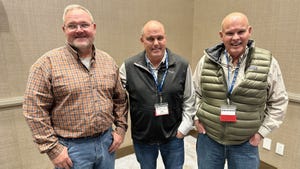
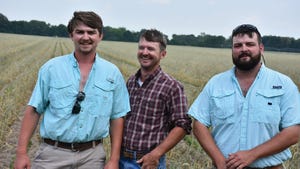
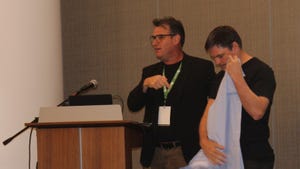
CHARLES GLOVER, left, E. Ritter and Company in Marked Tree, Ark., and Ted Glaub, Glaub Farm Management, Jonesboro, Ark., visit with Ernie Goss at the American Society of Farm Managers and Rural Appraisers annual meeting in Denver.

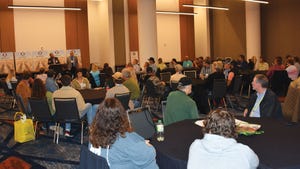
Ernie Goss, professor of economics at Creighton University in Lincoln, Neb., identified some of those indicators while giving members of the American Society of Farm Managers and Rural Appraisers his take on the current economic outlook at the ASFMRA’s 80th annual meeting in Denver.

“We’re all sitting on the sidelines, trying to figure out what’s happening,” said Goss, a graduate of the University of Tennessee who has held a number of public and private economic positions over the years. “I’ve never seen this much uncertainty over government policy and the national economy.”

While that might be a good scenario for economists and lawyers, it gives little comfort to farmers and other small business owners and consumers, said Goss. The uncertainty over the so-called cap and trade legislation, health care reform and tax increases are causing nightmares for much of America.

“I also have a small consulting business, and I’m sitting here thinking, ‘Should I hire now, should I hire later; should I buy a car now, should I buy a car later; should I buy a house now, should I buy a house later?” he said.

“We have millions of people sitting on the sidelines, and the chief, No. 1 economic problem we’re facing now is the lack of clarity. We don’t know the answers to those kinds of questions.”

Goss said the Commerce Department report issued when he spoke Thursday was “a very good sign.” The government reported that the nation’s gross domestic product grew by 3.5 percent in the third quarter of 2009.

“We don’t know how much of that is cash for clunkers or the tax credit for first-time home buyers,” he said. “We’re also likely to see continued high unemployment numbers until companies begin to do more hiring.”

Goss, one of 200 economists who took out a full page ad saying “We are not all Keynesians,” that appeared in the New York Times and the Wall Street Journal earlier this year, said he believes the government’s fiscal policies have not helped the economy all that much.

“Yes, the economy needed some stimulus; there’s no doubt about that,” he said. (Followers of the British economist John Maynard Keynes believe government spending or economic stimulus packages are the key to pulling the economy out of a recession/depression.) “Whether it was the right stimulus package is the question?

“It may be that if the government had allowed some of these big companies like AIG and General Motors to fail, it would have hurt, but we might also have a lot of this behind us now. We also wouldn’t have $11.2 trillion in federal debt.”

So what indicators should you be looking for in the coming months?

• The employment report for October will be released Nov. 6. “I expect the report to show job losses (above 200,000 persons) for a 24th straight month and an increase in the unemployment rate by 0.2 percent,” he said. “If the report goes above 10 percent unemployment, that would be very bad. A good report would be only 100,000 jobs.”

• First-time and continuing claims for unemployment insurance. This report is released every Thursday. “First time claims above 550,000 will be bearish,” he said. “I expect this number to drop below 500,000 by December (www.doe.gov.)

• The first and most important indicator for November will be the Mid-America and U.S. October Purchasing Manager Institute’s survey released Nov. 2 (www.outlook-economic.com and www.ism.ws.) “A drop in the national will be bearish (under 50 will be very, very bearish.”

• Goss suggests you keep an eye on the yield for 10-year U.S. Treasuries. If this yield approaches 4 percent within the next month, the Federal Reserve Board will be “between a rock and a hard place.” The rapidly rising yields reflect: (1) concerns regarding the large increases in the U.S. budget deficit; (2) rising inflation expectations; and (3) investors have reduced their risk perceptions and are pulling money out of treasuries and putting it into equity markets (“a good thing”). (http://finance.yahoo.com.

• Investors will be closely watching retail sales to detect a weak consumer reading. A weak consumer market will be a bad signal for the holiday buying season.

e-mail: flaws@farmpress.com

Get Copyright ClearanceWant to use this article? Click here for options!
© 2010 Penton Media, Inc.


Latest Jobs

Read More Daily News

Tillage tests — ‘trash farm for profit’

Feb 9, 2010 9:47 AM

As he speaks, Merle Anders has a small prop on the table behind him: a baseball cap inscribed with “Trash Farming for Profit.” ...

Reduced-till and cotton seedling diseases

Feb 9, 2010 9:43 AM

Managing no-till or reduced-till cotton production properly, including following appropriate planting recommendations and taking care of early weed problems, may reduce potential for disease outbreaks....

Chicken litter — ‘smell of success’

Feb 9, 2010 9:33 AM

Having used poultry litter on his family’s Jonesboro, Ark.-area farm for years, Wayne Wiggins III is a proponent of the practice. ...

NCC: 10.1 million cotton acres

Feb 8, 2010 10:30 AM

After three straight years of declines, U.S. cotton acreage could be headed back up, according to the National Cotton Council’s 27th annual Early Season Planting Intentions Survey....

Weed resistance, Washington headline Farm & Gin Show

Feb 8, 2010 10:24 AM

This year’s Mid-South Farm and Gin Show offers “perhaps the best set of exhibits ever,” says Tim Price, manager of the annual event to be held Feb. 26-27 at the downtown Memphis Cook Convention Center....

Delta Farm Press News
Southeast Farm Press News
Southwest Farm Press News

Western Farm Press News
resources

events icon events

product info icon tradeshows

tradeshow icon digests

research icon photos

Continuing Education


(New Course)
Weed Resistance Management in Cotton

This course covers a wide range of options to effectively control weeds in cotton and reduce the risk of weed resistance management. It is accredited for hours/units for licensed/accredited applicators in 7 U.S. Cotton Belt states (Florida, Georgia, New Mexico, Oklahoma, Texas, South Carolina an d Tennessee. CCA credit is pending).

This course is accredited in Texas, Oklahoma, New Mexico, Virginia, West Virginia and Wyoming as well as for CCA credits:

(New Course)
Spray Drift Management

Keeping crop protection chemicals on the crop for which they are intended has been a cornerstone of farming not only to protect neighboring crops, but to not waste money allowing products to drift off the intended target. This accredited online continuing education course covers the critical elements of spray drift management.

Back to Top

Browse Print Issues

Additional Resources

subscribe to Farm Press Daily Southeast Farm Press Southwest Farm Press Western Farm Press