GPS survey can improve farm’s bottom line

Dec 6, 2006 9:21 AM

Inaccurate acreage estimates could lead to some farmers spending too much or too little on producing their crops, according to an LSU AgCenter watershed agent, who says the cost of more accurate surveys may be worth the investment.

“Precision agriculture is putting the right stuff in the right place at the right time, and the first step is to find out how large your field really is,” said Tom Hymel, an LSU AgCenter agent working in the Teche-Vermilion, Atchafalaya and lower Red River watershed basins in southwestern Louisiana.

Overestimating acreage could be an expensive mistake because all inputs are acreage-based. And input recommendations usually are based on research results obtained from work conducted on accurately measured plots, Hymel said.

Most producers rely on acreage estimates made by government agencies, which use detailed aerial photographs taken from several thousand feet overhead. But Hymel said such factors as a shadow caused by a tree line can result in significant inaccuracies.

Although they can cost several thousand dollars, Hymel says estimates made using global position system (GPS) equipment can be much more precise, and experts say the more accurate measurements can make major differences for farmers.

The GPS surveys are conducted using an antenna mounted on an all-terrain vehicle that follows the perimeter of a field. Using that system, ditches, odd-shaped fence lines and irregular shapes can be accurately measured.

Agricultural consultant Blaine Viator said almost half of his clients are going to GPS surveys. “More and more growers are seeing the need for it — once they see the errors,” Viator said. “What we’ve found on average, a farm ends up with 7 percent less acreage.”

A 7 percent mistake could mean a farmer is paying an additional 7 percent in expenses to grow a crop, since aerial applicators charge for their services on a per-acre basis. And usually, acreage estimates by federal agencies don’t include levees or ditches as non-productive areas.

A farmer would be more pleased with the production and associated profit margin of 100 tons of cane on 950 acres than the same tonnage on 1,000 acres, he said.

Handheld GPS units lack the precision to get an accurate measurement, Hymel added, but many agricultural consultants have the proper equipment.

The LSU AgCenter agent said he has seen several examples of surprising results.

For example, crawfish acreage in St. Martin Parish had been reported at 28,000, but a GPS survey conducted by Hymel showed the actual figure at 20,000 acres.

Hymel said a farmer told him after getting a GPS survey he applied herbicides and was able to estimate so closely that the last jug of chemical was just enough to finish the last field.

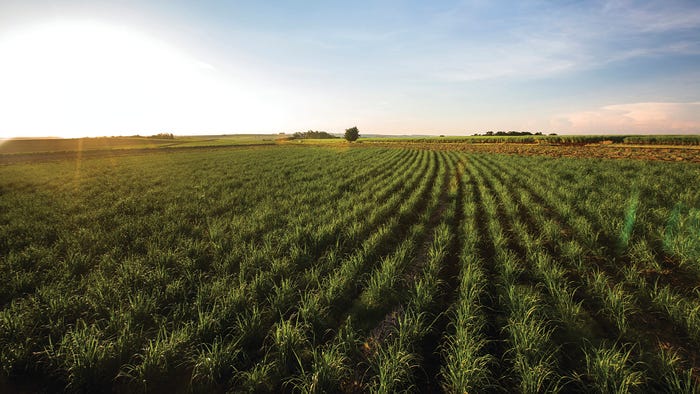
Hymel said he found many variances on a sugarcane farm. Almost half of the farm’s 164 fields were inaccurate by at least 5 percent, and the overall discrepancy was 7 percent.

“More of them were overestimated than underestimated,” he said, adding that the average underestimate was off by 5.8 percent and the average overestimate was off by 7.2 percent. “We had some that were off as much as 30 percent,” he said.

The LSU AgCenter agent said he plans to continue with the GPS work in the spring by picking a farm to use in a demonstration project.

Farmer Rene Simon of Iberia Parish said more accurate surveys allow for more accurate calibration of spray rigs. “Your fertilizer applications are much more accurate.”

Since cane harvesters lack yield monitors, determining acreage with some degree of accuracy also can provide basic yield information. Harvests on some fields may seem too high or too low because of erroneous acreage estimates, but the GPS work reveals the discrepancies.

Simon said farmers also are using GPS to make straighter rows, which can improve spraying efficiency. “You might think you’re in the right spot and might have a marker, but with GPS you’re dead on the money,” he said.

Get Copyright ClearanceWant to use this article? Click here for options!
© 2010 Penton Media, Inc.


Latest Jobs

Read More Daily News

Tillage tests — ‘trash farm for profit’

Feb 9, 2010 9:47 AM

As he speaks, Merle Anders has a small prop on the table behind him: a baseball cap inscribed with “Trash Farming for Profit.” ...

Reduced-till and cotton seedling diseases

Feb 9, 2010 9:43 AM

Managing no-till or reduced-till cotton production properly, including following appropriate planting recommendations and taking care of early weed problems, may reduce potential for disease outbreaks....

Chicken litter — ‘smell of success’

Feb 9, 2010 9:33 AM

Having used poultry litter on his family’s Jonesboro, Ark.-area farm for years, Wayne Wiggins III is a proponent of the practice. ...

NCC: 10.1 million cotton acres

Feb 8, 2010 10:30 AM

After three straight years of declines, U.S. cotton acreage could be headed back up, according to the National Cotton Council’s 27th annual Early Season Planting Intentions Survey....

Weed resistance, Washington headline Farm & Gin Show

Feb 8, 2010 10:24 AM

This year’s Mid-South Farm and Gin Show offers “perhaps the best set of exhibits ever,” says Tim Price, manager of the annual event to be held Feb. 26-27 at the downtown Memphis Cook Convention Center....

Delta Farm Press News

Southeast Farm Press News
Southwest Farm Press News

Western Farm Press News
resources

events icon events

product info icon tradeshows

tradeshow icon digests

research icon photos

Continuing Education


(New Course)
Weed Resistance Management in Cotton

This course covers a wide range of options to effectively control weeds in cotton and reduce the risk of weed resistance management. It is accredited for hours/units for licensed/accredited applicators in 7 U.S. Cotton Belt states (Florida, Georgia, New Mexico, Oklahoma, Texas, South Carolina an d Tennessee. CCA credit is pending).

This course is accredited in Texas, Oklahoma, New Mexico, Virginia, West Virginia and Wyoming as well as for CCA credits:

(New Course)
Spray Drift Management

Keeping crop protection chemicals on the crop for which they are intended has been a cornerstone of farming not only to protect neighboring crops, but to not waste money allowing products to drift off the intended target. This accredited online continuing education course covers the critical elements of spray drift management.

Back to Top

Browse Print Issues

Additional Resources

subscribe to Farm Press Daily Southeast Farm Press Southwest Farm Press Western Farm Press