Laws: New technologies require investments

Sep 6, 2006 9:32 AM, By Forrest Laws
Farm Press Editorial Staff

A friend and I were reminiscing about watching people pull cotton sacks through the fields in one of the Mid-South states in the 1950s and early 1960s.

LAWS

Then, you would see whole families out in the fields with all but the smallest children picking cotton. (My brothers and I picked on my grandfather’s farm after school and on Saturdays until we were in high school.)

I don’t remember anything particularly uplifting about the experience, although there have been efforts to try to put an aura of romanticism around it. The John Grisham novel and TV presentation, “A Painted House,” comes to mind.

My friend has not been involved in production agriculture and is not familiar with the $250,000 to $300,000 mechanical pickers that have replaced hand labor. Like most Americans, he still visualizes farmers driving small tractors and two- or four-row pickers and small combines.

They find it difficult to imagine a modern, six-row picker, equipped with auto steering systems, GPS receivers, yield monitors and — hopefully in the not too distant future — an on-board module builder that will pack the bale in a half-size module and drop it in the field.

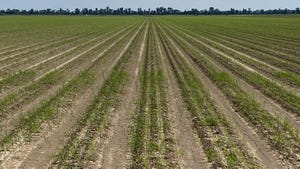
This conversation was prompted by my comments about a tour of Mid-South farms that are growing cotton in 15-inch rows, either solid cotton or variations of skip-row patterns that involve two 15-inch rows on a bed.

From an experiment on about 2,000 acres, mostly in Tennessee and North Carolina, the practice has grown to an estimated 40,000 acres across the Southern states. Most of the growers believe the practice is saving them from $40 to $100 per acre.

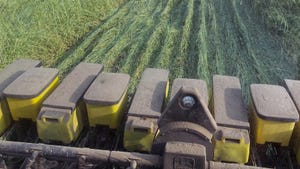
Of course, new production systems usually require investments of time and money. Besides buying the new variable-width 12-row pickers needed to pick the 15-inch cotton, growers are experimenting with 24- and 36-row, 15-inch row-spacing planters to put the crops in.

The high cost of trying to adapt new technology to stay competitive in world markets or just trying to upgrade conventional equipment is something that is rarely mentioned in some congressional circles.

Of course, few of those who criticize U.S. commodity programs or introduce legislation to lower payment limits have seen a six-row cotton picker or the new 12-row variable-spacing units that are being used to spindle pick the 15-inch row configurations in the field.

They don’t realize that a cotton farmer may have spent $100 an acre for seed, seed treatments, fertilizer and herbicides before the first plant comes out of the ground. Or that he can spend $55 to $60 an acre for custom-harvesting his crop if he doesn’t own a picker. Rice farmers, unfortunately, are in a similar situation.

Up until a few years before he retired, my grandfather planted his 13-acre cotton allotment with a two-row, mule-drawn planter. He owned a tractor, but he liked the stand he got from the old planter. Those days are gone — as much as we might like to have them back.

e-mail: flaws@farmpress.com

Get Copyright ClearanceWant to use this article? Click here for options!
© 2010 Penton Media, Inc.


Latest Jobs

Read More Daily News

Tillage tests — ‘trash farm for profit’

Feb 9, 2010 9:47 AM

As he speaks, Merle Anders has a small prop on the table behind him: a baseball cap inscribed with “Trash Farming for Profit.” ...

Reduced-till and cotton seedling diseases

Feb 9, 2010 9:43 AM

Managing no-till or reduced-till cotton production properly, including following appropriate planting recommendations and taking care of early weed problems, may reduce potential for disease outbreaks....

Chicken litter — ‘smell of success’

Feb 9, 2010 9:33 AM

Having used poultry litter on his family’s Jonesboro, Ark.-area farm for years, Wayne Wiggins III is a proponent of the practice. ...

NCC: 10.1 million cotton acres

Feb 8, 2010 10:30 AM

After three straight years of declines, U.S. cotton acreage could be headed back up, according to the National Cotton Council’s 27th annual Early Season Planting Intentions Survey....

Weed resistance, Washington headline Farm & Gin Show

Feb 8, 2010 10:24 AM

This year’s Mid-South Farm and Gin Show offers “perhaps the best set of exhibits ever,” says Tim Price, manager of the annual event to be held Feb. 26-27 at the downtown Memphis Cook Convention Center....

Delta Farm Press News

Southeast Farm Press News
Southwest Farm Press News

Western Farm Press News
resources

events icon events

product info icon tradeshows

tradeshow icon digests

research icon photos

Continuing Education


(New Course)
Weed Resistance Management in Cotton

This course covers a wide range of options to effectively control weeds in cotton and reduce the risk of weed resistance management. It is accredited for hours/units for licensed/accredited applicators in 7 U.S. Cotton Belt states (Florida, Georgia, New Mexico, Oklahoma, Texas, South Carolina an d Tennessee. CCA credit is pending).

This course is accredited in Texas, Oklahoma, New Mexico, Virginia, West Virginia and Wyoming as well as for CCA credits:

(New Course)
Spray Drift Management

Keeping crop protection chemicals on the crop for which they are intended has been a cornerstone of farming not only to protect neighboring crops, but to not waste money allowing products to drift off the intended target. This accredited online continuing education course covers the critical elements of spray drift management.

Back to Top

Browse Print Issues

Additional Resources

subscribe to Farm Press Daily Southeast Farm Press Southwest Farm Press Western Farm Press