Bollworms feeding on Bt cotton in Arkansas

Jul 28, 2006 10:31 AM, By Lamar James
Arkansas Extension Communications Specialist

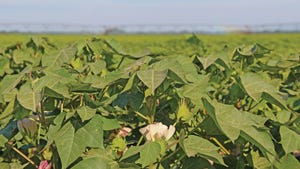
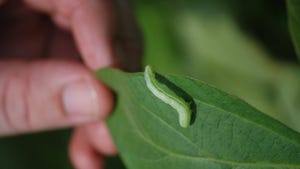
Bollworms have been showing up in cotton fields across Arkansas. They’re especially prevalent in south Arkansas, said Glenn Studebaker, entomologist with the University of Arkansas Cooperative Extension Service.

“They began showing up at the end of last week (July 16-22) in south Arkansas and now they’re in north Arkansas,” Studebaker said. “We’re seeing pretty heavy numbers.”

The entomologist said insect numbers tend to “blow up” in July and August. Worms tend to get worse this time of year in cotton as do the late-season insects, plant bugs and stink bugs.

“The big problem is that farmers are finding damage in Bollgard cotton, Bt cotton genetically modified to provide protection against tobacco budworms. Usually, they provide some protection against bollworms. But this year seems to be worse. Farmers are having to spray a lot of Bt cotton for bollworms.”

Studebaker said the insects are feeding in the terminal area on the upper plant. Usually, if they survive on Bt cotton, they feed from the lower portion of the plant.

Why isn’t the variety providing some degree of protection?

“It’s too early to say why yet. It could be a natural cycle or it could be growing tolerance for Bt in these insects,” Studebaker said.

“Farmers have been growing Bt cotton for about 10 years. Bollworms always had some tolerance to Bt, but after 10 years, we may have been selecting for insects that are more tolerant.”

He said the good news is that dual genetically protected Bt, Bollgard II, cotton is still holding up well against bollworms and tobacco budworms. This variety has two proteins that provide double protection.

The single protein Bt variety is working well to protect against budworms.

If bollworms are becoming more tolerant of Bt cotton, what will that mean to farmers?

“It could mean that more farmers will switch to Monsanto’s Bollgard II or Dow’s Wide Strike if we continue to see more bollworm damage to regular Bollgard,” Studebaker said. “The only problem is these are more expensive.”

Meanwhile, farmers with Bt cotton being damaged by bollworms are having to spray with pyrethroid insecticides. But Studebaker said it’s never a good thing when farmers have to spray costly insecticides.

In conventional cotton that doesn’t offer genetic protection, farmers are seeing budworms and bollworms. They should spray pyrethoroids mixed with Tracer or Denim, Studebaker said.

Unfortunately, it hits harder in a year like this when farmers are facing lost profit from high fuel and fertilizer prices. While spraying decreases their profits, Studebaker said farmers can’t afford to let insects steal their yields by not spraying.

He said farmers need to make sure their cotton fields are scouted for insects. He said they also need to check soybean and grain sorghum fields for bollworms, since they also feed on these crops.

ljames@uaex.edu

Get Copyright ClearanceWant to use this article? Click here for options!
© 2009 Penton Media, Inc.


Latest Jobs

Read More Daily News

Cotton gins closing as acres fall

Jul 9, 2009 12:04 PM

Fewer cotton acres in Mississippi mean less demand for cotton ginning, and whole communities in the Mississippi Delta are feeling the impact of the loss of their livelihood....

Herbicide shortages frustrating

Jul 9, 2009 12:02 PM

At this point in the season, things continue to get more complicated. ...

Pontotoc field day July 14

Jul 9, 2009 12:00 PM

Mississippi State University research and Extension experts will provide information and demonstrations about agronomic research activities July 14 when the Pontotoc Ridge-Flatwoods Branch Experiment Station hosts its annual Research and Demonstration Tour....

Problems implementing farm bill

Jul 9, 2009 8:04 AM

The writing and passage of the 2008 farm bill was hardly a smooth ride. ...

Louisiana ag recovery program

Jul 9, 2009 8:02 AM

Details of the $44.5 million Louisiana Farm and Agribusiness Recovery Grant and Loan Program were unveiled at the recent annual Farm Bureau convention in New Orleans....

Delta Farm Press News

Southeast Farm Press News
Southwest Farm Press News

Western Farm Press News
resources

events icon events

product info icon tradeshows

tradeshow icon digests

research icon photos

Continuing Education


(New Course)
Weed Resistance Management in Cotton

This course covers a wide range of options to effectively control weeds in cotton and reduce the risk of weed resistance management. It is accredited for hours/units for licensed/accredited applicators in 7 U.S. Cotton Belt states (Florida, Georgia, New Mexico, Oklahoma, Texas, South Carolina an d Tennessee. CCA credit is pending).

This course is accredited in Texas, Oklahoma, New Mexico, Virginia, West Virginia and Wyoming as well as for CCA credits:

(New Course)
Spray Drift Management

Keeping crop protection chemicals on the crop for which they are intended has been a cornerstone of farming not only to protect neighboring crops, but to not waste money allowing products to drift off the intended target. This accredited online continuing education course covers the critical elements of spray drift management.

Back to Top

Continuing Education


(New Course)
Weed Resistance Management in Cotton

This course covers a wide range of options to effectively control weeds in cotton and reduce the risk of weed resistance management. It is accredited for hours/units for licensed/accredited applicators in 7 U.S. Cotton Belt states (Florida, Georgia, New Mexico, Oklahoma, Texas, South Carolina an d Tennessee. CCA credit is pending).

This course is accredited in Texas, Oklahoma, New Mexico, Virginia, West Virginia and Wyoming as well as for CCA credits:

(New Course)
Spray Drift Management

Keeping crop protection chemicals on the crop for which they are intended has been a cornerstone of farming not only to protect neighboring crops, but to not waste money allowing products to drift off the intended target. This accredited online continuing education course covers the critical elements of spray drift management.

Browse Print Issues

Additional Resources

subscribe to Farm Press Daily Southeast Farm Press Southwest Farm Press Western Farm Press