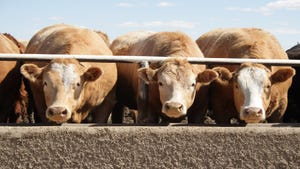
Funding set for FY 2006 Conservation Security Program contracts

Jun 7, 2006 7:51 PM

Agriculture Secretary Mike Johanns today announced USDA will provide nearly $440 million in funding for 4,404 Conservation Security Program contracts across the United States, Puerto Rico and Guam.


“This year more producers enrolled in the CSP, demonstrating that incentives work for voluntary conservation programs,” said Johanns. “The conservation benefits derived from this program will help farmers and ranchers improve their operations and increase the quality of our natural resources.”

The FY 2006 CSP contracts offered cover more than 3.7 million acres of private land in 60 watersheds nationwide, which translates to nearly a $440 million long-term investment in conservation over the next ten years, he said.

USDA expects to fully invest the $259 million provided by Congress for FY 2006. That amount covers prior CSP contracts and includes $50 million for FY 2006 contracts. USDA’s Natural Resources Conservation Service will begin notifying producers of the contracts today.

CSP is a voluntary conservation program that rewards private landowners for their ongoing stewardship of natural resources. CSP touches all agricultural production sectors from livestock operations to cropland and from orchards and vineyards to sugar bush and nursery crops.

The 2006 contracts encourage them to further conserve and improve soil, water, air, energy, plant and animal life, and other conservation purposes on their operations, while, at the same time, creating incentives for other producers to meet those same standards of conservation performance.

More than 8,570 applications were received during the FY 2006 CSP sign-up. Environmental enhancement activities offered by applicants include improving soil quality, water quality, wildlife habitat management, nutrient and pest management, air quality management and on-farm energy management.

As outlined in the 2002 farm bill, CSP payments will be made under three tiers of conservation contracts capped at $20,000, $35,000 and $45,000 annually. CSP contracts last for five years for Tier I contracts and 5 years to 10 years for Tier II and Tier III contracts.

Enrollment data for FY 2006 show that 99.6 percent of the applications approved include the complete agricultural operation, falling into the Tier III category for the most advanced conservationists. CSP will be available each year on a rotational basis in as many watersheds as funding allows.

NRCS financial and technical assistance promotes the conservation and improvement of soil, water, air, energy, plant and animal life, and other conservation purposes.

The state-by-state breakdown can be found at http://www.usda.gov/documents/statebystatenrcscsp062006.pdf

Additional information on CSP, including the self-assessment workbook and Federal Register notice, is at http://www.nrcs.usda.gov/programs/csp.

e-mail: flaws@farmpress.com

Get Copyright ClearanceWant to use this article? Click here for options!
© 2010 Penton Media, Inc.


Latest Jobs

Read More Daily News

NCC: 10.1 million cotton acres

Feb 8, 2010 10:30 AM

After three straight years of declines, U.S. cotton acreage could be headed back up, according to the National Cotton Council’s 27th annual Early Season Planting Intentions Survey....

Weed resistance, Washington headline Farm & Gin Show

Feb 8, 2010 10:24 AM

This year’s Mid-South Farm and Gin Show offers “perhaps the best set of exhibits ever,” says Tim Price, manager of the annual event to be held Feb. 26-27 at the downtown Memphis Cook Convention Center....

Darneille elected CCI president

Feb 8, 2010 10:22 AM

Wallace L. (Wally) Darneille, a Lubbock, Texas, cooperative official, will serve as 2010 president of Cotton Council International, the National Cotton Council’s export promotions arm....

Rice ‘growth industry’ — Weisemeyer

Feb 8, 2010 10:10 AM

Farmers attending the 2010 joint annual meeting of the Louisiana Rice Council and the Louisiana Rice Growers Association heard an optimistic report from a Washington, D.C., agriculture journalist recently....

U.S. cotton acres: 10.1 million

Feb 5, 2010 5:06 PM

U.S. cotton producers are expected to plant more than 10 million acres for the first time in three years as they begin making preparations for the 2010 planting season....

Delta Farm Press News

Southeast Farm Press News

Southwest Farm Press News
Western Farm Press News

resources

events icon events

product info icon tradeshows

tradeshow icon digests

research icon photos

Continuing Education


(New Course)
Weed Resistance Management in Cotton

This course covers a wide range of options to effectively control weeds in cotton and reduce the risk of weed resistance management. It is accredited for hours/units for licensed/accredited applicators in 7 U.S. Cotton Belt states (Florida, Georgia, New Mexico, Oklahoma, Texas, South Carolina an d Tennessee. CCA credit is pending).

This course is accredited in Texas, Oklahoma, New Mexico, Virginia, West Virginia and Wyoming as well as for CCA credits:

(New Course)
Spray Drift Management

Keeping crop protection chemicals on the crop for which they are intended has been a cornerstone of farming not only to protect neighboring crops, but to not waste money allowing products to drift off the intended target. This accredited online continuing education course covers the critical elements of spray drift management.

Back to Top

Browse Print Issues

Additional Resources

subscribe to Farm Press Daily Southeast Farm Press Southwest Farm Press Western Farm Press