ASR comparisons: Argentina instead of Brazil?

Jun 21, 2006 9:15 AM, By David Bennett Farm Press Editorial Staff

In discussions about how Asian soybean rust could affect the U.S. crop, Brazilian experiences with the disease are often cited. But Argentina’s ASR dealings might be the better parallel.

BLAINE

For just one example, Argentina’s weather is much more similar to the United States’ than is Brazil’s.

After visiting several South American countries on a trip sponsored by Dow AgroScience in March, Alan Blaine has a new understanding of how ASR progresses south of the equator. The Mississippi Extension soybean specialist also has an increased appreciation for the producers there.

“It became very obvious to me that… the majority of the U.S. soybean-growing region is much more similar to Argentina conditions than what we’ve heard and read about in Brazil.”

Geographic coordinates are similar. Marianna, Ark. — at 34 degrees — is equivalent to Buenos Aires. On the map, Sante Fe, Argentina, is equivalent to Alexandria, La.

As for crop management differences, “I was very impressed with the growers and leaders (in Brazil and Argentina). They had significant hands-on experience and a wide knowledge of crop production…I noticed that growers have very intimate knowledge about genus and species of diseases, insects and weeds. (That helps because I don’t speak Portuguese or Spanish) and genus and species are uniform throughout the world.”

Blaine says the Argentines have an “in-depth understanding of production and input costs. They’re very in tune to that.”

Sharing experiences

Much of Argentina’s soybean industry is relatively new. Over the last decade or so, there’s been a significant acreage expansion.

Soon, Blaine predicts, the Argentines “will be dealing with some things that we’ve already got here. That will include many late-season diseases. I asked many questions of the growers down there and they haven’t seen what we’ve already got.

“One in particular was SDS. I actually found some and they weren’t familiar with it. They’ll see more of it, particularly if the climatic conditions are right during the growing season.

“Also nematodes — a lot that’s being experienced in the Midwest they’ll face in the future.”

Another point of interest was the transportation systems — a “real obstacle” for the South American growers. “To me, in both Brazil and Argentina, the road situations are like ours might have been in the 1960s. Their roads are two lanes and it isn’t an easy task getting to an elevator. And they don’t have barge traffic like we do. Good infrastructure is something we should be thankful for.”

As for recommendations, U.S. producers should learn from the South Americans.

“We must take a program approach to growing this crop. One thing I’ve heard over the last few months is criticism like, ‘There’s no ASR. It was a lot of hype.’ But that’s not how we should think about it. (The lag) gave us an opportunity to prepare. We have a little time to do that.”

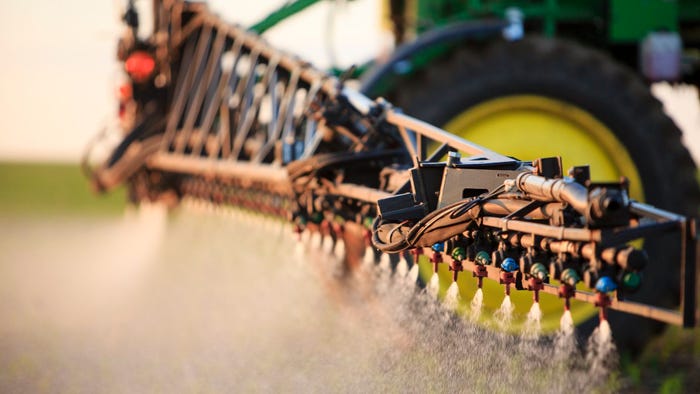
U.S. producers must consider several things regarding fungicide applications. Blaine insists that regular fungicide use will pay dividends.

“I know, as you move towards the Midwest, there are a lot of differing opinions. I question some of that. As you talk to individuals, there hasn’t been as much fungicide work done in the Midwest because they haven’t had the disease pressure of the South…Our information shows that without ASR being present, the strobilurins — because of the broad spectrum — will make more money when properly applied…

“It isn’t just Mississippi. Neighboring states also have data that supports the same conclusions. We must look at whole-crop management.

“The maturity of the crop will play a big role. If we get to that R-3 to R-5 window and ASR shows up, perhaps we can get by with one application. If we have to make applications earlier than that, it may require two sprays.”

Don’t forget

Last year, some growers in Mississippi were so consumed with ASR they forgot other crop diseases. There were “a lot of situations” where producers didn’t make needed spray applications.

“Yes, ASR will be a new input for us but it isn’t the only thing to worry about… Here in the deep South, we have a lot of other diseases. There’s a couple that make ASR look like a puppy dog. We must stay focused on the big picture.

“I saw a field last year (in the Southeast) where the fungicide did a wonderful job controlling ASR. But they didn’t pay attention to stink bugs that decimated the crop.”

Environmental conditions will be a key determinate in whether an ASR problem develops in the Mid-South.

“I think there’s currently a relatively low innoculum potential. We had the same last year.”

In Mississippi, although it’s very dry, the crop is extremely early.

“It’s shorter than we’d like. We haven’t begun making fungicide applications yet because we’re trying to get more vegetative growth on the crop. We just want to make the one application. That may not be the case every year. But if conditions are dry, it isn’t conducive for any disease — even ASR.”

Strobilurins versus triazoles

As for the best fungicides to deal with ASR, Argentine producers differed with Blaine.

“They’d tried the strobilurins the previous year and didn’t get the control they wanted. That likely meant ASR was in the field and they didn’t get the curative action after applying those chemistries.”

This year, many of the growers Blaine met were using triazoles.

“The thing that impressed me was the excellent control they were getting. We saw rust that was shut down.”

U.S. researchers have done a lot of work with fungicides over the last 20 years.

“But we’ve really (picked up the pace) since 1998 when we first got a Section 18 for Quadris. The reason we pursued that Section 18 was because we had aerial blight — the same thing as sheath blight in rice. We had nothing to control it.”

Since 1998, in research plots and on-farm trials (138 side-by-side comparisons of mostly Quadris-based programs), Blaine and colleagues have documented a 5.9-bushel yield increase.

“That encompassed an eight-year period and many maturity groups of 4s and 5s, a lot of crop rotations — behind cotton, behind rice, behind corn, beans following beans, irrigated versus non-irrigated.

“What you’ve got to keep in mind…is this (data was gathered) pre-ASR. The spectrum of disease in the Deep South is such that we can get a response from fungicides year-in and year-out without ASR being present…Personally, I believe a well-timed application from the R-3 window on is the next production input that takes our yield levels to a new plateau in the South.”

e-mail: dbennett@farmpress.com

Get Copyright ClearanceWant to use this article? Click here for options!
© 2010 Penton Media, Inc.


Latest Jobs

Read More Daily News

NCC: 10.1 million cotton acres

Feb 8, 2010 10:30 AM

After three straight years of declines, U.S. cotton acreage could be headed back up, according to the National Cotton Council’s 27th annual Early Season Planting Intentions Survey....

Weed resistance, Washington headline Farm & Gin Show

Feb 8, 2010 10:24 AM

This year’s Mid-South Farm and Gin Show offers “perhaps the best set of exhibits ever,” says Tim Price, manager of the annual event to be held Feb. 26-27 at the downtown Memphis Cook Convention Center....

Darneille elected CCI president

Feb 8, 2010 10:22 AM

Wallace L. (Wally) Darneille, a Lubbock, Texas, cooperative official, will serve as 2010 president of Cotton Council International, the National Cotton Council’s export promotions arm....

Rice ‘growth industry’ — Weisemeyer

Feb 8, 2010 10:10 AM

Farmers attending the 2010 joint annual meeting of the Louisiana Rice Council and the Louisiana Rice Growers Association heard an optimistic report from a Washington, D.C., agriculture journalist recently....

U.S. cotton acres: 10.1 million

Feb 5, 2010 5:06 PM

U.S. cotton producers are expected to plant more than 10 million acres for the first time in three years as they begin making preparations for the 2010 planting season....

Delta Farm Press News
Southeast Farm Press News

Southwest Farm Press News

Western Farm Press News

resources

events icon events

product info icon tradeshows

tradeshow icon digests

research icon photos

Continuing Education


(New Course)
Weed Resistance Management in Cotton

This course covers a wide range of options to effectively control weeds in cotton and reduce the risk of weed resistance management. It is accredited for hours/units for licensed/accredited applicators in 7 U.S. Cotton Belt states (Florida, Georgia, New Mexico, Oklahoma, Texas, South Carolina an d Tennessee. CCA credit is pending).

This course is accredited in Texas, Oklahoma, New Mexico, Virginia, West Virginia and Wyoming as well as for CCA credits:

(New Course)
Spray Drift Management

Keeping crop protection chemicals on the crop for which they are intended has been a cornerstone of farming not only to protect neighboring crops, but to not waste money allowing products to drift off the intended target. This accredited online continuing education course covers the critical elements of spray drift management.

Back to Top

Browse Print Issues

Additional Resources

subscribe to Farm Press Daily Southeast Farm Press Southwest Farm Press Western Farm Press