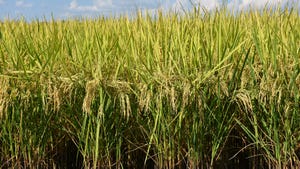
Louisiana Clearfield lawsuit points to stewardship requirements

Apr 25, 2006 9:41 AM, By David Bennett

Farmers are growing crops in a world where new rules apply. The latest evidence comes from south Louisiana, where an interesting lawsuit has been filed by BASF against a father and son for growing Clearfield rice illegally. LSU has even become a party in the fray.

By filing the suit, BASF obviously wants to protect its intellectual property rights through the Plant Variety Protection Act (PVPA), but those familiar with the suit insist an even more important aspect of the case is simply to protect the vibrancy of Clearfield varieties. Farmers combating red rice need the technology.

A trial date is set for November. In the meantime, under judge’s orders, some 40,000 bushels of Clearfield rice have been confiscated from the defendants.

Fighting red rice

For many Delta rice producers, Clearfield was a godsend. Red rice is a problem around the rice-producing world. A relative of cultivated rice, red rice can lower yields and reduce the worth of a harvested crop.

Much of the Delta’s rice — and most of Louisiana’s — has a red rice problem. Since it’s a close relative of cultivated rice, red rice is notoriously difficult to control. Most herbicides aren’t an option, because they can injure or kill both the unwanted red rice and the money-making crop. As a result, control options stagnated. In some desperate situations, farmers even sent crews out to hand-pick the weed.

And then, in the late 1990s, Clearfield technology came on the scene. After rigorous testing at LSU’s Crowley Rice Research Station, a rice was developed that could handle a herbicide while killing red rice. Since then, Clearfield varieties have improved yield potential and been widely adopted.

But the genetics of red rice and the Clearfield varieties remain incredibly close. That means out-crossing is a constant threat and vigilant oversight is needed.

“The LSU AgCenter position is that the Clearfield technology is one of the most important breakthroughs in rice research in many years,” says Steve Linscombe, a rice breeder at the Crowley, La., station involved with Clearfield innovations. “One of the potential issues with it is the fact that rice and red rice are so closely related. That means there’s potential to move the Clearfield resistance gene into a weed, a red rice plant.

“The most important way to prevent this from occurring is to always use certified, red-rice free seed. One of the biggest ways to cause the technology problems is to use saved seed. For that reason, LSU strongly supports the idea that you can’t save Clearfield seed.”

“The overwhelming (majority) of growers completely understand the reasons for the stewardship guidelines,” says Jason Ward, BASF marketing manager for Clearfield crops. “They protect the technology allowing growers to produce rice where red rice infestations have been so heavy. Everyone understands that one of the quickest ways to lose this technology is through the saving of seed.”

Even the defendants’ attorney, Baton Rouge-based Barbara Grodner, cites the risks. If red rice and Clearfield varieties cross-pollinate, “we’ll end up with a whole bunch of red rice that’s resistant to…Newpath. There’s nothing being done to prevent the red rice from cross-pollinating with the Clearfield. That will produce a Newpath-resistant red rice.”

For the defense

Characteristic of most lawsuits, there are points of dispute. Grodner says her clients had no intention of running afoul of BASF. She also says the lawsuit is fraught with legal loopholes, certificate problems and improper document filings. But she admits her clients bypassed the usual steps taken by producers prior to planting Clearfield varieties.

“In 2003, the son bought Clearfield 161 (CL161) from another farmer who had too much of the seed,” says the Baton Rouge-based attorney. “It was late in May and (my client) couldn’t find any seed. So he called his farming friend and asked if he had extra. His friend said, ‘Yeah, I’ve got some.’ So he paid the friend for the seed and planted it.”

By doing this, the farmer never signed a stewardship grower agreement. Under the Plant Variety Protection Act, producers “can replant seed grown from your product. That’s why the stewardship grower agreement is needed to override the Plant Variety Protection Act and stop farmers from re-planting seed from your crop.

“(The son) never signed that agreement and, two years later, he was planting seed he’d grown from seed he bought legally.”

The father, meanwhile, “had bought some Clearfield seed from a dealer but didn’t feel he had enough. He took some of his son’s seed out of the bin and planted it. He didn’t sign a stewardship grower agreement either.”

The partnership

As the original developer and patent holder on Clearfield technology (licensed to American Cyanamid before that company was bought out by BASF), LSU was inevitably drawn into the case.

Why BASF? Because in order for the technology to work, there had to be a herbicide to use. Since LSU didn’t own a suitable herbicide and didn’t have the financial wherewithal to register one, the institution had to look outside. Several sources say the only way Clearfield technology could find its way to farmers was for LSU to partner with someone.

In this case, it was logical to work with BASF because the company had a herbicide (Newpath) that allowed the system to function.

LSU owns the Plant Variety Protection certificates being asserted in the lawsuit. “The rights of those certificates have been licensed to BASF as part of an overall licensing program between LSU and BASF regarding Clearfield rice technology,” says Neil Arney, a BASF attorney with Lathrop & Gage. “This is an issue of patent and Plant Variety Protection law — that the owner of the patent typically has to be made a party. There are some exceptions to that. But rather than litigate those exceptions, we elected to have LSU participate since they’re the owner of the certificates.”

BASF representatives are tight-lipped regarding surveillance methods and how they found the offending rice.

“It’s BASF’s normal practice to monitor its growers and retailers to ensure they’re abiding by the stewardship program they all agree to,” says Arney. “Through that process it came to light that the (defendants) had — or we believe they had — saved (Clearfield) seed from prior years and planted it. That was in violation of the stewardship program as well as the intellectual property rights held by BASF.”

Increasing market share

As a Clearfield Orygen producer, processor and retailer in south Louisiana, Michael Hensgens says it’s absolutely critical for the longevity of Clearfield technology to have stewardship requirements followed by all.

“Look, anytime there’s an economic challenge in an industry, it increases the likelihood someone will try to save money to the detriment of others,” says Hensgens, the vice president and business manager of G&H Seed Company in Crowley, La. “The financial incentive is obvious. But the risk isn’t worth it. The vast majority of growers — 99-plus percent — support the technology and stewardship guidelines.

“The search for a red rice solution has been going on for a century. Now we have it and must hold onto it. The risk of out-crossing could cost farmers this great technology. I’m not singling out anyone — whoever’s doing anything illegal with Clearfield varieties must stop. My customer base wants this technology. All producer comments I’ve heard are in support of prosecuting anyone who’s abusing it.”

Clearfield acres continue to increase in Louisiana. In 2005, Hensgens’ seed sales — which track closely with the state averages — showed Clearfield had a 30 percent market share. In 2004, Clearfield had a 22 percent market share. That’s a big bump up and I don’t see that changing.”

Louisiana is about 60 percent planted, currently. Clearfield 131 looks to have at least 50 percent of the Clearfield variety market share.

“We’re expecting a 35 percent reduction in rice planted acres in the state. Saltwater in surface irrigation systems, salt on the soils left by the Hurricane Rita storm surge and high energy costs with low net returns are the causes of that drop. Even so, the Clearfield market share will likely rise to around 40 percent.”

Back to the case

The court has granted BASF a preliminary injunction.

“Subsequent to that, the court granted possession of the infringing rice to BASF,” says Arney. “That (rice) is being held by BASF subject to the court’s orders. In terms of what we’re going to do with the rice, we’ll hold it until the court orders us to do something different.”

Asked about any settlement talks, Arney says, “if it’s necessary for us to proceed with this litigation, we will. I’m not at liberty to discuss any settlement discussions between BASF and the (defendants).”

Grodner says settlement overtures have been made, but BASF’s “responses have been way out of the ballpark.”

e-mail: dbennett@farmpress.com

Get Copyright ClearanceWant to use this article? Click here for options!
© 2009 Penton Media, Inc.


Latest Jobs

Read More Daily News

Arkansas loss near quarter billion dollars

Nov 6, 2009 2:56 PM

A wetter-than-normal growing season has cut into Arkansas’ farm receipts by more than $224.8 million as of Nov. 1, according to a preliminary report issued by the University of Arkansas Division of Agriculture....

Cotton: a lot on the ground

Nov 6, 2009 11:13 AM

Cotton losses due to record rainfall during September and October in Mississippi totaled $71 million by early November, or nearly half the value of the expected crop, according to the Mississippi Department of Agriculture and Commerce....

Rep. Cassidy: rethink conservation efforts

Nov 6, 2009 11:02 AM

The only Louisianan on the House Agriculture Committee, Rep. Bill Cassidy tries to keep his state’s agricultural interests at the forefront....

Residuals in LibertyLink program

Nov 6, 2009 10:57 AM

Before continuing with my pigweed control articles, I have tried to think of something encouraging to say about trying to get a crop out with the weather we are having. ...

Letter: Mule-headed bunch of farmers

Nov 6, 2009 10:54 AM

I was greatly disappointed in Morgan Freeman’s recent comments referring to the base stock of this state as a mule-headed bunch of farmers (see Behind the curtain: ‘mule-headed farmers’?). ...

Delta Farm Press News

Southeast Farm Press News
Southwest Farm Press News

Western Farm Press News
resources

events icon events

product info icon tradeshows

tradeshow icon digests

research icon photos

Continuing Education


(New Course)
Weed Resistance Management in Cotton

This course covers a wide range of options to effectively control weeds in cotton and reduce the risk of weed resistance management. It is accredited for hours/units for licensed/accredited applicators in 7 U.S. Cotton Belt states (Florida, Georgia, New Mexico, Oklahoma, Texas, South Carolina an d Tennessee. CCA credit is pending).

This course is accredited in Texas, Oklahoma, New Mexico, Virginia, West Virginia and Wyoming as well as for CCA credits:

(New Course)
Spray Drift Management

Keeping crop protection chemicals on the crop for which they are intended has been a cornerstone of farming not only to protect neighboring crops, but to not waste money allowing products to drift off the intended target. This accredited online continuing education course covers the critical elements of spray drift management.

Back to Top

Continuing Education


(New Course)
Weed Resistance Management in Cotton

This course covers a wide range of options to effectively control weeds in cotton and reduce the risk of weed resistance management. It is accredited for hours/units for licensed/accredited applicators in 7 U.S. Cotton Belt states (Florida, Georgia, New Mexico, Oklahoma, Texas, South Carolina an d Tennessee. CCA credit is pending).

This course is accredited in Texas, Oklahoma, New Mexico, Virginia, West Virginia and Wyoming as well as for CCA credits:

(New Course)
Spray Drift Management

Keeping crop protection chemicals on the crop for which they are intended has been a cornerstone of farming not only to protect neighboring crops, but to not waste money allowing products to drift off the intended target. This accredited online continuing education course covers the critical elements of spray drift management.

Browse Print Issues

Additional Resources

subscribe to Farm Press Daily Southeast Farm Press Southwest Farm Press Western Farm Press