U.S. farmers say they’ll plant more soybeans and cotton

Apr 10, 2006 5:28 PM, By Elton Robinson

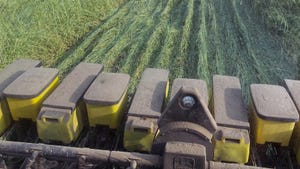
U.S. cotton producers intend to plant 14.6 million acres to the crop in 2005, up 3 percent from last year’s 14.2 million acres, according to USDA’s March 31 Prospective Plantings report. Plantings include 14.3 million acres of upland, also up 3 percent.

Growers intend to increase acreage in all cotton-producing states except Alabama and South Carolina, where expected acreage is down slightly from 2005. American-Pima cotton growers intend to increase their plantings 24 percent from 2005, to a record high 334,000 acres. California producers expect to plant 290,000 acres, up 26 percent from last year.

Soybean producers intend to plant 76.9 million acres in 2006, up 7 percent from last year. If realized, this will be the largest planted area on record. Acreage increases are expected in all growing areas, except in the central and southern Atlantic Coast states and the southern Great Plains. The largest acreage increase is in North Dakota, where record high soybean yields last year and high input costs have some farmers shifting acreage from other crops to soybeans. Large increases in soybean acreage are also expected across the Corn Belt, including 600,000 more acres in Illinois and 500,000 more acres in Indiana.

Corn growers intend to plant 78 million acres of corn in 2006, down 5 percent from 2005 and 4 percent below 2004. If realized, this will be the lowest corn acreage since 2001 when 75.7 million acres were planted. Expected acreage is down from last year in most states as producers intend to switch to other less input intensive crops due to high fertilizer and fuel costs. Dry conditions also contributed to lower corn planting intentions in the southern Great Plains.

All wheat planted area is expected to total 57.1 million acres, down slightly from 2005. If realized, this will be the lowest wheat acreage since 1972. Winter wheat planted area for the 2006 crop is 41.4 million acres, up 2 percent from last year. Of the total, about 29.8 million acres are hard red winter, 7.42 million acres are soft red winter, and 4.22 million acres are white winter.

USDA also projected 2006 rice plantings at 2.972 million acres, a 12 percent decline from last year’s 3.38 million acres. Acreage declined in all states except California.

e-mail: erobinson@farmpress.com

Get Copyright ClearanceWant to use this article? Click here for options!
© 2010 Penton Media, Inc.


Latest Jobs

Read More Daily News

Reduced-till and cotton seedling diseases

Feb 9, 2010 9:43 AM

Managing no-till or reduced-till cotton production properly, including following appropriate planting recommendations and taking care of early weed problems, may reduce potential for disease outbreaks....

Chicken litter — ‘smell of success’

Feb 9, 2010 9:33 AM

Having used poultry litter on his family’s Jonesboro, Ark.-area farm for years, Wayne Wiggins III is a proponent of the practice. ...

NCC: 10.1 million cotton acres

Feb 8, 2010 10:30 AM

After three straight years of declines, U.S. cotton acreage could be headed back up, according to the National Cotton Council’s 27th annual Early Season Planting Intentions Survey....

Weed resistance, Washington headline Farm & Gin Show

Feb 8, 2010 10:24 AM

This year’s Mid-South Farm and Gin Show offers “perhaps the best set of exhibits ever,” says Tim Price, manager of the annual event to be held Feb. 26-27 at the downtown Memphis Cook Convention Center....

Darneille elected CCI president

Feb 8, 2010 10:22 AM

Wallace L. (Wally) Darneille, a Lubbock, Texas, cooperative official, will serve as 2010 president of Cotton Council International, the National Cotton Council’s export promotions arm....

Delta Farm Press News
Southeast Farm Press News

Southwest Farm Press News

Western Farm Press News

resources

events icon events

product info icon tradeshows

tradeshow icon digests

research icon photos

Continuing Education


(New Course)
Weed Resistance Management in Cotton

This course covers a wide range of options to effectively control weeds in cotton and reduce the risk of weed resistance management. It is accredited for hours/units for licensed/accredited applicators in 7 U.S. Cotton Belt states (Florida, Georgia, New Mexico, Oklahoma, Texas, South Carolina an d Tennessee. CCA credit is pending).

This course is accredited in Texas, Oklahoma, New Mexico, Virginia, West Virginia and Wyoming as well as for CCA credits:

(New Course)
Spray Drift Management

Keeping crop protection chemicals on the crop for which they are intended has been a cornerstone of farming not only to protect neighboring crops, but to not waste money allowing products to drift off the intended target. This accredited online continuing education course covers the critical elements of spray drift management.

Back to Top

Browse Print Issues

Additional Resources

subscribe to Farm Press Daily Southeast Farm Press Southwest Farm Press Western Farm Press