Twin-row beans marries wide-row and narrow row

Mar 10, 2006 9:55 AM, By Elton Robinson

TUNICA, Miss. -- Twin-row soybeans can provide the same yield advantage as 30-inch soybeans without significant changes to wide-row equipment, according Trey Koger, agronomist at the USDA/ARS, Stoneville, Miss.

“We can plant the twin-row pattern on an 80-inch bed or a 40-inch bed, giving us a narrow-row spacing of somewhere around 30 inches, and we can still use our existing production system set up on 38- or 40-inch beds. The twin-row system is a narrow-row spacing in a wide-row system,” Koger said.

Koger spoke about his research on twin-row soybeans versus wide-row soybeans during the Conservation Systems Cotton and Rice Conference, in Tunica, Miss.

Two varieties were selected for the study, both early-season Group 4 varieties. One was short stature and bushy, Asgrow 4201. The other was a tall, slender upright, Asgrow 4403.

For the single-row, 40-inch system, researchers planted 8, 10 and 12 seeds per foot of row. In the twin-row pattern, they planted at 4, 5 and 6 seeds per foot of row. “We did that to compare the twin-row system with the single-row system at the same seeding rates.”

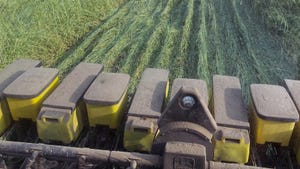
The experiment was planted on a heavy clay soil at the experiment station. Beds were 80 inches wide and accommodated two, twin-row plantings or two single-row plantings. They sprayed the entire study with a strobilurin fungicide at R-3 to R-4. The twin-row study was planted with a Great Plains twin-row drill. The single-row study was planted with a John Deere vacuum planter.

“We did not see any plant population differences between the twin-row system and the single-row system. This told us that the twin-row drill did just as good a job as the planter in getting a stand. This also meant that since there was no difference in plant population, we could compare the yield.”

Yield data across all three plant populations indicated the twin-row pattern out-yielded the single wide-row pattern by 8 percent, or 7 bushels.

“The twin-row pattern yielded more, but there was not a seeding rate response. This is good information because there is some data out there that suggests that you increase your seeding rate by 20 percent with a twin-row pattern.”

Twin-row plants canopied about 10 days earlier than single-row plants, according to Koger. “That might save you a herbicide application, but more importantly, we intercepted more light in the twin-row system. The increased light interception allowed the plants in the twin-row system to produce five more pods per plant.

“That doesn’t sound like a lot, but if you extrapolate that out on an acre basis, it’s about a half-million more pods per acre. That’s what’s accounting for the increased yield.”

Early findings also indicate the twin-row system won’t out-yield a 30-inch system if drainage is the same across both systems. “But we’re going to conduct some more research on that this coming season.”

Studies by USDA/ARS in Stoneville, Miss., indicate that as row spacing increases above 30-inches, soybean yields tend to go down. Conversely, yields trend higher as you move from a wide row to a 30-inch spacing. However, studies indicate that you don’t gain appreciable yield by going narrower than 30 inches.

e-mail: erobinson@prismb2b.com

Get Copyright ClearanceWant to use this article? Click here for options!
© 2010 Penton Media, Inc.


Latest Jobs

Read More Daily News

Tillage tests — ‘trash farm for profit’

Feb 9, 2010 9:47 AM

As he speaks, Merle Anders has a small prop on the table behind him: a baseball cap inscribed with “Trash Farming for Profit.” ...

Reduced-till and cotton seedling diseases

Feb 9, 2010 9:43 AM

Managing no-till or reduced-till cotton production properly, including following appropriate planting recommendations and taking care of early weed problems, may reduce potential for disease outbreaks....

Chicken litter — ‘smell of success’

Feb 9, 2010 9:33 AM

Having used poultry litter on his family’s Jonesboro, Ark.-area farm for years, Wayne Wiggins III is a proponent of the practice. ...

NCC: 10.1 million cotton acres

Feb 8, 2010 10:30 AM

After three straight years of declines, U.S. cotton acreage could be headed back up, according to the National Cotton Council’s 27th annual Early Season Planting Intentions Survey....

Weed resistance, Washington headline Farm & Gin Show

Feb 8, 2010 10:24 AM

This year’s Mid-South Farm and Gin Show offers “perhaps the best set of exhibits ever,” says Tim Price, manager of the annual event to be held Feb. 26-27 at the downtown Memphis Cook Convention Center....

Delta Farm Press News
Southeast Farm Press News
Southwest Farm Press News

Western Farm Press News
resources

events icon events

product info icon tradeshows

tradeshow icon digests

research icon photos

Continuing Education


(New Course)
Weed Resistance Management in Cotton

This course covers a wide range of options to effectively control weeds in cotton and reduce the risk of weed resistance management. It is accredited for hours/units for licensed/accredited applicators in 7 U.S. Cotton Belt states (Florida, Georgia, New Mexico, Oklahoma, Texas, South Carolina an d Tennessee. CCA credit is pending).

This course is accredited in Texas, Oklahoma, New Mexico, Virginia, West Virginia and Wyoming as well as for CCA credits:

(New Course)
Spray Drift Management

Keeping crop protection chemicals on the crop for which they are intended has been a cornerstone of farming not only to protect neighboring crops, but to not waste money allowing products to drift off the intended target. This accredited online continuing education course covers the critical elements of spray drift management.

Back to Top

Browse Print Issues

Additional Resources

subscribe to Farm Press Daily Southeast Farm Press Southwest Farm Press Western Farm Press