Pushing the variable-rate envelope

Mar 8, 2006 9:09 AM, By David Bennett

Last year, when Delta Farm Press first visited Kin-Co Ag Aviation in Light, Ark., it was mid-May and some extraordinary research had begun. A large team comprised of pilots, company technical staff, a professor and his graduate students was working with variable-rate dry fertilizer applications in rice, a first. The project had the attention of truly smart people from different disciplines. The work linking up application systems, computers, infra-red cameras, imaging software, prescriptions and the ability to apply chemicals precisely promised future advances as well (see Crew worksVR dry applications.)
In mid-February, DFP paid Kin-Co a return visit to see what’s planned for 2006.

LIGHT, Ark. -- As it’s the off-season, Kin-Co Ag Aviation’s large, clean hanger is jammed full of planes, spare parts and tool lockers. A helicopter, parked just outside the operation’s office door, will be joined by another any day now. One gets the sense things are about to start hopping.

The crew is impatient to unwrap the coming growing season, to see what challenges it offers. The months since last harvest have been used to prep and outfit two more planes with variable-rate equipment. Having spent 2005 on technology’s cutting edge, they’re ready to return.

“If it sounds like we’re a little impatient, we are,” says Casey Couch, a pilot and partner at Kin-Co. “We’re just waiting for the weather to clear up so we can test this equipment and get going. We want to see what we’re capable of.”

Camera trouble

When it began last spring, Kin-Co’s variable-rate work was focused on dry applications and variable rate work in rice fields. To make it work, an Auto Cal (used to control the flow of dry material) was married to a Del Norte computer.

“We worked very, very hard to make sure the equipment was accurate,” says Bill Baker, a professor at Arkansas State University in Jonesboro, Ark. “That was a problem in the past. We put it out variable rate, but the field wasn’t getting the rates claimed. The (operating systems available didn’t allow) rates to change quickly enough — there was too much lag.”

Last year, Baker and his graduate students made the 20-minute drive from Jonesboro to Light often. The opportunity to work with aircraft equipped to handle variable-rate applications was a godsend for the longtime precision ag researcher. And once the project got rolling, it rarely paused.

“Even when things weren’t working out early on, we weren’t sitting around,” says Baker. “We were scrambling.”

An example of this was when one of the cameras — mounted on a plane to produce scrip imagery — went bad. TerraVerde, a precision ag company out of Stillwater, Okla., came to the rescue.

“One thing we’ve found: hard-drives and planes don’t mix,” says Baker. “TerraVerde hooked us up with one of the last cameras available. We traveled to Stillwater, picked up the camera and turned around and came back. Then, the TerraVerde guys drove all night to get here and help tweak the computer and guidance system. They were a tremendous help. “

The Kin-Co team rues the missed days of data-gathering, though. “If we’d had our camera problems solved just a bit earlier, we’d have had twice as many farmers and fields to work with,” says Joey Massey, a Kin-Co pilot. “As it was, there were at least 30 fields and 20 farmers involved.”

Like wildfire

Rice doesn’t have the large applications window cotton does. “Between weather, clouds and computer problems, we lost tons of data,” says Baker. “We all agreed at the outset of 2005 that it would be a research year. But without the camera (snafu), Harvey (Songer, Kin-Co owner/operator) could have kept two planes busy all day for at least another two weeks.”

After the early slow-down, the project “took off like wildfire,” says Harvey Songer, Kin-Co owner/operator. “People saw what we were doing and wanted to be a part.”

“Usually, you have to twist arms, but not with this,” adds Baker. “It caught on overnight. This is a friendly place and farmers are in and out of here all the time. They’d see us tinkering in the back and ask what we were doing.”

Having seen the imagery and fieldwork, producers showed persistent interest.

“We also kept a spreadsheet going. If an image was made along with a prescription, we’d add it. Producers would check that regularly. When they were comfortable with a variable-rate approach, they’d give it a shot. And once it worked, they’d want to do more.

“We almost had more than we could handle. In order to process everything properly, we didn’t sleep some nights. The windows with rice are very short, so we burned the midnight oil in order to get the systems figured out.”

Fungicides

Those long nights contributed to the ability of Kin-Co’s planes to apply variable-rate fungicides to rice and soybeans. Baker produces three tables showing the costs associated with the applications. Variable rate flying was set at $1.50 per acre and $2 per acre for the image (although no one was actually charged for the images).

“We’re trying to paint as true a picture as possible. In some fields, it wouldn’t have paid to use variable rate.”

In the tables (Stratego on 12 rice fields, Quadris on six rice fields, and Quadris on 11 soybean fields), only three fields (all sprayed with Stratego) didn’t show savings from variable-rate application. Even so, the Stratego fields had an average savings of $1.49 per acre. The Quadris-on-rice fields showed even more significant results with an average savings of $10.37 per acre. Savings in the soybeans sprayed with Quadris averaged $3.43 per acre.

“What I’m proudest of is the farmer, the scout — or both, in most instances — checked the field prior to spraying and then sat down with us and made the recommendations,” says Baker. “We took it from there. With the rice fields, we were trying to deal with sheath blight. Folks believe you can see sheath blight with an image. But what you’re actually seeing is bio-mass — the differences between thick and thin rice.”

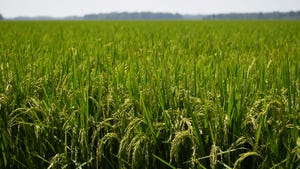
In the field, sure enough, much of the thicker rice was infested with a heavier infestation of sheath blight. The thinner rice, perhaps due to cold water, didn’t have sheath blight.

“So that’s where we saw the opportunity to make this work,” says Couch. “And it paid off. We didn’t waste chemical and kept the fields clean. And not only were the farmers and consultants involved, but the fields ended up with pretty good yields. I’m not making any claims about yields, but we don’t believe we hurt anyone and still saved money. The milling quality was good, too, so we feel good about the fungicide work.”

As for the soybeans, while flying over soybean fields, Kin-Co pilots would often spot large craters “likely due to a lack of rain,” says Baker. “The fields came up very patchy, even contract-seed fields.”

Contract-seed producers are required to put out a prophylactic fungicide. Realizing this, the Kin-Co crew figured it was time to push the boundary again. When seed companies allowed variable rate work, the $3.43 per acre savings were realized.

“We had Rick Cartwright (Arkansas Extension plant pathologist) check behind us,” says Baker. “I wanted to be sure about what we were doing. I’m all about remote sensing. So when it comes to plant diseases we needed an expert to come in. It turned out the variable-rate fungicides worked especially well on varieties that were more susceptible.”

A bevy of ideas

A keen desire to provide farmers with variable rate nitrogen has followed Kin-Co from last year to this.

“Last year, we imaged fields and picked out lighter and darker areas,” says Baker. “The planes would then make a mid-season variable nitrogen application. It evened those areas up. I’m not claiming variable rate nitrogen saved money. However, with the cost of urea skyrocketing, that’s what this summer’s focus will be.”

Another new project involves chemical-injection rigs on the airplanes.

“We’re only now developing it and can’t make claims yet,” says Songer. “But we have certified the droplet spectrum and, as far as we can tell, it’s ready for a test flight. Weather is all that’s holding us back. As soon as it clears, we’ll give it a go.”

Dennis Gardisser, Arkansas Extension engineer, “is bringing up testing equipment used to pattern planes. He’s going to show us how to use it. When the weather gets right, that’ll allow us to see what kind of work pattern it’s producing. We’ll be able to adjust and calibrate it from there.”

The injection rigs will allow the planes, in one pass, to apply two chemicals not labeled for a tank-mix.

“As long as the chemicals are labeled for the crop, we can get them out in one pass,” says Massey. “That means we’ll be able to put out two chemicals at two different rates. One will go out at variable rate through the system we’ve already been using. The second chemical will go out at a constant rate with the second tank. A good example would be a constant rate of a quart of Roundup with a variable rate of Command.”

Couch recalls incidents last season when the new setup would have paid dividends. “Some producers wanted to variable-rate Quadris but also needed Tilt across the whole field. This year, we’ll be able to take care of that in one pass. That will at least save (our clients) plane costs.”

Nutsedge, which typically comes up in patches in rice crops, will also be a target.

“We think we’ll be able to pick nutsedge up well with the camera,” says Couch. “If so, we can take the imagery, go across the field and when we reach a patch of nutsedge, apply a full rate.”

Variable-rate seeding is also a possibility. Last December, the crew tried a practice run with wheat seed. “We didn’t worry about a stand or anything — we just wanted to test the concept and see if it would work,” said Couch.

“It was so cold when we tried that,” recalls Baker. “My hands were blocks of ice and I was out there trying to reprogram the computer. This equipment can work on water-seeding and the wheat test was prep for rice this spring.”

Couch expresses interest in seeing if variable rate can help control red rice. “Can it work in Clearfield varieties with Beyond after the crop is past Newpath applications? Why not check? There’s a lot of red rice around here. Beyond is expensive — $26 an acre. I think producers would be open to variable rate if we can make it work.”

Feeding frenzy

Last season was “incredibly rewarding,” says Baker. “I almost have to curb my enthusiasm, but it was exciting to see people be so interested and accepting of this new technology. Once the scouts checked the fields after the variable rate work, they were positive and that meant producers were too.

“Thank God for Kin-Co. These guys are a cutting-edge team — they’re pushing the boundaries and figuring things out that will benefit everyone.”

And the possibilities just keep coming. Do members of the Kin-Co team feed off each other’s ideas?

“You bet,” laughs Couch. “It’s a feeding frenzy around here.”

e-mail: dbennett@prismb2b.com

Get Copyright ClearanceWant to use this article? Click here for options!
© 2009 Penton Media, Inc.


Latest Jobs

Read More Daily News

Arkansas loss near quarter billion dollars

Nov 6, 2009 2:56 PM

A wetter-than-normal growing season has cut into Arkansas’ farm receipts by more than $224.8 million as of Nov. 1, according to a preliminary report issued by the University of Arkansas Division of Agriculture....

Cotton: a lot on the ground

Nov 6, 2009 11:13 AM

Cotton losses due to record rainfall during September and October in Mississippi totaled $71 million by early November, or nearly half the value of the expected crop, according to the Mississippi Department of Agriculture and Commerce....

Rep. Cassidy: rethink conservation efforts

Nov 6, 2009 11:02 AM

The only Louisianan on the House Agriculture Committee, Rep. Bill Cassidy tries to keep his state’s agricultural interests at the forefront....

Residuals in LibertyLink program

Nov 6, 2009 10:57 AM

Before continuing with my pigweed control articles, I have tried to think of something encouraging to say about trying to get a crop out with the weather we are having. ...

Letter: Mule-headed bunch of farmers

Nov 6, 2009 10:54 AM

I was greatly disappointed in Morgan Freeman’s recent comments referring to the base stock of this state as a mule-headed bunch of farmers (see Behind the curtain: ‘mule-headed farmers’?). ...

Delta Farm Press News
Southeast Farm Press News
Southwest Farm Press News

Western Farm Press News
resources

events icon events

product info icon tradeshows

tradeshow icon digests

research icon photos

Continuing Education


(New Course)
Weed Resistance Management in Cotton

This course covers a wide range of options to effectively control weeds in cotton and reduce the risk of weed resistance management. It is accredited for hours/units for licensed/accredited applicators in 7 U.S. Cotton Belt states (Florida, Georgia, New Mexico, Oklahoma, Texas, South Carolina an d Tennessee. CCA credit is pending).

This course is accredited in Texas, Oklahoma, New Mexico, Virginia, West Virginia and Wyoming as well as for CCA credits:

(New Course)
Spray Drift Management

Keeping crop protection chemicals on the crop for which they are intended has been a cornerstone of farming not only to protect neighboring crops, but to not waste money allowing products to drift off the intended target. This accredited online continuing education course covers the critical elements of spray drift management.

Back to Top

Continuing Education


(New Course)
Weed Resistance Management in Cotton

This course covers a wide range of options to effectively control weeds in cotton and reduce the risk of weed resistance management. It is accredited for hours/units for licensed/accredited applicators in 7 U.S. Cotton Belt states (Florida, Georgia, New Mexico, Oklahoma, Texas, South Carolina an d Tennessee. CCA credit is pending).

This course is accredited in Texas, Oklahoma, New Mexico, Virginia, West Virginia and Wyoming as well as for CCA credits:

(New Course)
Spray Drift Management

Keeping crop protection chemicals on the crop for which they are intended has been a cornerstone of farming not only to protect neighboring crops, but to not waste money allowing products to drift off the intended target. This accredited online continuing education course covers the critical elements of spray drift management.

Browse Print Issues

Additional Resources

subscribe to Farm Press Daily Southeast Farm Press Southwest Farm Press Western Farm Press