Twin-row is the only way to go

Mar 8, 2006 9:11 AM, By Elton Robinson

VANDUSER, Mo. -- Missouri farmer John Engram wanted the higher efficiency and yield he could get with narrow rows, but he didn’t want to change his equipment spacing or lose irrigation efficiency due to difficulty of maintaining narrower beds. He found a way to accomplish both goals with twin-row planting.

ENGRAM

Engram, who farms cotton, corn and soybeans near Vanduser, decided to make a change in his row spacing in 1990. He didn’t like the yields he was getting in corn on 38-inch rows. “I saw where farmers were getting yield increases on 30-inch configurations, because they were increasing their plant populations and utilizing sunlight and all their inputs better.”

Instead of changing his equipment from 38s to 30s, Engram, a ridge tiller, came up with the idea for planting two rows on each 38-inch bed.

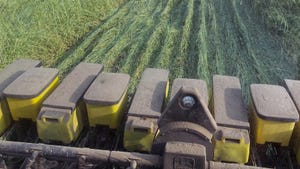
Engram modified his existing International planter, moving all his row units over 3.75 inches from the center. “I planted down then turned around and planted back, giving me two 7.5-inch rows, each with half the population.”

The system was so successful that Engram soon converted his soybean and cotton acres to the concept. He rotates all three crops on the same beds, which he keeps for a dozen or more years, “which eliminates a lot of my ground preparation costs.”

While the International planter did a good job for Engram, the configuration meant he had to cover the same ground twice. Engram later purchased a Monosem vacuum planter which gave him the ability to plant a 7.5-inch spacing in one pass.

Engram suggests that producers plant the two rows 7.5 inches apart directly in the middle of a bed that has been flattened by a roller. “You don’t want the plants falling off the bed on one side.”

To settle on a plant population add 10 percent to the plant population you feel comfortable with, then divide that by two. Engram chose the same population he used for planting single rows on 38-inch beds.

“If you’re planting 30,000 plants per acre in corn in a single-row, 38-inch configuration, an extra 10 percent gets you 3,000 more plants, or 33,000 plants. You divide by two to get 16,500 plants per acre for each twin row.

“What you’re looking for is more fruit. If you have 3,000 more ears of corn out there and each is just as big as the other 30,000 ears, you make more grain per acre. We’ve done a lot of studies since 1993 and we’re picking up about 19 bushels per acre on the twin-row versus the single-row. We’ve been picking up 12 to 15 extra bushels per acre on beans and have increased our cotton yields by about 10 percent, to about 1,320 pounds.”

Engram noted that cotton “will tend to grow shorter planted in twin rows. It wants to fruit up faster and it will stay compact. Be sure to pick a variety that will fruit high off the ground. And remember, if you apply too much plant growth regulator, the plants will be too short.”

Engram added that the twin-row soybeans achieve canopy quickly. “I don’t lose as much moisture to evaporation. Every time I irrigate, I have a pretty substantial cost. If I can save an irrigation by getting a good canopy on top, that will save me money.”

Engram was able to easily pick his twin-row cotton with a spindle cotton picker. “It picks fine as long as you don’t get wider than 7.5 inches. You start tagging cotton a little bit when you go wider and you start losing cotton yield.”

The twin-row planting system “has been very economical for us because of the yield increases,” Engram said. “I will never go back to single row.”

e-mail: erobinson@prismb2b.com

Get Copyright ClearanceWant to use this article? Click here for options!
© 2010 Penton Media, Inc.


Latest Jobs

Read More Daily News

NCC: 10.1 million cotton acres

Feb 8, 2010 10:30 AM

After three straight years of declines, U.S. cotton acreage could be headed back up, according to the National Cotton Council’s 27th annual Early Season Planting Intentions Survey....

Weed resistance, Washington headline Farm & Gin Show

Feb 8, 2010 10:24 AM

This year’s Mid-South Farm and Gin Show offers “perhaps the best set of exhibits ever,” says Tim Price, manager of the annual event to be held Feb. 26-27 at the downtown Memphis Cook Convention Center....

Darneille elected CCI president

Feb 8, 2010 10:22 AM

Wallace L. (Wally) Darneille, a Lubbock, Texas, cooperative official, will serve as 2010 president of Cotton Council International, the National Cotton Council’s export promotions arm....

Rice ‘growth industry’ — Weisemeyer

Feb 8, 2010 10:10 AM

Farmers attending the 2010 joint annual meeting of the Louisiana Rice Council and the Louisiana Rice Growers Association heard an optimistic report from a Washington, D.C., agriculture journalist recently....

U.S. cotton acres: 10.1 million

Feb 5, 2010 5:06 PM

U.S. cotton producers are expected to plant more than 10 million acres for the first time in three years as they begin making preparations for the 2010 planting season....

Delta Farm Press News
Southeast Farm Press News
Southwest Farm Press News

Western Farm Press News
resources

events icon events

product info icon tradeshows

tradeshow icon digests

research icon photos

Continuing Education


(New Course)
Weed Resistance Management in Cotton

This course covers a wide range of options to effectively control weeds in cotton and reduce the risk of weed resistance management. It is accredited for hours/units for licensed/accredited applicators in 7 U.S. Cotton Belt states (Florida, Georgia, New Mexico, Oklahoma, Texas, South Carolina an d Tennessee. CCA credit is pending).

This course is accredited in Texas, Oklahoma, New Mexico, Virginia, West Virginia and Wyoming as well as for CCA credits:

(New Course)
Spray Drift Management

Keeping crop protection chemicals on the crop for which they are intended has been a cornerstone of farming not only to protect neighboring crops, but to not waste money allowing products to drift off the intended target. This accredited online continuing education course covers the critical elements of spray drift management.

Back to Top

Browse Print Issues

Additional Resources

subscribe to Farm Press Daily Southeast Farm Press Southwest Farm Press Western Farm Press