Automated systems simplifying farm data

Mar 3, 2006 9:13 AM, By Hembree Brandon

ROBINSONVILLE, Miss. -- Agriculture is on the cusp of technology that can make really complex recordkeeping simple, says Ted Macy. “It’s a very exciting time” in terms of hardware and software that will automate generation, storage, and analyzing much of the data related to crop production, he said at the ninth annual National Conservation Systems Cotton and Rice Conference.

“Precision agriculture technology has become a given, an integral part of everyday farming operations.”

Macy, who’s president of MapShots, Inc., Cummings, Ga., says many of the hardware/software incompatibilities that have limited the use of such technology are now being resolved as the industry becomes more standardized.

By using computerized technology to track usage of resources in crop production — land, products applied, machines, people, fertilizer, grain bins, warehousing, ginning, etc. — a producer can document and analyze everything that occurs during the crop cycle.

“We’ve been doing yield monitoring for almost 15 years,” Macy said, “but it’s only within the last year that there has been a single piece of software able to read data from any manufacturer.

“One of the simplest forms of automated records is generated by sensors on harvesting equipment: grain flow, moisture, distance, width, etc. But now we have systems with the capability of monitoring and recording variable product applications from a planter.”

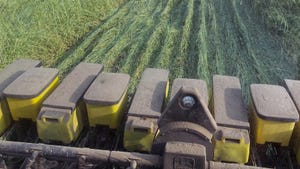
Spatially aware sensors can monitor the seeding rate on every planter hopper and calculate plant populations for each row, along with amounts of fertilizer applied.”

Radio frequency identification (RFID) tags on product containers, receivers on planters, and flow meters can all communicate via wireless “Bluetooth” devices, Macy said, and can capture data on everything that’s taking place with a planter or other machinery and record it for analysis.

All this is done automatically, Macy noted, eliminating the need for operator training. “The data can be captured without the operator even knowing which button to push.”

As improvements continue to be made in hardware and software, he said, the entire process will become even more user friendly.

“The most exciting thing we see in the industry, given the movement to auto-steer guidance systems, is the ability to automate the spray boom to avoid overlapping on rows.” This will not only cut chemical use, but will reduce crop damage and enhance environmental stewardship.

“Sensors on the spray boom can make a decision to turn the spray on or off, based on field maps generated as the equipment passes through the field. The system can detect which areas have already been sprayed and turn the nozzles off.”

Data generated can also be valuable in producing records for the Environmental Protection Agency, Macy said.

Equipment is now available, he noted, to automate data exchange between growers and cotton gins for monitoring the status of cotton harvest, without manual data entry.

Documentation is “much more complex” than for grain harvesting, he noted, and can capture data related to specific fields and allow modules from different fields to be combined while keeping separate records for each. The system tracks modules produced, picked up, ginned, classed, etc.

“It can automatically identify a module in the field, notify the gin that the module is available, notify the grower when the gin picks up the module, and provide notification to the grower when the module has been ginned and classed. And there’s potential for all this to be done wirelessly.”

By linking to a global positioning system (GPS), it can map every module’s location in the field and even generate directions to the truck driver for picking up the module. And it can generate status reports without any keyboard entries.

Alabama producer Larkin Martin, who grows cotton, corn, and soybeans, is using MapShot’s EASi Suite crop recordkeeping, mapping, and precision agriculture program to automate many data generation and analysis functions of her 6,000-acre farm, Macy said.

Mrs. Martin was unable to attend the conference, but Macy said she has been using the system for five years, during which time it has evolved from a grain-oriented recordkeeping program to a sophisticated, flexible software package for grain, cotton, and chemical/fertilizer applications.

“She can walk into her office each morning and immediately generate a status report of her entire cotton harvesting operation.”

The system, Macy said, can organize information related to various farming operations, coordinate it, and make it readily available for decision-making, variable rate application prescription writing, and other uses “never before possible.”

It provides her the ability to reconcile business records and agronomic records, to do share rent calculations and reports, to use data to create management zones, to use yield maps to manage soil fertility, and to create soil test sampling and liming zones.

While currently much of the information is manually entered into the system by farm staff, he said Mrs. Martin wants to move to additional automation as quickly as possible.

Even though farmers may not have a use for all the data that can now be generated by automated technology, Macy said, it is advisable to begin capturing it so it will be available as future needs develop.

And, he said, even though data generation and recordkeeping are becoming easier, “human knowledge is still a very valuable component in interpreting that information and using it for management advantage.”

e-mail: hbrandon@prismb2b.com.com

Get Copyright ClearanceWant to use this article? Click here for options!
© 2009 Penton Media, Inc.


Latest Jobs

Read More Daily News

WTO awards Brazil retaliation authority

Nov 20, 2009 11:01 AM

The World Trade Organization has authorized Brazil to seek retaliation against the United States for it support of two U.S. commodity programs....

Precision ag – online course

Nov 20, 2009 10:53 AM

University of Missouri Extension is offering an eight-week online course on managing farm machinery using precision agriculture, Jan. 12 through March 4....

Soybeans — U.S. key export supplier

Nov 20, 2009 10:48 AM

Weather problems are now thought to be factored into market prices. ...

$485 million loss – Mississippi

Nov 19, 2009 3:57 PM

Mississippi State University agricultural economists calculate Mississippi farmers are suffering an estimated $485 million value loss in 2009. ...

Biofuels goal beyond ethanol

Nov 19, 2009 10:05 AM

If the U.S. is to reach the government-mandated target of producing 36 billion gallons of biofuels annually by 2022, “We will need to change the way we do business,” says a USDA official....

Delta Farm Press News

Southeast Farm Press News

Southwest Farm Press News

Western Farm Press News
resources

events icon events

product info icon tradeshows

tradeshow icon digests

research icon photos

Continuing Education


(New Course)
Weed Resistance Management in Cotton

This course covers a wide range of options to effectively control weeds in cotton and reduce the risk of weed resistance management. It is accredited for hours/units for licensed/accredited applicators in 7 U.S. Cotton Belt states (Florida, Georgia, New Mexico, Oklahoma, Texas, South Carolina an d Tennessee. CCA credit is pending).

This course is accredited in Texas, Oklahoma, New Mexico, Virginia, West Virginia and Wyoming as well as for CCA credits:

(New Course)
Spray Drift Management

Keeping crop protection chemicals on the crop for which they are intended has been a cornerstone of farming not only to protect neighboring crops, but to not waste money allowing products to drift off the intended target. This accredited online continuing education course covers the critical elements of spray drift management.

Back to Top

Continuing Education


(New Course)
Weed Resistance Management in Cotton

This course covers a wide range of options to effectively control weeds in cotton and reduce the risk of weed resistance management. It is accredited for hours/units for licensed/accredited applicators in 7 U.S. Cotton Belt states (Florida, Georgia, New Mexico, Oklahoma, Texas, South Carolina an d Tennessee. CCA credit is pending).

This course is accredited in Texas, Oklahoma, New Mexico, Virginia, West Virginia and Wyoming as well as for CCA credits:

(New Course)
Spray Drift Management

Keeping crop protection chemicals on the crop for which they are intended has been a cornerstone of farming not only to protect neighboring crops, but to not waste money allowing products to drift off the intended target. This accredited online continuing education course covers the critical elements of spray drift management.

Browse Print Issues

Additional Resources

subscribe to Farm Press Daily Southeast Farm Press Southwest Farm Press Western Farm Press