Lower cotton production costs with variable-rate applications

Jan 31, 2006 8:42 AM, By Elton Robinson

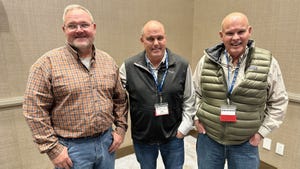
SAN ANTONIO, Texas -- For Gunnison, Miss., cotton producer and InTime, Inc., founder Kenneth Hood, variable-rate application of inputs is a matter of survival.

HOOD

“There are two factors that influence how we do things,” Hood said during a panel on variable-rate technology at the 2006 Beltwide Cotton Conferences in San Antonio. “One is legislation and regulation. The other is economics. The latter is the driving point. Since 1995, we had one little blip (where cotton prices rose in 2004) but since then, prices have been down.”

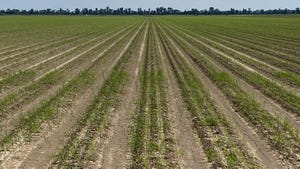
Hood farms cotton on Perthshire Farms, about 100 miles south of Memphis. His cotton land is highly variable, which Hood traces back to 1897, the year a levee broke west of the farm. “Today, our soil type changes at least five times from one end of the field to the other. It’s a challenge to farm that kind of land.”

In addition, cotton producers face increasing costs, decreasing returns, a hostile legislative environment and increasing global competition.

Variable-rate application of inputs can help Hood do a better job with the economic side of the issue by finding the least cost of production for each input. Varied inputs on Hood’s operation include seed, fertilizer, insecticides, herbicides, plant growth regulator and defoliants. Here’s a closer look at the savings:

Cotton seed — “We took our soil sampling data, overlaid our yield maps and bare soil aerial imagery from InTime on top of the data and wrote a prescription for variable-rate seeding.”

The result was a 10 percent increase in yields. “We also reduced our seed costs tremendously and increased our profits by 7 percent to 13 percent. When you can do that with precision ag technology, it makes you take notice. Today, our cost of planting the seed is approaching $100 an acre. You can’t just put out X-number of plants per acre. You need to know where to put the plants.”

Nitrogen — Hood overlaid soil sampling data, yield maps and Veris rig maps. The Veris machine measures the soil’s electrical conductivity and clay content. The maps showed five classes of soil. Armed with this information, Hood’s scouts can go to each of the five areas to soil sample and not have to spend valuable time grid sampling.

Imagery also indicated where there was carryover nitrogen in a portion of a field that had been in corn. Hood was able to reduce his nitrogen application in those zones.

“On one 2,810-acre block, we applied 182.6 tons of ammonium nitrate using variable-rate technology. The previous year, we used 330 tons. That’s 147 tons that we actually saved. When you multiply that by $230 it is quite a bit a savings ($33,810) using variable-rate technology.”

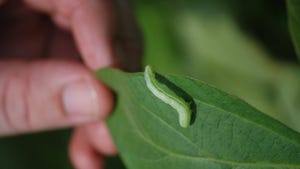
Insect control — Hood has found that certain types of insects like certain types of cotton better than others (some insects may prefer stressed cotton, for example). “You can go to those spots in the fields and find where your thresholds are.”

On a neighboring farm, a variable-rate plant bug application saved 53 percent in chemical applications, according to Hood. “That has got to get your attention. And remember, the applicator is either on or off during the insecticide application. So where the chemical was not applied, beneficial insects were not eliminated. You’re leaving them there to help control your damaging insects.”

Plant growth regulator — Aerial images from InTime indicate seven different management zones with various levels of plant vigor. “It makes sense that we don’t over-apply or under-apply plant growth regulators. The plants will respond positively.

“How many times have you planted two fields, just a jump in the turnrow from each other, and one field picks 800 pounds and the other picks 1,100 pounds? Something went right in the 1,100-pound field.”

Defoliation — Another neighbor using variable-rate applications reported 16 percent chemical savings because he was able to go with a once-over defoliation due to a more uniform crop. “Another farm in Arkansas did its variable-rate defoliation by air. It cost him $15.94 to put it out and it was a one-time defoliation.”

On another field, imagery indicated a potassium deficiency. “The prescription was applied using an airplane. The chemical cost of the variable-rate application was $5.85. Had he made a blanket application, the cost would have been $9.39.

Variable-rate technology will also allow the farmer to estimate the cost of the application versus a blanket spray.

Hood noted that users of the imagery can often get multiple uses from an image. And imagery can show the unexpected as well. “On one field, the farmer had an image taken on July 5 and picked up a nitrogen deficiency. He did a variable-rate foliar nitrogen application on July 13. On July 20, when the image was acquired again, the deficient part of the field was starting to come back.”

Another advantage to imagery is that very little data collection is required, according to Hood, “which is unlike most precision agriculture practices.” He advises cotton producers to find a service provider that has the calibrated imagery and knows what he is doing and knows what you want.”

e-mail: erobinson@prismb2b.com

Get Copyright ClearanceWant to use this article? Click here for options!
© 2009 Penton Media, Inc.


Latest Jobs

Read More Daily News

Climate change not aberration

Jul 1, 2009 1:06 PM

The world’s climate is getting warmer, and that could have a profound impact on U.S. agriculture, says Jerry Hatfield, supervisory plant physiologist with USDA’s National Soil Tilth Research Laboratory at Iowa State University....

Ag tech field day at Agricenter

Jul 1, 2009 1:04 PM

Agricenter International will again host the biggest field day in the Mid-South for commercial agricultural technology at the 2009 Mid-South Ag-Technology Field Day July 16 in Memphis....

100 years: LSU AgCenter Rice Research Station

Jul 1, 2009 1:02 PM

The LSU AgCenter Rice Research Station at Crowley, La., is celebrating a century of operation this year, making it the oldest facility of its kind in the Western Hemisphere....

Glyphosate-resistance shocking

Jul 1, 2009 1:00 PM

I recently wrote in an article that I would sure like to get called out to a “normal-looking” rice field because I have looked at so many messes this year....

Downside of wildlife programs

Jul 1, 2009 10:18 AM

We quickly learn in this business that one man’s caviar and Champagne may well be just smelly fish eggs and icky grape juice to another....

Delta Farm Press News

Southeast Farm Press News

Southwest Farm Press News
Western Farm Press News

resources

events icon events

product info icon tradeshows

tradeshow icon digests

research icon photos

Continuing Education


(New Course)
Weed Resistance Management in Cotton

This course covers a wide range of options to effectively control weeds in cotton and reduce the risk of weed resistance management. It is accredited for hours/units for licensed/accredited applicators in 7 U.S. Cotton Belt states (Florida, Georgia, New Mexico, Oklahoma, Texas, South Carolina an d Tennessee. CCA credit is pending).

This course is accredited in Texas, Oklahoma, New Mexico, Virginia, West Virginia and Wyoming as well as for CCA credits:

(New Course)
Spray Drift Management

Keeping crop protection chemicals on the crop for which they are intended has been a cornerstone of farming not only to protect neighboring crops, but to not waste money allowing products to drift off the intended target. This accredited online continuing education course covers the critical elements of spray drift management.

Back to Top

Continuing Education


(New Course)
Weed Resistance Management in Cotton

This course covers a wide range of options to effectively control weeds in cotton and reduce the risk of weed resistance management. It is accredited for hours/units for licensed/accredited applicators in 7 U.S. Cotton Belt states (Florida, Georgia, New Mexico, Oklahoma, Texas, South Carolina an d Tennessee. CCA credit is pending).

This course is accredited in Texas, Oklahoma, New Mexico, Virginia, West Virginia and Wyoming as well as for CCA credits:

(New Course)
Spray Drift Management

Keeping crop protection chemicals on the crop for which they are intended has been a cornerstone of farming not only to protect neighboring crops, but to not waste money allowing products to drift off the intended target. This accredited online continuing education course covers the critical elements of spray drift management.

Browse Print Issues

Additional Resources

subscribe to Farm Press Daily Southeast Farm Press Southwest Farm Press Western Farm Press