Busted to back in black

Jul 25, 2005 8:40 AM, By Elton Robinson

Ten years ago, West Memphis, Ark., farmer Fred Bollinger was broke and near the end of his farming career. Twelve banks in five towns had turned him down for a crop loan. He was down to one employee, trusty John “Tip” Stanton, who had been with him 31 years.

BOLLINGER

Bollinger admitted there was good reason for his misfortune. He could barely borrow enough money to get a cotton or rice crop in the ground, much less care for it through the season. “It looked like I didn’t know what I was doing. My fields were so weedy that people were calling my landlords asking for the timber rights to my crop. I was so broke I couldn’t pay attention.”

Friends begged him to declare bankruptcy, but Bollinger refused. In 1996, he decided to simplify his life. “I quit raising cotton and rice and started raising soybeans and wheat.”

His luck soon started to turn. He took a chance on a then revolutionary herbicide-resistant technology, purchasing as much Roundup Ready soybean seed as he could find on credit, “and planted it all along the highway — on all the banker fields.”

He and Stanton farmed the fields with two tractors, John Deere 4430s with no cabs. To their amazement, the technology worked just like it was supposed to, and he was able to no-till wheat and soybeans. With Mother Nature cooperating and close attention paid to fertility, Bollinger started paying off debts. Soon the poor house was a shrinking image in his rear-view mirror.

Over the next 10 years, Bollinger went from 800 acres to over 9,000 acres of soybeans and wheat. His farm grew by 16 employees, three combines, several tractors and GPS-equipped spray rigs, two large air seeders, three spreaders and one trucking company.

Bollinger’s operation has gotten bigger and better, but he hasn’t stopped looking for ways to improve yields on his farm, which stretches 5 miles around the Port of West Memphis, Ark.

He wondered why he wasn’t getting consistent yields in wheat and soybeans. Fields with similar soil type often would have significant yield differences. So he added another layer of management to his production system, which made wheat and soybean yields more consistent and pushed them higher.

The key to bin-busting wheat yields this year began with gypsum applied to fields the previous spring before soybeans. Bollinger said gypsum improves air and water management in the soil.

University of Arkansas Extension soil specialist Leo Espinosa is studying the effects of gypsum on cotton soils, but results are too preliminary to discuss. Part of the funding for his research comes from Ag Spectrum, Dewitt, Iowa, which recommends gypsum applications as part of its Nu-Till System. Bollinger planted most of his wheat and soybean crops under the system this year.

“It is well known that gypsum is an anti-crusting agent,” Espinosa said. “Crusting is a problem here in Arkansas, especially in silt loam soils. I believe the greatest benefits of gypsum come from continual use of the product.”

Bollinger started applying gypsum two years ago and began trucking it to his farm when it became hard to find. The gypsum shortage pushed Bollinger into two additional profitable ventures — he became a gypsum dealer and started his own trucking company.

Bollinger planted his wheat between Oct. 5 and Oct. 15, with Delta King DK 9410 on most of his acreage. He applied GroZyme to enhance microbial activity, Clean Start, a special formulation of phosphorus, and Kick-Off, a micronutrient enhancement, all in-furrow with the seed. The products are also components of the Nu-Till System.

“There is nothing magical about the system,” said Espinosa. “The parts of the system are based on sound science. The use of fertilizer with the seed, especially in no-till conditions, may increase the seedling vigor by giving the crop a jump start. The system also is based on the common knowledge that proper timing and placement of chemicals and seed are critical.”

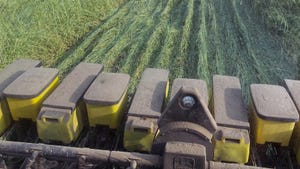
He made applications with two air seeders, a John Deere 8520T tractor pulling a 1910 Air Cart with an 1890 seeder and another John Deere 8520T pulling a 1900 Air Cart and 1860 seeder.

He started fertilizing the crop Feb. 15 and finished about March 20. “I was going to use my rigs, but because the ground was wet, I used an airplane to apply three doses — 100 pounds of ammonium sulfate, and two 100-pound shots of urea.”

He put out Harmony and 2,4-D for garlic and onion. “This year, I also sprayed for wheat rust. We had a few Hessian flies, but my wheat was so advanced they didn’t affect it.”

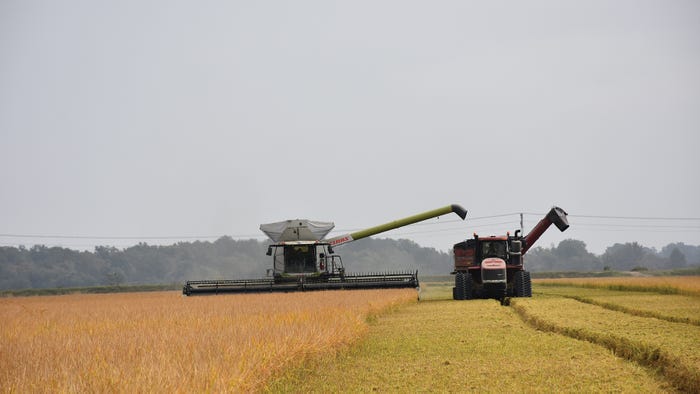
On a recent day, during a mad scramble to harvest wheat before a rain, Bollinger was asked what kind of wheat yields he was getting. He replied with a typical farmer preamble. “Everybody thinks I’m crazy, now they’re going to think I’m a liar, too. But the first field cut 89 bushels, the next cut 96 bushels, then 102 bushels. That was scale tickets divided by acres. That’s not the yield monitor.”

Test weights have been good, too, with hardly a load going under 60.

Bollinger ran check plots beside his Nu-Till wheat, and the differences between them are significant. Two checks yielded 52 and 60 bushels, while the Nu-Till plots cut 88 bushels and 79 bushels. His Nu-Till wheat was still averaging in the mid-70s to low 80s deep into the June harvest.

He said he was lucky pricing wheat as well. “I booked a good portion of the crop at the highest price. I think I did the best job of booking wheat I’ve ever done.”

Not bad for a man who once owed over a million dollars to creditors. “Ten years ago, everybody was telling me to file bankruptcy because I owed so much money. I sure thought about quitting. I just about was ready to give it up. But I didn’t.

“Don’t think I’m on Easy Street. I’m still paying off debt. Luckily, the people I’m still paying money to tell me, ‘Don’t quit coming in just because you owe me.’”

Bollinger said several people continued to support him on his climb out of debt. Mack Brown, who worked for Bollinger’s father, “has been a good employee. He’s like one of my best friends. He’s 73 years old, still hopping up on combines.

“Bill Looney at Looney Implement let me ride for a number of years and let me pay my debt off over time. Andrew Landrum, who used to work for Chickasaw Chemical, and Fidelity National Bank in West Memphis gave me credit when I needed it. They all had faith in me.”

e-mail: erobinson@primediabusiness.com

Get Copyright ClearanceWant to use this article? Click here for options!
© 2010 Penton Media, Inc.


Latest Jobs

Read More Daily News

NCC: 10.1 million cotton acres

Feb 8, 2010 10:30 AM

After three straight years of declines, U.S. cotton acreage could be headed back up, according to the National Cotton Council’s 27th annual Early Season Planting Intentions Survey....

Weed resistance, Washington headline Farm & Gin Show

Feb 8, 2010 10:24 AM

This year’s Mid-South Farm and Gin Show offers “perhaps the best set of exhibits ever,” says Tim Price, manager of the annual event to be held Feb. 26-27 at the downtown Memphis Cook Convention Center....

Darneille elected CCI president

Feb 8, 2010 10:22 AM

Wallace L. (Wally) Darneille, a Lubbock, Texas, cooperative official, will serve as 2010 president of Cotton Council International, the National Cotton Council’s export promotions arm....

Rice ‘growth industry’ — Weisemeyer

Feb 8, 2010 10:10 AM

Farmers attending the 2010 joint annual meeting of the Louisiana Rice Council and the Louisiana Rice Growers Association heard an optimistic report from a Washington, D.C., agriculture journalist recently....

U.S. cotton acres: 10.1 million

Feb 5, 2010 5:06 PM

U.S. cotton producers are expected to plant more than 10 million acres for the first time in three years as they begin making preparations for the 2010 planting season....

Delta Farm Press News
Southeast Farm Press News

Southwest Farm Press News

Western Farm Press News
resources

events icon events

product info icon tradeshows

tradeshow icon digests

research icon photos

Continuing Education


(New Course)
Weed Resistance Management in Cotton

This course covers a wide range of options to effectively control weeds in cotton and reduce the risk of weed resistance management. It is accredited for hours/units for licensed/accredited applicators in 7 U.S. Cotton Belt states (Florida, Georgia, New Mexico, Oklahoma, Texas, South Carolina an d Tennessee. CCA credit is pending).

This course is accredited in Texas, Oklahoma, New Mexico, Virginia, West Virginia and Wyoming as well as for CCA credits:

(New Course)
Spray Drift Management

Keeping crop protection chemicals on the crop for which they are intended has been a cornerstone of farming not only to protect neighboring crops, but to not waste money allowing products to drift off the intended target. This accredited online continuing education course covers the critical elements of spray drift management.

Back to Top

Browse Print Issues

Additional Resources

subscribe to Farm Press Daily Southeast Farm Press Southwest Farm Press Western Farm Press