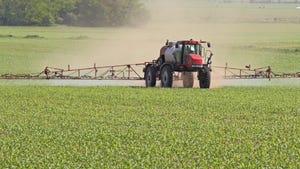
5 percent of growers decreasing acres due to rust

Apr 11, 2005 7:59 AM, By Elton Robinson

Most U.S. producers say that Asian soybean rust wasn’t even a factor in their planting decisions this year. However, of the 11 percent of U.S. producers who did consider Asian rust a factor, almost half said they intend to decrease acres because of the disease. Hence, a little over 5 percent of U.S. soybean producers intend to decrease acres due to rust.

In the Mid-South, 19 percent of soybean producers said that rust was a factor in their planting decision. Of these producers, 63 percent said they will reduce their soybean acres this year because of it.

In the Southeast, 29 percent of soybean producers said that rust was a factor in their planting decisions. As in the Mid-South, 63 percent said they intend to decrease acreage because of it.

Essentially, this means 12 percent of Mid-South soybean farmers surveyed and 18 percent of Southeast soybean farmers surveyed intend to decrease acres due to rust.

In the Corn Belt, 10 percent of soybean farmers considered rust as a factor in their planting decisions. Of these producers, 47 percent intend to decrease acres, indicating that less than 5 percent of all surveyed intend to decrease acres due to rust.

A few producers who said that rust was a factor in their planting decisions said they will increase acres due to rust, perhaps hedging their bets on a combination of higher soybean prices or the expectation of minimal impact of the disease on their farms or in their regions. These producers were mostly concentrated in the Northeast, Great Lakes states and Northern Plains.

The survey did not provide a state-by-state breakdown of how rust affected the planting decisions of soybean farmers.

Much of the decline in Mid-South acreage is in Louisiana, where growers are planning to decrease soybean acres by 23 percent, or around 350,000 acres. While some of this decline is ostensibly due to concerns over rust, another reason could be the lack of an early harvest premium this year. Last year an early harvest premium resulted in a spike of soybean acres in the Mid-South, especially Louisiana.

Nationally, soybean producers intend to plant 73.9 million acres in 2005, according to USDA. That’s down 2 percent from last year’s record-high acreage. Of the 31 soybean producing states, growers in 16 states intend to plant fewer acres this year, while producers in 11 states intend to plant more acres than in 2004.

The largest acreage declines are in the Dakotas. Mid-South acres are expected to decline by about 500,000 acres.

Questions on Asian rust were included in USDA’s annual survey for its March 31 Prospective Plantings report. USDA conducted the survey because of heightened speculation of how growers would react to the fast-spreading, yield-robbing disease.

USDA also questioned farmers in soybean producing states about their awareness of the disease. Of those intending to plant soybeans this year, 89 percent had seen, read, or heard at least some information about Asian soybean rust.

In Illinois, 98 percent of soybean farmers have read or heard information about rust, the highest in the United States. In the Mid-South, awareness ranged from 85 percent for Tennessee to 91 percent for Louisiana. Only 65 percent of soybean producers in Kentucky had read or heard about soybean rust, the lowest in the United States.

e-mail: erobinson@primediabusiness.com

Get Copyright ClearanceWant to use this article? Click here for options!
© 2009 Penton Media, Inc.


Latest Jobs

Read More Daily News

Arkansas loss near quarter billion dollars

Nov 6, 2009 2:56 PM

A wetter-than-normal growing season has cut into Arkansas’ farm receipts by more than $224.8 million as of Nov. 1, according to a preliminary report issued by the University of Arkansas Division of Agriculture....

Cotton: a lot on the ground

Nov 6, 2009 11:13 AM

Cotton losses due to record rainfall during September and October in Mississippi totaled $71 million by early November, or nearly half the value of the expected crop, according to the Mississippi Department of Agriculture and Commerce....

Rep. Cassidy: rethink conservation efforts

Nov 6, 2009 11:02 AM

The only Louisianan on the House Agriculture Committee, Rep. Bill Cassidy tries to keep his state’s agricultural interests at the forefront....

Residuals in LibertyLink program

Nov 6, 2009 10:57 AM

Before continuing with my pigweed control articles, I have tried to think of something encouraging to say about trying to get a crop out with the weather we are having. ...

Letter: Mule-headed bunch of farmers

Nov 6, 2009 10:54 AM

I was greatly disappointed in Morgan Freeman’s recent comments referring to the base stock of this state as a mule-headed bunch of farmers (see Behind the curtain: ‘mule-headed farmers’?). ...

Delta Farm Press News

Southeast Farm Press News
Southwest Farm Press News

Western Farm Press News
resources

events icon events

product info icon tradeshows

tradeshow icon digests

research icon photos

Continuing Education


(New Course)
Weed Resistance Management in Cotton

This course covers a wide range of options to effectively control weeds in cotton and reduce the risk of weed resistance management. It is accredited for hours/units for licensed/accredited applicators in 7 U.S. Cotton Belt states (Florida, Georgia, New Mexico, Oklahoma, Texas, South Carolina an d Tennessee. CCA credit is pending).

This course is accredited in Texas, Oklahoma, New Mexico, Virginia, West Virginia and Wyoming as well as for CCA credits:

(New Course)
Spray Drift Management

Keeping crop protection chemicals on the crop for which they are intended has been a cornerstone of farming not only to protect neighboring crops, but to not waste money allowing products to drift off the intended target. This accredited online continuing education course covers the critical elements of spray drift management.

Back to Top

Continuing Education


(New Course)
Weed Resistance Management in Cotton

This course covers a wide range of options to effectively control weeds in cotton and reduce the risk of weed resistance management. It is accredited for hours/units for licensed/accredited applicators in 7 U.S. Cotton Belt states (Florida, Georgia, New Mexico, Oklahoma, Texas, South Carolina an d Tennessee. CCA credit is pending).

This course is accredited in Texas, Oklahoma, New Mexico, Virginia, West Virginia and Wyoming as well as for CCA credits:

(New Course)
Spray Drift Management

Keeping crop protection chemicals on the crop for which they are intended has been a cornerstone of farming not only to protect neighboring crops, but to not waste money allowing products to drift off the intended target. This accredited online continuing education course covers the critical elements of spray drift management.

Browse Print Issues

Additional Resources

subscribe to Farm Press Daily Southeast Farm Press Southwest Farm Press Western Farm Press