Column: Brazil’s farmers set sights on expansion

Mar 24, 2005 9:06 AM, By Forrest Laws

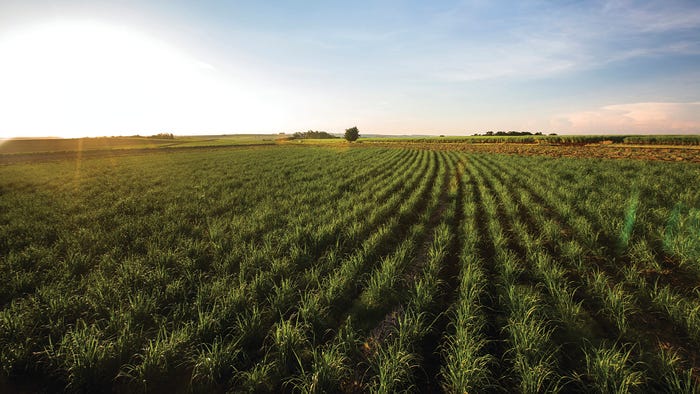
A giant relief map of the state of Mato Grosso hangs in the airport in Cuiaba, Brazil. It shows large tracts of land north of Cuiaba and between Cuiaba and Mato Grosso So Sul that have been cleared for soybeans, cotton and other crops.

But it also pictures vast areas of northern and eastern Mato Grosso that have yet to be cleared, land covered with grasses and scrub trees that grow to 10 or 12 feet in height because of the region’s Cerrados or savannah climate.

Visitors hear stories of Brazilian farmers hooking a chain between two tractors and clearing land. When you drive past one of the few remaining natural areas southeast of Cuiaba, it’s easy to imagine farmers pulling up trees one day and planting soybeans the next.

That’s not the whole story. Until lime deposits were discovered in central Brazil in the 1970s, few crops could be grown on the highly acidic Cerrados soils. Farmers generally have to grow two years of upland rice and apply generous amounts of phosphates and potash to make the land productive.

The lime deposits and increasingly crowded conditions in southern Brazil sparked a migration from the south into Mato Grosso, Goias and Minas Gerais. That and soybean varieties specifically adapted for the tropical climate.

The first soybeans were grown in Mato Grosso in 1978. Now Mato Grosso and other center-west states account for 46 percent of Brazil’s soybeans — the “yellow gold” of the Cerrados, as some call it.

The Cerrados contains 520 million acres, about one-fourth of Brazil’s land mass. Of those, about 50 million acres are planted in row crops. Agronomists estimate another 250 million acres could be used for modern mechanized agriculture.

The state of Mato Grosso has become Brazil’s largest producing soybean state, growing about 13.3 million acres this season. Agronomists with Foundation Mato Grosso, a private development organization, say farmers hope to double that in the next five years.

Mato Grosso also produces 88 percent of Brazil’s cotton. Growers hope to expand cotton acres as well — if, they say, the United States reduces its subsidies.

Any animosity Brazilian farmers hold for their U.S. counterparts was not evident on a recent trip to Mato Grosso. (At one stop, a Brazilian TV reporter asked a Brazilian chemical company rep why the Brazilians were helping a group of Valent USA technicians and customers learn to deal with soybean rust.)

The biggest problem Brazilian farmers face — other than the erosion in the value of their currency — is the transportation system. Most of the soybeans and cotton grown in Mato Grosso have to be trucked 1,000 to 1,300 miles over two lane roads.

Mato Grosso’s governor, Blairo Maggi, who happens to be the country’s largest soybean producer, is trying to remedy that. But, unlike its farmers, government projects move slowly in Brazil. That may be U.S. farmers’ best hope for slowing the Brazilian juggernaut for now.

e-mail: flaws@primediabusiness.com

Get Copyright ClearanceWant to use this article? Click here for options!
© 2009 Penton Media, Inc.


Latest Jobs

Read More Daily News

WTO awards Brazil retaliation authority

Nov 20, 2009 11:01 AM

The World Trade Organization has authorized Brazil to seek retaliation against the United States for it support of two U.S. commodity programs....

Precision ag – online course

Nov 20, 2009 10:53 AM

University of Missouri Extension is offering an eight-week online course on managing farm machinery using precision agriculture, Jan. 12 through March 4....

Soybeans — U.S. key export supplier

Nov 20, 2009 10:48 AM

Weather problems are now thought to be factored into market prices. ...

$485 million loss – Mississippi

Nov 19, 2009 3:57 PM

Mississippi State University agricultural economists calculate Mississippi farmers are suffering an estimated $485 million value loss in 2009. ...

Biofuels goal beyond ethanol

Nov 19, 2009 10:05 AM

If the U.S. is to reach the government-mandated target of producing 36 billion gallons of biofuels annually by 2022, “We will need to change the way we do business,” says a USDA official....

Delta Farm Press News

Southeast Farm Press News

Southwest Farm Press News
Western Farm Press News

resources

events icon events

product info icon tradeshows

tradeshow icon digests

research icon photos

Continuing Education


(New Course)
Weed Resistance Management in Cotton

This course covers a wide range of options to effectively control weeds in cotton and reduce the risk of weed resistance management. It is accredited for hours/units for licensed/accredited applicators in 7 U.S. Cotton Belt states (Florida, Georgia, New Mexico, Oklahoma, Texas, South Carolina an d Tennessee. CCA credit is pending).

This course is accredited in Texas, Oklahoma, New Mexico, Virginia, West Virginia and Wyoming as well as for CCA credits:

(New Course)
Spray Drift Management

Keeping crop protection chemicals on the crop for which they are intended has been a cornerstone of farming not only to protect neighboring crops, but to not waste money allowing products to drift off the intended target. This accredited online continuing education course covers the critical elements of spray drift management.

Back to Top

Continuing Education


(New Course)
Weed Resistance Management in Cotton

This course covers a wide range of options to effectively control weeds in cotton and reduce the risk of weed resistance management. It is accredited for hours/units for licensed/accredited applicators in 7 U.S. Cotton Belt states (Florida, Georgia, New Mexico, Oklahoma, Texas, South Carolina an d Tennessee. CCA credit is pending).

This course is accredited in Texas, Oklahoma, New Mexico, Virginia, West Virginia and Wyoming as well as for CCA credits:

(New Course)
Spray Drift Management

Keeping crop protection chemicals on the crop for which they are intended has been a cornerstone of farming not only to protect neighboring crops, but to not waste money allowing products to drift off the intended target. This accredited online continuing education course covers the critical elements of spray drift management.

Browse Print Issues

Additional Resources

subscribe to Farm Press Daily Southeast Farm Press Southwest Farm Press Western Farm Press