How to get more from your irrigation dollars

Mar 7, 2005 10:11 AM, By David Bennett

The temptation in Arkansas, said Vories, was to turn the pivot on and leave the water to fill row-ends and ditches. That approach can waste a lot of diesel and hurt the crop simultaneously.


KENNETT, Mo. — In discussing irrigation, drainage is a good place to start. Producers must be able to not only apply water to a field, but get it off quickly as well.

“If you can’t do that, what’s the point of spending money to put out more water?” asks Earl Vories, USDA-ARS agricultural engineer stationed at the Delta Center in Portageville, Mo. “We irrigate most of our cotton in the Bootheel — probably close to 60 percent. We have a great water supply… But, the truth is, irrigation by itself won’t do much for you — you must look at your whole production system.

“You’ve got to pick the correct variety and manage the crop properly. You can irrigate properly, but if you don’t take care of weeds, your cotton won’t be any good.”

Furrow irrigation

Vories, who spent the last 16 years at the research station in Keiser, Ark., is newly arrived in the Bootheel. One thing that’s the same between the two regions: a lot of furrow irrigation.

“One thing to pay attention to is the amount of time it takes to water using furrow,” Vories told those attending the Missouri Cotton Production and Outlook Conference. “We’ve always recommended being on and off the field between six and 12 hours. If you’re watering quicker than 6 hours, the water likely isn’t soaking in well. If it takes more than 12 hours, you may be over-watering and hurting the crop.”

To operate in that kind of timeframe, producers probably need to water in sets.

“One thing I always point out is the sequence of the sets. Starting out, you’ll probably start punching holes at the end and then move back towards the well. Once you get to the well, the easiest thing to do is reverse course and re-water the section closest to the well. It’s already set up and all you have to do is kick the well back on.”

But that’s like running a pivot in a half circle — you’re watering the wettest part of the field and leaving the driest to suffer. It is more trouble, Vories admitted, “but you should go ahead and go back to the end where it’s driest. To make it easier, a lot of growers are now running two lines of tubing parallel. It does cost more money for the tubing, but the labor is lot simpler and offsets the cost of the extra tubing.”

Pivots

Many of the problems associated with center pivots have to do with infiltration.

“We just can’t get the water into the soil fast enough. It’s not uncommon for water to soak in only 6 inches to 8 inches deep after irrigation. From what I’ve seen, Missouri is better than Arkansas about putting out lower rates so that you don’t get so much runoff.”

The temptation in Arkansas, said Vories, was to turn the pivot on and leave the water to fill row-ends and ditches. That approach can waste a lot of diesel and hurt the crop simultaneously.

Many pivots don’t have enough capacity at the most “dreadfully hot” part of the summer. To combat this, Vories recommended keeping some of the deep moisture in the bank.

“Don’t use that all up early. That way, if you have a pivot break down mid-summer, the crop won’t stress so badly before you get the pivot running again.”

One thing tried in Mississippi — “I haven’t had a chance to try it yet” — is using a fertilizer knife to plow slits between rows. That breaks the crust, lets the water fill in the slit and allows better infiltration.

Vories also fields many questions about pivot use during bloom. More study is needed, he said, because “there’s some contradictory data. Another question asked in conjunction with bloom is ‘should I only be watering at night?’ That isn’t an option, really. Most of our pivots don’t have the capacity to run only part-time.”

In Arkansas, the recommended irrigation capacity for a pivot is 5 gallons per acre per minute. With that capacity, it takes about the same amount of time to make a circle as it does for the crop to use the water.

“So if you shut down during the day for 8 hours or more, you’ll get behind.

“Something also being recommended in Mississippi is staggering your start point. Rather than make a continuous circle all season, switch up. In such situations in dry years, there’s a noticeable difference between the crop watered during the day and that watered at night. So you can move your starting point around to make sure an equal number of day and night irrigations are reaching everything under the pivot.”

Tubing

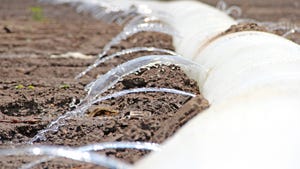
With rolled tubing, it’s important to place the proper size. “I’ve worked in areas where 15 inches was standard — farmers put that on little wells and big wells too. They would run into problems on either side. If you’re pumping a well allowing less than 1,000 gallons per minute, you should be using 12-inch pipe. If you’ve got a 3,000-gallon well, move up to 18-inch pipe.”

Producers should know their wells. Every couple of years, producers need to test wells and keep a log of the findings.

“We’re blessed with good water in this area. But problems can show up even without aquifer troubles. For example, your well can start plugging up. If you’re keeping logs, you can see that last check showed you were pumping 1,200 gallons per minute and now it’s pumping 800. In such a case, it’s time to find out what’s going on.”

Drip

Although still a minor player, drip irrigation is gaining more play in the Delta. Drip was developed in arid areas — like west Texas — where water savings are very important.

“The nice thing about drip is, when a cotton crop isn’t using much water, the system allows you to easily manipulate the amount put out. You can do the same with pivot, but not in such a specific range. With drip, you can keep soil moisture at the optimum level.”

With a good water supply in the Bootheel, there will have to be another selling point if drip is to be adopted.

“It has high front-end costs. Another consideration: water treatments. We have a lot of iron in our water and that requires a lot more monitoring than systems we’re already used to working with. A drip system, like a pivot, has a long lifetime if maintained properly. Without water treatments, though, a drip system can die quickly.”

e-mail: dbennett@primediabusiness.com

Get Copyright ClearanceWant to use this article? Click here for options!
© 2008 Penton Media, Inc.


Latest Jobs

Read More Daily News

Weed resistance issues increasing

Jul 23, 2008 10:21 AM

This year, there are some 1.4 million acres of rice in Arkansas. Given the new chemistries available, researchers say it’s surprising that growers continue to find more fields of propanil-resistant and Facet-resistant barnyardgrass....

National Cotton Council moves headquarters

Jul 23, 2008 10:18 AM

The National Cotton Council has closed the doors on one era and opened the doors to another. ...

Deltapine soybeans to transition to Asgrow

Jul 23, 2008 10:15 AM

Another well-known Mid-South brand will soon disappear into the new world of corporate mergers. ...

Strain challenge: eat local Louisiana

Jul 23, 2008 10:10 AM

Louisiana’s agriculture and forestry commissioner is challenging the residents of his state to eat local for one week....

Late Missouri corn most at risk to beetles

Jul 22, 2008 9:45 AM

After years of being primarily a horticultural pest, Japanese beetles are emerging as a threat to field crops across Missouri, said Wayne Bailey, University of Missouri Extension entomologist....

Delta Farm Press News
Southeast Farm Press News

Southwest Farm Press News

Western Farm Press News

resources

events icon events

product info icon tradeshows

tradeshow icon digests

research icon photos

Continuing Education

For Texas and Oklahoma Licensed Applicators

A free online continuing education course on spray drift management accredited by the Texas and Oklahoma departments of agriculture.

For National Certified Crop Advisers

A free American Society of Agronomy-accredited one-CEU course on spray drift management.

ACCREDITED IN CALIFORNIA ONLY:


Almond Pest Management

Get the latest info on almond insect pest management and earn 2 hrs. CE DPR and CCA credit in California.

California Groundwater Protection Regulations

Earn 2 hrs. in California laws and regs CE and learn how to protect California groundwater supplies.

Powdery Mildew Control in California Grapevines

Learn about the No. 1 grape disease in California; earn 2 California CE hours.

ACCREDITED IN CALIFORNIA AND ARIZONA:


Insecticide Resistance Management in Agronomic and Row Crops

A 3-hr. CE approved for California and Arizona licensees and CCAs in both states.

Agronomic Weed Resistance Management in Row Crops, Trees Nuts and Vines

Weeds Resistance Management is approved for 3 hours of CE credit for all California and Arizona licensees and Certified Crop Advisers.

Lepidopterous Pest Management/ Pesticide Safety

This course is approved for 2 hours in Arizona and California (1 hr. of laws/regs; 1 hour Other) and for CCAs.

Managing Spray Drift to Minimize Problems

2-hrs laws and regs for California licensees; 2 hours in Arizona and for CCAs.

Back to Top

Browse Print Issues

Additional Resources

subscribe to Farm Press Daily Southeast Farm Press Southwest Farm Press Western Farm Press