Column: Is this farmers' 'reward' for 2004 support?

Feb 17, 2005 9:51 AM, By Forrest Laws

But time — and budgets — waits for no man, and the president’s first major announcement of an agricultural nature in his second term was that he believed taxpayers are spending too much on farmers.


It would have been nice if the Bush administration could have waited a little longer before dropping a bomb on the nation’s farmers when the president announced his fiscal 2006 budget proposal on Feb. 7.

But time — and budgets — waits for no man, and the president’s first major announcement of an agricultural nature in his second term was that he believed taxpayers are spending too much on farmers.

It must have been galling for mainline farm organizations, who made little secret of their support for the president in 2004, to hear farm programs take a major hit, especially for producers who receive payments for more than one farm entity.

Some leaders may have shared the sentiments expressed by Rep. Marion Berry, D-Ark., who definitely did not support the president’s re-election.

“This is an unmitigated attack on Southern agriculture,” said Berry. “It’s interesting that the president would choose to literally attack Southern agriculture that has been a big factor for him being in the White House two terms. When you look at the blue states, you don’t see many cotton and rice farmers out there.”

Number crunchers quickly noted the impact the cuts could have on cotton and rice farmers in the predominantly Republican South compared to corn and soybean farmers in Democratic states like Iowa and Minnesota.

A reporter for the Chicago Tribune, for example, wrote that cotton and rice farmers generally receive higher payments than corn and soybean farmers because the money is spread among fewer farmers. In 2003, 908,000 U.S. corn farmers received $2.8 billion while 142,000 cotton farmers got $2.7 billion.

What he failed to note was that high 2003 corn prices meant growers did not earn a counter-cyclical payment while cotton prices were so low that producers received the maximum CCP. The same was true for loan deficiency payments, which would also help account for the disparity in payments.

The other angle that few in the national media are mentioning is that why, if farmers are getting so wealthy off government payments, aren’t more people going into farming?

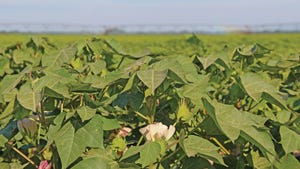
In Texas, more than 90 cents of every dollar earned on a cotton farm is spent producing the crop, according to agricultural economists at Texas A&M University. The remainder is not profit but goes to cover living expenses, new equipment, land costs and taxes.

From 2 to 5 cents may be left over. “That’s the average,” says Jim Richardson, chairman of Texas A&M’s Agricultural and Food Policy Center. “Some years it’s a negative 2 cents; some years, it’s a positive 2 cents.”

Despite the gloom and doom that have greeted the president’s budget, many observers believe the cotton and rice organizations, which are legendary for their ability to influence farm policy, can pull another rabbit out of the hat.

“When the dust settles, we will have altered the law to allow six entities and raised the payment limits to $1 million,” a friend from the Midwest e-mailed me.

e-mail: flaws@primediabusiness.com

Get Copyright ClearanceWant to use this article? Click here for options!
© 2008 Penton Media, Inc.


Latest Jobs

Read More Daily News

Farm bill and flooding: economist Daryll Ray

Jul 3, 2008 12:08 PM

After the first round of producer organization-sponsored farm bill meetings, Mid-South farmers still have plenty of questions about the new legislation....

Long-time Arkansas goat rancher — Jack Black

Jul 3, 2008 12:06 PM

As Jack Black looks on in the afternoon’s fading light, a flock of guinea fowl fords tall pasture grass pecking at insects and weaving through 30, or so, multi-hued goats. ...

Peanuts appeal to Mississippi growers

Jul 3, 2008 12:04 PM

Strong market prices and the ability to cope with less moisture than most crops have Mississippi’s peanut growers expanding their acreage again this year....

Rice field day in Richland Parish set for July 21

Jul 3, 2008 12:02 PM

The LSU AgCenter’s annual Northeast Louisiana rice field day will be held July 21 at the Elliot Colvin farm and the Rayville Civic Center in Rayville, La....

LSU AgCenter to host more biodiesel workshops July 29-31

Jul 3, 2008 12:00 PM

By popular demand, the LSU AgCenter will host another set of one-day workshops on how to make your own biodiesel. ...

Delta Farm Press News

Southeast Farm Press News
Southwest Farm Press News

Western Farm Press News
resources

events icon events

product info icon tradeshows

tradeshow icon digests

research icon photos

Continuing Education

For Texas and Oklahoma Licensed Applicators

A free online continuing education course on spray drift management accredited by the Texas and Oklahoma departments of agriculture.

For National Certified Crop Advisers

A free American Society of Agronomy-accredited one-CEU course on spray drift management.

ACCREDITED IN CALIFORNIA ONLY:


Almond Pest Management

Get the latest info on almond insect pest management and earn 2 hrs. CE DPR and CCA credit in California.

California Groundwater Protection Regulations

Earn 2 hrs. in California laws and regs CE and learn how to protect California groundwater supplies.

Powdery Mildew Control in California Grapevines

Learn about the No. 1 grape disease in California; earn 2 California CE hours.

ACCREDITED IN CALIFORNIA AND ARIZONA:


Insecticide Resistance Management in Agronomic and Row Crops

A 3-hr. CE approved for California and Arizona licensees and CCAs in both states.

Agronomic Weed Resistance Management in Row Crops, Trees Nuts and Vines

Weeds Resistance Management is approved for 3 hours of CE credit for all California and Arizona licensees and Certified Crop Advisers.

Lepidopterous Pest Management/ Pesticide Safety

This course is approved for 2 hours in Arizona and California (1 hr. of laws/regs; 1 hour Other) and for CCAs.

Managing Spray Drift to Minimize Problems

2-hrs laws and regs for California licensees; 2 hours in Arizona and for CCAs.

Back to Top

Browse Print Issues

Additional Resources

subscribe to Farm Press Daily Southeast Farm Press Southwest Farm Press Western Farm Press