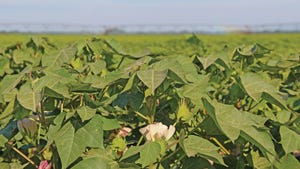
Column: Huge yield complicates prognosticating

Feb 14, 2005 9:47 AM, By Elton Robinson

Despite the smaller crop, total supplies for the 2005 marketing year remain at roughly the same level as the current marketing year.


How big will the 2005 U.S. cotton crop be? This is a troubling question for prognosticators these days, especially in light of what has happened the last two years.

“After a decade of relatively flat yields, we’ve seen new records set in each of the past two years,” said Gary Adams, the National Cotton Council’s vice president, economic policy analysis. “In 2003, the average yield was 730 pounds per acre, surpassing the previous record of 708 pounds set in 1994. This past year, the average yield is currently estimated at an incredible 846 pounds per acre.”

The Mid-South did its share of pushing the average higher. Southeast Missouri and Arkansas had yield increases of nearly 200 pounds over 2003, which was also a record-setting year for average yield for both states. Yields were substantially above trend in most other Mid-South states. So, will U.S. cotton producers set records again in 2005?

The challenge, according to Adams, is figuring out how much of the yield boost in 2004 was due to better-than-average growing conditions and how much was due to other factors such as new seed varieties and the effects of boll weevil eradication.”

In the NCC’s current outlook for 2005 — in which yield is pegged at 733 pounds per acre — the assumptions are that it’s going to be a little of both. The figure is almost 50 pounds above last year’s trend yield and 90 pounds higher than 2003’s trend yield.

The record average yield of 2004 harvested on just over 13 million acres produced a crop of 23 million bales, which surpassed the previous record by almost 3 million bales. Combined with beginning stocks of 3.5 million bales, total supplies for the current marketing year are at a record high 26.6 million bales.

For the coming year, NCC yield assumptions combined with average abandonment would produce a crop of 18.9 million bales, down more than 4 million bales from last year. Despite the smaller crop, total supplies for the 2005 marketing year remain at roughly the same level as the current marketing year.

A larger gap projected between foreign production and consumption and increased imports by China both bode well for U.S. cotton exports in 2005, Adams said. “Our estimates indicate a rebound to 13.4 million bales, up from 12.7 million bales currently estimated for 2004.” That would be the second highest export total ever.

U.S. consumption should exceed production in 2005, which would lead to a slight decline in stocks to 7.4 million bales, according to Adams. Those are still large stocks, however.

Meanwhile, the world total for 2005 production is estimated at 104.6 million bales, down 11 million bales from 2004 but still the second largest on record. The crop falls 2 million bales short of consumption of 106.4 million bales, which would lead to a reduction in stocks to 45.3 million bales.

“The figure is comparable to the late 1990s, and for stocks outside of China, is the second highest level ever, only behind ending stocks of the current marketing year.

“While a host of uncertainties can lead to major changes in the balance sheet, not the least of which is weather, the current estimates still leave us with a lot of stocks to work through the system,” Adams said. “However, on the positive side, we now have a demand base that will quickly draw down stocks should the world crop fall below 100 million bales.”

e-mail: erobinson@primediabusiness.com

Get Copyright ClearanceWant to use this article? Click here for options!
© 2008 Penton Media, Inc.


Latest Jobs

Read More Daily News

Arkansas’ rice crop, post-Gustav

Sep 4, 2008 1:56 PM

Reached Thursday morning, Chuck Wilson, Arkansas Extension rice specialist, could offer only a preliminary assessment of the damage done to Arkansas’ rice crop by Hurricane Gustav. ...

Gustav pounds Mid-South crops

Sep 4, 2008 1:47 PM

After the latest rains courtesy of Hurricane Gustav, extreme southeast Arkansas could float an ark. ...

Essay winners lay out cotton’s future

Sep 4, 2008 8:10 AM

The grand prize winners of the Future of Delta Cotton Student Essay Contest took completely different approaches in describing their visions of tomorrow’s cotton industry. ...

For Cotton’s Future: Open mind, technology muscle

Sep 4, 2008 8:08 AM

Matthew Turner learned at an early age that cotton is a very special crop in his family. ...

Cotton’s Future: A little science fiction?

Sep 4, 2008 8:04 AM

Michael Ferro might seem an unlikely person to win an essay contest on cotton production in the Delta. Ferro is a graduate student in the entomology department at Louisiana State University working on a doctorate on beetles in rotting wood....

Delta Farm Press News

Southeast Farm Press News

Southwest Farm Press News

Western Farm Press News
resources

events icon events

product info icon tradeshows

tradeshow icon digests

research icon photos

Continuing Education

For National Certified Crop Advisers

A free American Society of Agronomy-accredited one-CEU course on spray drift management.

Back to Top

Browse Print Issues

Additional Resources

subscribe to Farm Press Daily Southeast Farm Press Southwest Farm Press Western Farm Press