Agribusiness: New RTK System putting tractor guidance on the curve

Feb 22, 2005 10:16 AM

HARLINGEN, Texas – Anyone who’s ever driven a tractor with a cultivator rig for 10 or 12 hours a day knows that having a GPS guidance system that can steer a tractor or combine in a straight line isn’t that big a deal.

It’s when a tractor can move down a quarter-mile, curved row with no human hands at the wheel and not plow up any cotton that GPS Guidance Systems will have arrived. AutoFarm, the agricultural arm of the company that developed the first GPS steering system in 1992, believes that day is here.

The Novariant Co., subsidiary was scheduled to introduce its new AutoFarm RTK AutoSteer System at the World Ag Exposition in Tulare, Calif., Feb. 7. But farm editors got a sneak preview of the system near Harlingen, Texas, in January.

With its new RTK (real time kinematic) AutoSteer capability providing sub-inch accuracy, tractors equipped with the company’s A5 platform can perform a variety of hands-free steering functions that the older DGPS (Differential Global Positioning Systems) cannot.

Among those are: listing/bedding up, row crop planting, strip-till, ridge-till, postemergence spraying, banding fertilizer, side-dressing and, oh, yeh, cultivating.

“The new RTK system covers all the bases,” said Matt Rossow, director of field marketing for AutoFarm, speaking to editors at the Glenn Wilde farm near Lyford, Texas. “While a DGPS system is limited to broadcast tillage and planting and pre-emergence spraying, RTK is multi-functional.”

Besides allowing a farmer to perform more task hands free, the system is designed to be easily moved from one tractor to another or to sprayers or harvesting equipment so that farmers can use the AutoFarm Logic7D system to follow the same path that was programmed in when the field was planted.

“Repeatability is one of the biggest features of this system,” Rossow noted. “You can establish rows in the same spot for 10 years or longer for controlled traffic systems or for drip irrigation or any other uses where you need to be able to come back to the exact same spot in the field.”

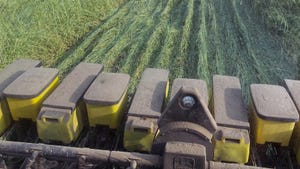
During the demonstrations at Wilde Farms, James McWhorter of Seiver Implement Co., in Donna, Texas, drove an RTK AutoSteer System-equipped tractor pulling an Orthman cultivator rig on a curved path along the edge of a field.

When McWhorter turned the tractor around, he pressed a button on the System’s new 10.4-inch color touch screen and the tractor aligned itself with the first set of rows and paralleled the curved path back to the other end of the field. McWhorter slowed the tractor and brought it to a stop when it reached the opposite turnrow.

“The first time you punch that button and watch as the tractor makes that gentle curve along side the first path, it’s amazing,” said McWhorter. McWhorter says an inexperienced operator can learn the system in one to two hours.

One of the farmers on hand for the preview said he’s already seen first hand how the sub-inch accuracy of the RTK system expands the potential of the GPS guidance systems.

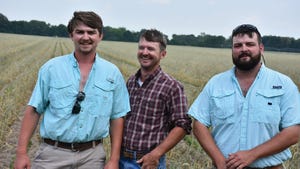
“We decided several years ago that we wanted to switch to strip-till,” said Ellis Moore, a grower from Sun Ray, Texas. “But we couldn’t do it farming 10,500 acres without a guidance system.”

The systems available at the time only operated in a straight line, which would not work on the land Moore farms with his brother and two employees. Many of his corn and cotton fields are planted to circular rows that follow the wheel path of the 50-plus center pivot systems they operate.

“I was talking to one company, and they kept saying they would have a curved guidance system in six months. Finally, they told me that it just wasn’t going to happen. Then I heard about the AutoFarm System,” said Moore.

Moore worked with AutoFarm’s Tony Christopher to get an RTK System that could be moved from tractor to tractor and to other equipment on their farm north of Amarillo in the Texas Panhandle.

“Without the AutoFarm system we couldn’t have gone to strip-till because you have to pay such close attention to putting the strip right on top of the row,” he said. “You just wear a tractor driver out covering the amount of land we have to cover.”

Moore said he hired a mechanic to help maintain the tractors and other equipment used on the farm.

“This guy had never driven a tractor before in his life,” he said. “But I put him on one of the AutoFarm-equipped tractors and you couldn’t really tell that he had never driven before.”

He estimates that using AutoFarm’s guidance system on his tractors and other equipment has taken about $50 an acre out of the expense of his operation. “$50 might not sound like a whole lot, but you spread that across 10,000 acres, and you’re talking about $500,000.”

“We’ve been somewhat surprised by the level of acceptance by the hired hands,” said AutoFarm’s Christopher. “It doesn’t take them long to get spoiled to not having to pay constant attention to trying to stay in the row middle.”

One way that Moore has been able to save money is by reducing the “overlap” on tillage passes. Some drivers put the first plow on their cultivator rig in the last furrow they plowed on the previous pass. An operator of an AutoSteer-equipped tractor doesn’t have to do that.

Some drivers become almost too accustomed to relying on AutoSteer, another farmer from the Lyford area said.

“We had a driver who was working in a field about five miles from the base station who radioed in that he had lost the signal for the AutoSteer,” said Jerry Chapel. “We finally figured out that he went behind a big equipment barn. But I had a hard time convincing him that he could drive the tractor on across the field without the AutoSteer.”

e-mail: flaws@primediabusiness.com

Get Copyright ClearanceWant to use this article? Click here for options!
© 2009 Penton Media, Inc.


Latest Jobs

Read More Daily News

Arkansas loss near quarter billion dollars

Nov 6, 2009 2:56 PM

A wetter-than-normal growing season has cut into Arkansas’ farm receipts by more than $224.8 million as of Nov. 1, according to a preliminary report issued by the University of Arkansas Division of Agriculture....

Cotton: a lot on the ground

Nov 6, 2009 11:13 AM

Cotton losses due to record rainfall during September and October in Mississippi totaled $71 million by early November, or nearly half the value of the expected crop, according to the Mississippi Department of Agriculture and Commerce....

Rep. Cassidy: rethink conservation efforts

Nov 6, 2009 11:02 AM

The only Louisianan on the House Agriculture Committee, Rep. Bill Cassidy tries to keep his state’s agricultural interests at the forefront....

Residuals in LibertyLink program

Nov 6, 2009 10:57 AM

Before continuing with my pigweed control articles, I have tried to think of something encouraging to say about trying to get a crop out with the weather we are having. ...

Letter: Mule-headed bunch of farmers

Nov 6, 2009 10:54 AM

I was greatly disappointed in Morgan Freeman’s recent comments referring to the base stock of this state as a mule-headed bunch of farmers (see Behind the curtain: ‘mule-headed farmers’?). ...

Delta Farm Press News
Southeast Farm Press News

Southwest Farm Press News

Western Farm Press News

resources

events icon events

product info icon tradeshows

tradeshow icon digests

research icon photos

Continuing Education


(New Course)
Weed Resistance Management in Cotton

This course covers a wide range of options to effectively control weeds in cotton and reduce the risk of weed resistance management. It is accredited for hours/units for licensed/accredited applicators in 7 U.S. Cotton Belt states (Florida, Georgia, New Mexico, Oklahoma, Texas, South Carolina an d Tennessee. CCA credit is pending).

This course is accredited in Texas, Oklahoma, New Mexico, Virginia, West Virginia and Wyoming as well as for CCA credits:

(New Course)
Spray Drift Management

Keeping crop protection chemicals on the crop for which they are intended has been a cornerstone of farming not only to protect neighboring crops, but to not waste money allowing products to drift off the intended target. This accredited online continuing education course covers the critical elements of spray drift management.

Back to Top

Browse Print Issues

Additional Resources

subscribe to Farm Press Daily Southeast Farm Press Southwest Farm Press Western Farm Press