North Carolina’s Thomas Porter named Expo Farmer of the Year

What is in this article?:

• Porter’s farm includes 850 acres with 270 acres of rented land and 580 acres of owned land.

• Last year, his swine operation had 2,200 sows that produced an average of 23.5 pigs per sow.

• He’s growing Matua bromegrass.

• The poultry operation consists of four pullet houses and four layer houses.

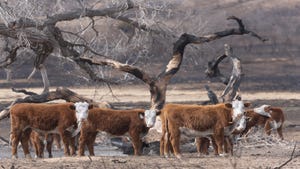
• He built his beef herd from five cows. It now consists of 300 Hereford-Angus cows bred to Angus bulls.

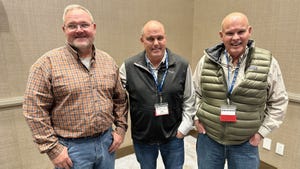
NORTH CAROLINA FARMER of the Year Thomas Porter, Jr., third from left, was named the 2011 Swisher Sweets/Sunbelt Expo Farmer of the Year during the 34th Expo, held Oct. 18-20 in Moultrie, Ga. Also shown are Expo Director Chip Blalock, Porter’s wife Vicky, and J. Thomas Ryan of Swisher International. Despite a difficult economic climate, the Expo drew 1,211 exhibitors this year.

North Carolina’s Thomas Porter, Jr., was named the Swisher Sweets/Sunbelt Expo Southeastern Farmer of the Year during the opening day of the Expo, being held Oct. 18-20 in Moultrie, Ga.

“I’m humbled to be named as Farmer of the Year,” said the Concord, N.C., grower. “I thank God for the privilege of being able to tend a small portion of his land and taking care of his creatures. It’s really something to be honored and respected for going out and doing what I love to do.”

Porter’s farm includes 850 acres with 270 acres of rented land and 580 acres of owned land.

He’s growing Matua bromegrass. This forage produces earlier in the spring and later in the fall than tall fescue. His 110 acres of Matua yield about six tons per acre when irrigated with hog lagoon effluent. He also grows fescue-clover hay on 436 acres yielding up to five tons per acre, and his fescue-oats forage mix yields six tons per acre from 105 acres.

He has fescue-clover stands on 110 pasture acres, and he planted 25 acres of Laredo, a seeded bermudagrass variety. “We wanted a warm season grass to utilize animal waste,” he adds.

Last year, his swine operation had 2,200 sows that produced an average of 23.5 pigs per sow. Pigs leave his farm when weaned at 21 days of age. He grows the swine under contract with Murphy-Brown.

“We’re paid on a per head basis for weaned pigs,” he explains. “We are also a multiplication unit for Murphy-Brown. This means our gilts are grown as replacement breeding stock.”

He had shipped up to 1,100 pigs weekly, but now ships 931 pigs per week. “We produced more pigs than they could handle,” he explains. “Now, we’re shipping fewer pigs from fewer sows, yet we’re making the same money we made with more sows.”

Discuss this Article 0

Post new comment
Sign In or register to use your Delta Farm Press ID

(optional)

Continuing Education
Potassium nitrate has a positive effect in controlling plant pests and diseases when applied...
This online CE course details sound mechanical irrigation design and management practices to...

Newsletter Signup