‘Forestry-friendly’ farm bill

May 28, 2009 3:30 PM, By Hembree Brandon
Farm Press Editorial Staff
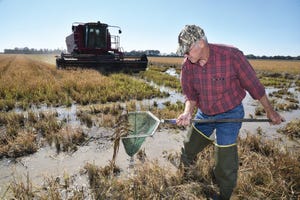
Despite the cutbacks in many federal and state agriculture programs, a number of incentive and cost-share programs are still available to farmers and other landowners for planting trees.

And, says George Byrd, outreach forester for the Mississippi Forestry Commission’s Grenada regional office, the new farm bill promises to be “more forestry-friendly” than the previous one.

“The type of assistance varies from county to county, and work is still being done on how provisions of the new farm bill will be carried out, so the thing to do is to check with your local NRCS office on the status of these programs,” he said at a recent landowner resources workshop at Circle M Plantation at Paulette, Miss.

The event was sponsored by the National Wild Turkey Federation, which works with landowners to encourage development and improvement of habitat — including tree farms — to enhance populations of the native birds.

Mississippi is the No. 1 tree farm state in the nation, and forestry programs by farmers and landowners play a vital role in the sustainability of turkey and other wildlife species, Byrd says. Forests cover 18.6 million acres in the state, or 62 percent of its total land area.

Among assistance programs available through the Mississippi Forestry Commission to state landowners:

• Forest Resource Development Program, which provides technical assistance and cost-share funding for tree planting and forest improvement practices. Landowners with at least 10 acres of manageable land are eligible for up to $7,000 of cost-share assistance per year. Established practices must be maintained for 10 years. The program is supported through a state severance tax on harvested timber that, Byrd says, has generated $78 million since 1974 for landowner assistance.

• Forest Land Enhancement Program can provide cost-share assistance up to $3,000 per year for resource plan development, tree planting, water quality improvement, watershed protection, wildlife habitat improvement, and invasive species control.

• Additionally, the Mississippi Reforestation Tax Credit is available for certain approved hardwood and pine reforestation practices (and a federal tax credit and amortization is available for certain reforestation practices).

• Forest Stewardship Program promotes natural resource planning based on sound management principles designed to restore and protect forest resources and improve fish/wildlife habitat.

Assistance that may be available through federal programs include:

• Conservation Reserve Program, which offers cost-share assistance for certain practices, as well as annual rental payments based on acres enrolled. Payment periods range from 10 years to 15 years.

• Environmental Quality Incentives Program targets areas where environmental quality is threatened, offering cost-share assistance for practices such as manure storage and conservation practices on agricultural land; incentive payments for land management practices such as nutrient/manure management, integrated pest management, and wildlife habitat management.

• Wildlife Habitat Incentives Program provides technical assistance to help establish and improve fish/wildlife habitat. Agreement periods range from 5 years to 10 years.

• Wetlands Reserve Program provides technical and financial assistance for wetlands, wildlife habitat, soil/water, and related natural resource concerns on private lands. Landowners may receive financial incentives to enhance wetlands in exchange for retiring marginal land from agriculture.

Information on federal assistance programs may be obtained through the Farm Service Agency or NRCS.

“Mississippi is blessed with an abundance of natural resources — land, water, wildlife — and farmers play a key role in managing these resources so they can be there for future generations,” Byrd says.

“We need to continue to promote awareness in our children and grandchildren of the important role that forests play in our overall ecology.”

e-mail: hbrandon@farmpress.com

Get Copyright ClearanceWant to use this article? Click here for options!
© 2010 Penton Media, Inc.


Latest Jobs

resources

events icon events

product info icon tradeshows

tradeshow icon digests

research icon photos

Continuing Education


(New Course)
Weed Resistance Management in Cotton

This course covers a wide range of options to effectively control weeds in cotton and reduce the risk of weed resistance management. It is accredited for hours/units for licensed/accredited applicators in 7 U.S. Cotton Belt states (Florida, Georgia, New Mexico, Oklahoma, Texas, South Carolina an d Tennessee. CCA credit is pending).

This course is accredited in Texas, Oklahoma, New Mexico, Virginia, West Virginia and Wyoming as well as for CCA credits:

(New Course)
Spray Drift Management

Keeping crop protection chemicals on the crop for which they are intended has been a cornerstone of farming not only to protect neighboring crops, but to not waste money allowing products to drift off the intended target. This accredited online continuing education course covers the critical elements of spray drift management.

Back to Top

Browse Print Issues

Additional Resources

subscribe to Farm Press Daily Southeast Farm Press Southwest Farm Press Western Farm Press