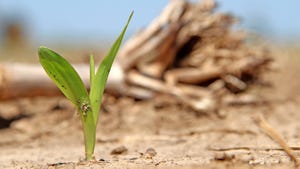
Seed and seedling diseases will reduce germination and/or emergence of soybeans. Therefore, using a proper seed treatment fungicide product with high-quality seeds is recommended for early soybean plantings in the Mid-South.
Fungicide seed treatments will ensure or improve soybean stands and subsequently maintain the benefits from early planting. In a previous article (Delta Farm Press, March 3, 2006, Page 45), I cited a report that showed using a proper seed treatment also will increase net returns.
There are two classes or types of seed treatment fungicides. Contact or protectant fungicides are active against pathogens present on planted seeds. Systemic fungicides are active against soil- and residue-borne fungi that attack planted seeds if soil conditions promote disease development.
A good and economically sound management practice is to use a product that contains both systemic and contact materials.
Phomopsis, Pythium, Phytophthora, Rhizoctonia, and Fusarium are the most common pathogens that reduce soybean germination and emergence.
Fungicide combinations that control or suppress various of these diseases are shown in the accompanying table.

There may be sizeable cost differences among products, but the cheapest materials cost less than $2 per 50 pounds of seed when applied by the producer. It is economical (about $3.50 per acre) to have the desired product applied by the seller before seeds are packaged.

Environments that favor responses to fungicide seed treatments are early planting in cool, wet soils with anticipated slow seedling emergence and growth, minimum-till or no-till systems, high amounts of surface residue, deep planting, fields that have continuous or frequently-grown soybeans, and fields with a previous history of seedling diseases.
Soybeans replanted into a failed stand are especially prone to fungal disease infection since the soil likely will have a high level of fungal activity.
Larry G. Heatherly is a retired USDA-ARS research agronomist and current crop consultant. e-mail larryheatherly@bellsouth.net
Seed-treatment fungicide combinations
Seed-treatment fungicide combinations (contact and systemic) available for broad-spectrum control of soybean seed and seedling diseases, and organisms controlled or suppressed by each fungicide product as stated on its label* or in Extension publications.
| Trade name | Ingredients | Pathogens controlled or suppressed |
|---|---|---|
| ApronMaxx (RTA and RFC) and Warden RTA | Mefenoxam, Fludioxonil | Phytophthora*, Phythium*, Fusarium*, Rhizoctonia*, Phomopsis* |
| Bean Guard/Allegiance | Metalaxyl, Captan, Carboxin | Phythium*, Fusarium*, Rhizoctonia*, Phomopsis |
| Catapult and Delta Coat AD | Metalaxyl, Chlorneb | Phytophthora*, Phythium*, Rhizoctonia* |
| Catapult XL and Delta Coat XL | Mefenoxam, Chloroneb | Phytophthora*, Phythium*, Rhizoctonia* |
| Prevail | Metalaxyl, Carboxin PCNB | Phythium*, Rhizoctonia*, Phomopsis |
| Protector-L-Allegiance | Metalaxyl, Thiram | Phythium*, Rhizoctonia*, Phomopsis |
| Rival Pak | Metalaxyl, Captan, PCNB, Thiabendazole | Phythium*, Rhizoctonia*, Phomopsis*, Fusarium |
| Soygard | Metalaxyl, Azoxystrobin | Phythium*, Rhizoctonia*, Phomopsis*, Fusarium |
| Stiletto | Metalaxyl, Carboxin, Thiram | Pythium*, Fusarium*, Rhizoctonia*, Phomopsis |
| Cautions: Check product label for compatibility with B. japonicum inoculant, and do not feed or sell treated seeds that are not planted. |