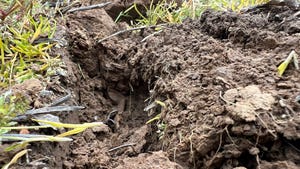
Rains cut Midwest corn by 1.2 million acres

Jun 30, 2008 10:46 AM, By Elton Robinson
Farm Press Editorial Staff

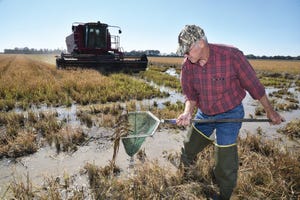
Midwest corn producers are reporting losses of around 1.2 million acres to extensive rains and flooding in June, according to USDA’s June 30 Planted Acreage Report.

USDA’s National Agricultural Statistics Service reported the losses after re-interviewing approximately 1,200 farmers June 23-25 in the flood-affected areas. NASS says it will conduct a more extensive acreage update survey during July. Findings from this study will be incorporated in the August crop production report.

Corn planted area for all purposes is estimated at 87.3 million acres, down 7 percent from last year.

Despite the decrease, corn planted acreage is the second highest since 1946, behind last year’s total of 93.6 million acres. Growers expect to harvest 78.9 million acres for grain, down 9 percent from 2007. If realized, this would be the second highest since 1944, behind last year.

The difference between planted and harvested acreage reported by USDA grew from 7.2 million acres in early June to 8.4 million acres after the 1,200 growers were interviewed, a difference of 1.2 million acres.

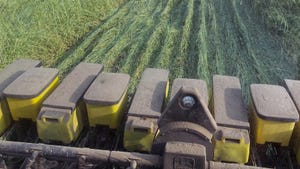
NASS reported that farmers increased corn plantings 1.31 million acres from their March intentions. But planting got off to a slow start across the Corn Belt, Ohio Valley, and the northern half of the Great Plains as frequent rainfall and cool temperatures during March and April prevented spring planting preparations.

Producers were able to make rapid progress during May, particularly across the upper Midwest and northern Great Plains. Farmers reported that 97 percent of the intended corn acreage had been planted at the time of the survey interview compared with the average of 98 percent for the past 10 years.

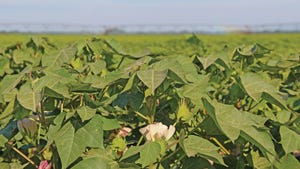
Cotton plantings for 2008 are estimated at 9.25 million acres, 15 percent below last year and the lowest since 1983. Upland planted area is estimated at 9.04 million acres, down 14 percent from 2007. Decreased planted acres are estimated for all states except Oklahoma and Virginia.

The largest percentage declines are in California and Mississippi, where upland producers planted 44 percent fewer acres than last year at 110,000 acres and 370,000 acres, respectively. American-Pima cotton growers planted 202,000 acres, down 31 percent from 2007.

Soybean planted area for 2008 is estimated at 74.5 million acres, up 17 percent from last year but 1 percent below the record high acreage in 2006. Area for harvest, at 72.1 million acres, is up 15 percent from 2007. Planted acreage increases are expected in all states.

The largest increase is expected in Nebraska, up 950,000 acres from 2007, followed by Illinois and South Dakota, both up 900,000 acres. Increases of at least 800,000 acres are also expected in Indiana, Iowa, and Minnesota. If realized, the planted acreage in Kansas, New York, and Pennsylvania will be the largest on record. Nationally, farmers reported that 79 percent of the intended soybean acreage had been planted at the time of the survey interview, which is the lowest since 1996.

USDA projects U.S. rice acreage at 2.89 million acres, up from 2.761 million acres in 2007.

e-mail: erobinson@farmpress.com

Get Copyright ClearanceWant to use this article? Click here for options!
© 2008 Penton Media, Inc.


Latest Jobs

HEADLINES

Could Arkansas have a record soybean yield?

Nov 20, 2008 10:26 AM, By David Bennett
Farm Press Editorial Staff

On Nov. 18, Delta Farm Press spoke with Jeremy Ross, Arkansas Extension soybean specialist. ...
Guest Comments: Doha in December

Nov 20, 2008 10:21 AM, By Larry McClendon

During my tenure as chairman of the National Cotton Council, I have represented the industry in several important meetings across the United States and around the world....

Louisiana wheat acres down by half

Nov 20, 2008 10:17 AM, By Tobie Blanchard
LSU AgCenter

Farmers are planting the 2009 Louisiana wheat crop, which will be on significantly fewer acres than the 2008 wheat crop. ...

Tri-State Soybean Forum Jan. 9

Nov 20, 2008 10:11 AM

Producers from Arkansas, Louisiana, and Mississippi will have an opportunity to hear the latest in soybean research during the 2009 Tri-State Soybean Forum, Jan. 9, at the Thomas Jason Lingo Center in Oak Grove, La....

Switching from catfish to rice

Nov 19, 2008 10:12 AM, By David Bennett
Farm Press Editorial Staff

One of the consequences of falling catfish prices is the removal of ponds from production. ...

ACRE decisions ‘enormously complicated’

Nov 19, 2008 10:09 AM, By Hembree Brandon
Farm Press Editorial Staff

Mississippi producers face “a nasty, complicated choice” in analyzing whether to participate in the new Average Crop Revenue Election (ACRE) program or stick with the countercyclical program, says Keith Coble, professor of agricultural economics at Mississippi State University....

An ag secretary on no one’s list

Nov 19, 2008 10:02 AM, By Forrest Laws
Farm Press Editorial Staff
First of all, let me say that I have nothing against the state of Iowa. I have criticized its senior senator, Charles Grassley, but then he’s criticized farmers in the South — unjustifiably....

resources

events icon events

product info icon tradeshows

tradeshow icon digests

research icon photos

Continuing Education

Accredited in Florida, Georgia, New Mexico, Oklahoma, Texas, South Carolina and Tennessee:


(New Course)
Weed Resistance Management in Cotton

This course covers a wide range of options to effectively control weeds in cotton and reduce the risk of weed resistance management. It is accredited for hours/units for licensed/accredited applicators in 7 U.S. Cotton Belt states (Florida, Georgia, New Mexico, Oklahoma, Texas, South Carolina an d Tennessee. CCA credit is pending).

For National Certified Crop Advisers

A free American Society of Agronomy-accredited one-CEU course on spray drift management.

Back to Top

Continuing Education

Accredited in Florida, Georgia, New Mexico, Oklahoma, Texas, South Carolina and Tennessee:


(New Course)
Weed Resistance Management in Cotton

This course covers a wide range of options to effectively control weeds in cotton and reduce the risk of weed resistance management. It is accredited for hours/units for licensed/accredited applicators in 7 U.S. Cotton Belt states (Florida, Georgia, New Mexico, Oklahoma, Texas, South Carolina an d Tennessee. CCA credit is pending).

For National Certified Crop Advisers

A free American Society of Agronomy-accredited one-CEU course on spray drift management.

Browse Print Issues

Additional Resources

subscribe to Farm Press Daily Southeast Farm Press Southwest Farm Press Western Farm Press